You aren’t forensic auditors. You aren’t financial experts of any kind. You aren’t government workers. You have never staffed or planned a headcount for an agency or department. You aren’t supply chain managers. You have never negotiated a contract, let alone a government contract. You have no experience with grants or administration of grants. You have no experience with education administration. Or research administration. Or field administration. You have no background in organizational change management. You have no background in risk management. You don’t understand risk tolerance, risk avoidance, or risk mitigation. You have no experience with crisis management. You don’t even know how to undo the things that you have broken by your actions.
You aren’t even very good at the job you purport to know; writing search queries, or parsing data, or analyzing large blocks of information. You are breaking federal security standards. You are breaking privacy laws. You are stealing data. You are compromising the personal information of US citizens. And you are not transparent in your actions.
Everything you are doing right now goes against ethical coding. Everything you are doing right now goes against developmental standards (ISO 31000, DevOps, Agile Practice, SAFe, Site Reliability Engineering).
The likelihood is that your actions open our data to compromise. The likelihood is that our country, our security, and our people are more at-risk. The likelihood is that your work will be successfully hacked by threat actors. The likelihood is that you may already be personally compromised.
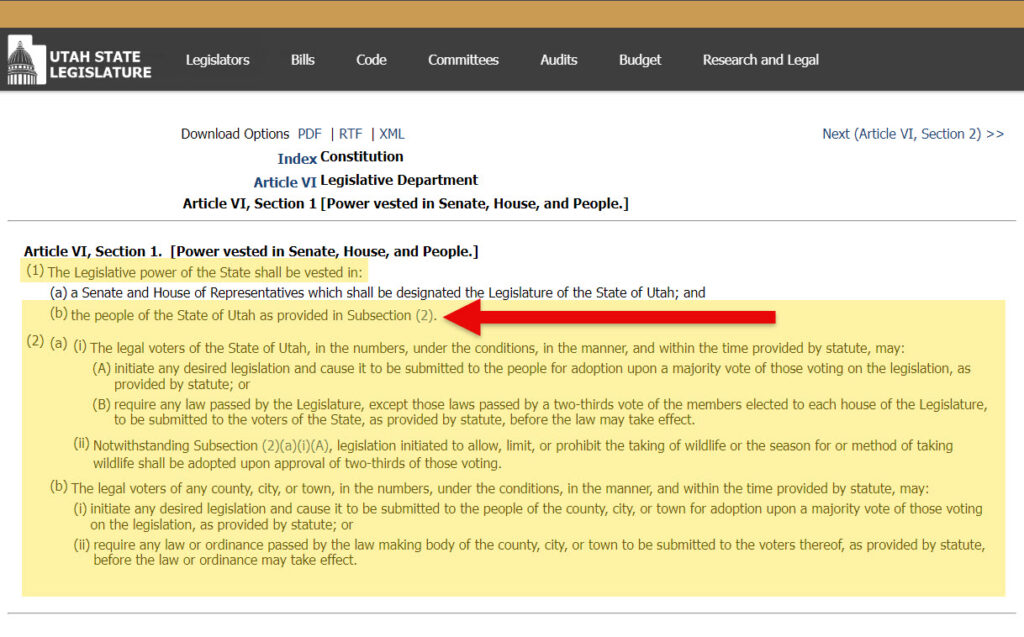
According to the Utah Constitution, Utah voters can initiate any desired legislation and cause it to be submitted to the people for adoption.
In response to HB267 Public Sector Labor Union Amendments, Utah voters need to consider going all the way to change Utah’s constitution to become a right-to-organize state. We can work on language and support for restructuring Utah Title 34 similar to Michigan’s 2023 HB4004 that overturned their “right-to-work” law in favor of workers’ rights.
It’s important to note the difference between right-to-work laws and right-to-organize laws. Right-to-work typically focuses on the individual employee, and weakens collective bargaining power. Employees not covered by a union can be subject to at-will work agreements where employers can reduce workforce, lay-off and re-organize with no significant repercussions to the business, but devastating impacts to the employee. Additionally, employees often discover that loyalty to a company isn’t rewarded through commensurate advancement, pay or recognition because employees are treated like assets rather than an investment. In contrast, right-to-organize typically focuses on the fundamental right of workers to form unions and perform collective bargaining, and strengthens collective bargaining power.
If it’s a veto referendum for HB267 that the newly formed “Protect Utah Workers” PIC is pursuing, consider that they are doing the same work to gather signatures that a citizen’s initiative would require. We can collect signatures for both.
It’s worth noting that the Utah legislature didn’t follow Utah law when submitting its own amendments to the people last year. There were four constitutional amendments in 2024, and none followed state laws to appear on ballots. Two were challenged in the courts and ignored, but two unchallenged amendments remained for voters to weigh in on.
The supermajority in our Utah legislature believes that it isn’t beholden to anyone, and they have plans to keep scrapping with everyone, picking fights with the Feds, picking fights with Utah courts, and picking fights with Utah voters.
This time, we need to bring the fight to them.
References
Article 23 Amendment and Revision https://le.utah.gov/xcode/ArticleXXIII/Article_XXIII,_Section_1.html A constitutional amendment can be proposed by either chamber and is run via a joint resolution. The resolution must be approved by two-thirds of each body. If it is, then the question gets placed on the ballot for voters in the next general election.
Article 6 Legislative Department https://le.utah.gov/xcode/ArticleVI/Article_VI,_Section_1.html (1) The Legislative power of the State shall be vested in: (a) a Senate and House of Representatives which shall be designated the Legislature of the State of Utah; and (b) the people of the State of Utah as provided in Subsection (2). (2)(a)(i) The legal voters of the State of Utah, in the numbers, under the conditions, in the manner, and within the time provided by statute, may: (A) initiate any desired legislation and cause it to be submitted to the people for adoption upon a majority vote of those voting on the legislation, as provided by statute; or (B) require any law passed by the Legislature, except those laws passed by a two-thirds vote of the members elected to each house of the Legislature, to be submitted to the voters of the State, as provided by statute, before the law may take effect.
I’m 57 years old. It’s worth starting with that because that’s how long, at least approximately, it took me to know something that happened when I was only eight months old. It took this long for me to unwrap a family secret had been buried except for a comment that my older sister made years ago, that was disregarded but remained waiting to be picked up again so that it could be broken wide open.
This story is about death and disability. It’s about how we perceive ourselves through bad things, and how that perception ripples through relationships and time. Its about religion and judgement, and grace.
Part 1: Family
One of my youngest memories is of my oldest sister, who had a habit of sitting on the couch in our living room and constantly rocking back and forth. I didn’t know this was a type of self-stimulation, or “stimming” behavior. She was withdrawn, and often had trouble with social interactions, but she was also beautiful and my big sister. She had a “flat” way of speaking and was typically very direct. She didn’t understand humor at times, and this would often result in some sort of fight or argument. I didn’t know what autism or ADHD was. She was just my sister.
As we grew up, my older brother and sister were constantly fighting. It was a never-ending squabble between the two of them because of an action my sister took, or because my brother expected to be the authority over the rest of us. I tried to be a peacekeeper and regularly failed, or ended up in my own altercation with my brother. We fought like siblings and we stuck together like siblings.
My younger brother was born, and my two youngest sisters were born almost exactly two years apart to the day. They looked so much alike that they were often confused as twins. They were adorable together, and shared the status of youngest in the family. They had the benefit of attention and older siblings. In the grown-up version of ourselves they became the most well-adjusted and social members of our family.
When the girls began to draw, it was noted then that they were writing in mirror-form, like my older brother had done when he was younger. We learned then that this was called dyslexia, and that there were methods to treat it that my older brother did not have the opportunity to be part of. This may have explained his love of the outdoors more, and why he became an avid reader later than I, or my younger brother did.
I’m under the impression that we grew up in the 70’s in very rural spaces that did not have access to the services and medical supports that could have benefited us. My father had always said he wanted to go where there were no sidewalks, and this very much defined our circumstance and place in life growing up.
I would not describe myself as a social butterfly. I had few friends growing up, that I self-explained as being a result of moving several times in my youth. I had (and still have) tendencies to ruminate on thoughts or generally lose myself in thought. I had favorite clothes and dressed in specific ways – and still do. I remember being taken out of class in middle school to have a Counselor test me using questions on social situations and how I felt about them. I can say with confidence that my family had a lot of neuro-divergence that was unrecognized for what it was. As an adult I struggle with the idea that I could have been diagnosed at a younger age but am too masked and am just “normal”.
In high school, my oldest sister started a pattern of behavior that was at first rebellion, then recognized as symptoms of mental illness. Her world had already begun collapsing in 1981, when my mother was diagnosed with a particularly aggressive form of Multiple Sclerosis (MS).
Before MS took my mother’s independence away, she was a very much the homemaker and loving mom. Her MS stripped away that independence though. First, she had trouble walking. Her eyes couldn’t focus on anything and her hands shook to the point that she couldn’t feed herself. She needed help getting out of bed, getting bathed, getting downstairs to the couch. If she went on her own she would sit on the floor and scoot to move inside the home. And at first there was no-one there for her except the kids.
There had been some trouble with her diagnosis at the start, and for a year or so she was trying to make lifestyle changes (like avoiding caffeine, or not eating certain foods) to remedy her imbalance and vision problems. As her condition progressed it was more evident that something wasn’t right. Her doctors in Alaska recommended that she go to better hospitals in Seattle, where she was diagnosed. She flew back east to participate in experimental treatments with ACTH, which helped restore some ability to walk. But MS takes ahold in a series of attacks and remissions, and her form was particularly aggressive. She returned and was wasting away from the disease.
My father spent most of his time at work or in the outdoors before my mother became seriously ill. It was only after her diagnosis that he took a desk job in Anchorage, an hour away from where we lived. He would get up at 4AM, travel to work, and be home between 4-5PM every day during the week, but would still disappear for the weekends with my brothers. I was left to watch my mother and two younger sisters and my older sister, who was “in charge” but couldn’t be relied upon. We didn’t know why she acted the way she did. She was angry and believed things that were obviously not true, but she was adamant and resistant and rebellious. She didn’t have a diagnosis at that point; instead she struggled with her reality and her family. We didn’t have a name for it, and it was only years later that we found a name: schizophrenia.
Part 2: Religion
Before her MS, religion was a part of my mother’s life that was a celebration and joy to see. Through all of our early travels as a family, wherever we landed she would find a local church to be part of. She was raised a Methodist in New England. When we lived in Minnesota we were part of Lutheran services there. When we moved to Petersburg we started at a Lutheran church, but were drawn to a new Assemblies of God that was starting because their song service was joyous, and my mother loved to sing. When we moved off the island in the Southeast to the mainland of Alaska, she found another Assembly of God. And then she became ill.
Church should be, above anything else, a community that draws together. Church should be a celebration and discipline of faith that is executed in practice. We are taught to seek humility, to make service, and uphold our ways. But church can be other things. It can be petty, and judgmental, and cliquish. It can be backward and superstitious. And it can be damning.
There is a practice in Pentecostal Charismatic churches of faith healing. If you’re not familiar with this, the idea is that your tribulations are all some sort of test that can be spiritually healed through acceptance of Christ. This typically means fervent prayer, and some laying on of hands. It’s the idea that belief in God’s power can heal you, based on your faith. But you have to be faithful, and you have to mean it. If God doesn’t heal you, it’s because you aren’t believing or confessing properly. This is an incredibly shitty concept to apply to someone diagnosed with a chronic, progressive disease.
My mother was a kind person, before all else. I will never remember her any other way than someone who walked into a room and made it brighter with her presence. She was educated and well-mannered. Before she was sick the worst thing she could say was “Lord love a duck” when she was angry. People were drawn to her.
After she became seriously ill, that changed. She lost her friends. At church we were told by the visiting faith healers that she was not accepting Christ into her heart if she could not be healed, and I could see that breaking her. We were not able to attend church regularly, and when we did it was painful to pass the tithing plate without contributing to it. We were poor, my mother was disabled, my father refused to attend any church, and it was obvious to them that we suffered only due to lack of faith.
Part 3: Secrets
My oldest sister had said a very long time ago that my mother had killed someone. I could not imagine what she meant or why she would say that, and I refused to repeat what she said. My sister was known to say things, after all. This wasn’t the first time an outlandish accusation had been laid by her.
At the same time, there was something about how my mother was so troubled by these ridiculous faith healers at church, and her desire to be healed. I wanted to attribute it to her faith, then I wanted to attribute it to her desire to be healed and truly live again. As her disease progressed there was a distance between my mother and father that was apparent. I think he felt hopeless and stuck, but loved her. I think she wanted him to be close when he couldn’t bring himself to be there for her.
Part 4: Ripples
At home I took care of my mother. I would get up in the mornings and help my mother get ready before carrying her downstairs to the living room, then get everybody out the door to get on the bus for school. If a note had to be written for one of the kids at school, I was the one who wrote it. When other kids played sports after school, I was heading home to take care of my mother. My oldest sister had graduated in 1980, before my mother became ill. She was supposed to stay home to help my mother during the day.
The day my oldest sister left home is like a scar in my memory. I was walking home, and was greeted by my two younger sisters who were running down the road to me. They were both crying and said that my oldest sister was killing our mother. I panicked and ran home in front of them. I entered through the back sliding doors of the house, and saw my sister positioned above my mother with her hand raised like she was going to hit her. My mother was lying on the floor, hands above her head and crying. There was blood on her head. I screamed.
My older sister had a panicked look. She turned and ran up into her room. My younger sisters and I picked up my mother and tried to console her as my older sister came back down. She had grabbed some personal belongings and was leaving as we yelled at her. None of us knew what had led up to the altercation. We focused on our mother but my older sister was gone. It would be days later that we found out she had called family back east and been provided a ticket to leave the state. It would be years later that I understood she was in psychosis that day, and would have no memory of what had taken place. It has taken a much longer time for me to forgive her for that.
It was after that when I became a primary caretaker for my mother. I was in my last year at school, and my grades were dropping because I had given up. The level of dysfunction at home was absurd. I was beginning to feel hopeless and angry.
My father had a regular habit of hitting me when he was angry. He would slap me, or hit me with a belt, or punch me when I made him upset. There was one night that my father was repeatedly hitting me in the kitchen and something inside just snapped, like I don’t have to just take this any longer. I wasn’t going to fight back, so I grabbed his hands and wouldn’t let go. I was angry, but just said “Stop hitting me!”. When he realized he couldn’t pull his hands away, I could see a change in his eyes. It was the last time that he hit me. I moved out shortly after. My younger sisters were old enough to take care of my mother, and I had to leave.
In 1988 my mother’s MS had progressed far enough that she wasn’t able to live at home anymore, and she moved to a full-time care facility. That was the same year that I left the state. I left to escape. I left to get out from under the care of my mother, and from my family, from religion, from a community I felt did not accept me. When she passed away in 2004 I wept unconsolably. There was regret, and guilt, and shame in what I had done by leaving.
Part 5: Reflections
It’s 2025 now. My parents have both passed away along with their siblings and family before them. My generation is now the oldest of the family, and there is time to look back. I was reminded this weekend of what my oldest sister had told me so many years ago, and I was reflecting on that and other thoughts. There was clear separation and distancing of my extended family. There was some unexplained vitriol between my aunt and my father that remained unresolved. There was the suffering that my mother went through with her fastidious devotion to religion, and how she dealt with her diagnosis with a sort of resigned acceptance. There was my father’s choice to distance himself from her. So much didn’t make sense.
I received an advert for a free weekend to look up newspaper articles using an online service. On Friday night I decided to go searching, and was finding old articles about the family. I started by looking for information about my wife’s family in the East Bay. She has a very lively family with all sorts of fun stories, and I was bolstering some family genealogy with what I found. One article in particular prompted the memory of my sister’s secret confession, so at 2AM I decided to start going down the rabbit hole.
It took some time, but I found what I was looking for. The story was from 1968, when I was just eight months old. My older sister would have been just over six years old, which is likely old enough to remember a traumatic event. Besides the story my sister had told me, this had never been mentioned by my family. It crushed me to have found it.
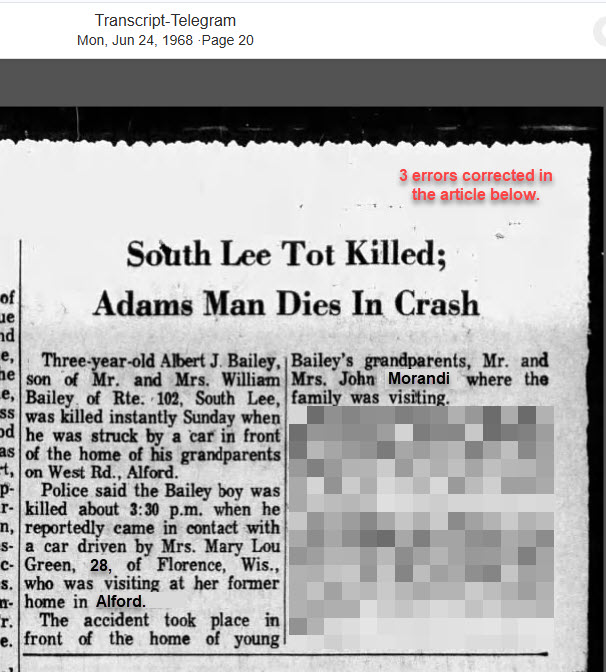
There are several newspapers that carried the story, all repeated with the same errors in facts, which still reliably made the account of what took place. My parents were visiting my mother’s family. We were living in Florence, Wisconsin at the time and had driven out to Massachusetts – my father and mother, along with then 3 kids. Part of the story is unconfirmed – but it goes that my uncle (who loved cars) bought a green Ford Mustang. My mother and my grandmother took the car out to drive, so they ambled out the long road from my grandparent’s home, and turned onto the rural West Road. They had just started to drive down that road as they approached a neighbor’s residence. There were cars parked along the road, and from between some cars a 3 year old boy suddenly ran out and was struck by the car that my mother was driving. The boy was instantly killed. He was the grandson of the family who lived there. His parents had dropped him off at their home while they visited from a neighboring town. It was devastating.
My grandfather, and the child’s grandfather, were neighbors. They were both politically active and served together as Selectmen in their city. My mother was undoubtedly an acquaintance of their daughter, whose child had been killed. It was unfathomable to think this could happen, and yet it had. It irrevocably changed my mother, my parents, their system of support, and our lives afterwards. I hadn’t known it, but could see the ripples of tragedy that shaped our family.
My mother was the only child of four who had grandchildren. My mother’s older sister had died from Polio when she was just nine, so there were only three siblings in her family that grew to be adults. My grandparents were kind, but distant from us. My uncle was like my grandparents but died early from cancer in 1997. My mother’s sister was the longest lived and unrelenting in her animosity for my family. I think this partially explains the distance, and apparent abandonment felt on both sides.
Part 6: Summary
I think what bothers me most is how my mother persevered, and how this accident shaped her. She embraced religion and found comfort in it. If she had remained a Methodist or a Lutheran, the church may have consoled her for an unfortunate death of a child, and helped her come to some solace for her physical ailments. It was song service that brought her to the Assembly of God, but that church also chose to damn her with judgements of her faith and disregard her desire for forgiveness.
I wonder if we, the children, were considered some form of god’s retribution to my parents. I don’t know that they understood neuro-diversity at that time. There were programs coming in place in the early 70s to recognize and diagnose disability in schools that the older children weren’t able to take advantage of. I had a distinct sense growing up that we were a burden, especially from my father.
I can’t imagine how my mother lived with the trauma of a young child’s death, or how she perceived herself after that. I can’t imagine how my father decided to bottle everything up and distance himself from us. But it makes sense looking back, that this was what was happening.
I’m overwhelmed and reeling a bit to try to understand what impact this has had for four families. To the Bailey and Morandi families, my sincerest sadness and desire for peace to you. To the Chapin and Green families, understand what happened and know that there is healing in forgiveness and the passing of time.
It feels too late, but we can only start when we know.
References
The Morning Union, June 24 1968, Page 6 (Springfield, MA)
The Berkshire Eagle, June 24 1968, Page 14 (Pittsfield, MA)
The North Adams Transcript, June 24 1968, Page 3 (North Adams, MA)
The Transcript-Telegram, June 24 1968, Page 20 (Holyoke, MA)
I was getting my hair cut today and listening to some conversation in the salon. A young man was talking to his barber and mentioned he was from Texas. “So are you a Texan?” she asked. He answered with a short story – he was born in California, was raised in Mexico, and later moved to Texas. The culture was a shock, and it took him a while to adjust living there. But was he a Texan? His answer was yes.
I reflected on this exchange because I have lived in Utah for 25 years, longer than anywhere else that I have lived previously. My family hopped around when I was younger, but my formative years were all in Alaska, and it was only after I became an adult that I moved to California, and eventually made my way to Utah. I met my wife when we worked together at Costco, were married in Alaska and have three kids who were all born out of state but grew up and consider Utah their home. Our oldest was only turning four when we moved, and our youngest was barely 3 months old. For them, this is really all they have known.
“So am I Utahn? ” That was the question in my head. What the young man next to me said next was important. “People here are nice.”
That’s true. There is a civility here, generally speaking, that takes precedent over most everything else. It’s an ingrained cultural phenom that people in Utah are typically pleasant when you talk to them. We smile, ask how you’re doing before catching up on pleasantries and nodding good day as we leave. And that’s a problem.
Because we don’t air disagreements or talk about conflict. Everything is swept under the rug of polite exchange, and that’s the norm here. Utahns avoid conflict because we #disagreebetter, and as a result when we’re told what to think, and what to do… we invariably end up putting on our brave face and just bearing it.
But that’s not who I am, and it’s not what I strive to be. If eggs are problems, I’m more about cracking the eggs than collecting them, and blunt honesty has a certain allure that I can respect and enjoy. It’s dirty, it can be uncomfortable, but cracking those eggs sure makes the omelet faster.
I have always considered that I’m a liberal person living in conservative communities. This is what it was like growing up in Alaska, and it’s what it has been like living in Utah. It was familiar to me, and I’ll even mention that the Salt Lake valley has some Matanuska valley vibes that make me feel comfortable here. Both places are predominantly Republican. There is a strong outdoors culture here, and I was raised in a hunting/trapping family. In Wasilla the church was the Assembly of God, which I fell out of when I realized that religion didn’t answer the questions or address the pains I experienced growing up. In Utah the church is the Church of Jesus Christ of Latter Day Saints, which is different but the same. I’m an outsider to the church, but I understand and respect the community and the culture around. I also respect the ex-Mormons who make the consequential decision to leave their church because, like them, I have lived through the loss of faith, community and friendships.
What’s not here, and what I have found lacking is conflict. I miss raucous behavior, and some occasional incivility. Utahns seem drained of their willingness to passionately endorse, or oppose, or ridicule something. We avoid uncouth words and replace controversy with euphemisms. We tolerate so much that we let the intolerant find a home here.
When HB267 ran, the committee rooms were packed with people opposed to the bill. There were overflow rooms and hallways filled with people who came specifically to show opposition to the bill. When speakers were allowed to present, opposition was overwhelmingly present but the committee chair wanted to “both sides” the testimony to give more opportunity to a very small group of supporters to speak, and the opposition let them. When people clapped for an opposition speaker, the chairperson reprimanded the room for its “impolite” behavior. No-one shouted. No-one raised there voices. It was all so unsettling to see that many people watch a few who would strip their rights away in front of them, because it is in our culture to be polite.
After it passed in the legislature, Governor Cox let the bill sit on his desk for seven days, before eventually signing the bill into law. It was clear that if he vetoed the bill it would have had difficulty gaining a 2/3 majority vote in both the house and senate to override. There was even an alternative, less egregious bill that was planned to be introduced if he refused to let the bill move forward. It was a viable option for a Governor to consider vetoing the bill, especially after a contentious election that he would have lost if he had primaried, especially after he declared shortly into his term that he would not seek re-election. Governor Cox was not beholden to the legislature or to the Republican political machine. But he signed the bill.
What happened is that the people of Utah failed to raise a voice. We failed to be vocal about the disagreement right in front of us, even when the impact of the legislation made Utah one of the strongest anti-union states in America. We allowed our Utah public employees to be sacrificed with nothing to gain. We didn’t put up a fight because we’re nice people, after all.
My concern should be the same concern you have. Shameless people take advantage of civility. Pundits will lie and no-one will speak up to call them out for lying. Politicians push copy/paste bills that attack personal rights or dismantle worker rights or take away voter rights. Special interests move forward because feckless profiteers see the opportunity. They build a prison in front of you and tell you to go in, and we go in. We are victims of our own good manners.
There are people out there, right now, who are emboldened to do some really terrible stuff. There are right-wing militias, hate groups, ultra-right-wing legislators and their creepy lobbyists, christian nationalists, transphobes… a whole bunch of bad people with their bad ideas. But they are civil. Their lies are polite. They say and do horrible things without raising their voices. We should be raising our voices. We should be fighting back.
When I ran for office in 2024, I was told that I “obviously have nothing in common with the people you are running to represent” because I used protest, and because I advocated not just to elect me, but to vote out and unseat my opponent. There were several instances talking on social media that I used language that had some heat, and I was called a potty-mouth (seriously, I have to laugh at that moniker when it’s another adult male calling me that). I am a 25 year resident of South Jordan, and this is where I raised my family. This is my home.
“So am I Utahn? ” That’s still the question in my head.
NOW, THEREFORE, BE IT RESOLVED that the Legislature of the state of Utah hereby calls upon the United States Congress to propose and send to the states for ratification an amendment to the United States Constitution that clarifies that the states may reasonably regulate and limit the spending of money in their jurisdictions to influence campaigns, elections, or ballot measures, and that, in doing so, the states may also distinguish between natural persons and artificial entities such as corporations, unions, and artificial intelligences.
Sen. Cullimore’s resolution isn’t about better campaign financing. It’s about removing federal limits and allowing states to control that funding. Utah currently has no contribution limit for state senate and representative seats. Utah would undoubtedly remove contribution limits for federal as well.
What’s interesting about the resolution is that he does specifically call out unions. If you aren’t aware, Cullimore is the Senate House Sponsor of HB267 Public Sector Labor Union Amendments that would dismantle workers rights to organize. Of particular interest in committee and floor discussion are queries on union dues that go to campaigns (there are none, and there are no reported violations). Cullimore is adding language here to specifically target unions.
At a state level, Sen. Cullimore has done nothing to control campaign financing and unlawful political activity.
Reform current state legislative disclosure processes to include audits and tracking of online payment processing apps like Venmo that operate like banks;
Reform current state legislative disclosure processes to penalize egregious reporting errors, like Sen. Stuart Adams’ campaign disclosures that used his credit card name for expenses rather than the actual recipient
Address crypto currency as a source of unregulated campaign funds that need controls for reporting and audits
Reinforce the separation of church and state, where the Republican super majority are also members of the predominant faith here in Utah
Prevent the church (i.e. an outside influence) from financing political activity here or elsewhere
At a federal level, if Senator Cullimore were serious about reforming campaign finance, he would have included
Support to turn over Citizens United
Make it illegal for Legislators to conduct Insider Trading
Prohibit foreign interference through blockchain, crypto currency and AI
Set Transparency and Reporting for crypto currency
Disclaimer: I’m the person who ran against Teuscher in last year’s election. A question was posted in the r/Utah sub Reddit: Who profits from Teuscher’s HB267? that I’d like to respond to. This post was too long to submit so I’m publishing it here and providing the link in the thread.
Jordan is an idealist, and his beliefs are his virtue.
Jordan is bent on weakening organized labor, breaking the public school system, and taking voter rights away from Utah voters. He is an acolyte of the conservative right ALEC (American Legislative Exchange Council) and under the wing of Utah Senate President Stuart Adams, who is a past National Chairman of ALEC.
Teuscher is the primary officer of the Conservative Millennials PAC, whose members include Rep. Candice Pierucci (sponsor of voucher programs to de-fund public schools); Kera Birkeland (sponsor of anti-trans legislation); and Anthony Loubet (relatively quiet on bills but votes in favor of legislation from the group). This group is responsible for some serious shit legislation in Utah.
Teuscher is doubling down in a multi-year effort to purge unions for public employees, with the intent of weakening labor overall in Utah. He wants to see public education de-funded. He is the sponsor of copy/paste legislation that was introduced in other conservative states to move on a national agenda. He is supported by his PAC, by Schultz (House Speaker), by Adams (Senate President), and the Utah GOP.
It’s worth mentioning Teuscher’s pettiness. The UEA advocated strongly against constitutional amendments that were on the ballot last year, and particularly for an amendment that would have discarded protections for public school funding, which would force education spending to compete in the general fund. HB267 is Teuscher’s retribution.
Incoming Funds
Aside from contributions, Teuscher’s campaign funding was coming from in-kind services provided by (primarily) the Utah Republican Party (disclosures here), and the conservative Utah Taxpayers Association (disclosures here), which covered multiple thousands of spend on signs and mailers. All of Teuscher’s reported campaign finances are on the disclosure site here, and for the Conservative Millennials PAC here.
I would also raise a concern that Jordan is a strong proponent of blockchain and crypto, and would like more transparency on his investments and funds received using cryptocurrency or collected transaction fees.
End collective bargaining – prohibits a public employer from recognizing a labor organization as a bargaining agent for public employees; and prohibits a public employer from entering into collective bargaining contracts. Because public employees are not covered by the National Labor Relations Act, Teuscher is targeting them.
Prohibit the use of public property – (think schools, parks, libraries, community centers, and the public employee workspace) for groups conducting union organizing or administration. For example, if teachers wanted to meet in the library at the end of the day to discuss topics that might include information about their UEA membership, they would not be allowed to do so.
Mandate reporting to the Labor Commission – The public employer could certainly provide information to the Labor Commission on the number of members with payroll deduction of dues, but members who pay directly and choose to remain anonymous should be allowed to do so without fear of retribution. Similarly, the amounts of spend by a labor organization for representation, lobbying, donations, activities, or giving should not require disclosure to the Labor Commission. The members are the stakeholders of the labor organization, not the Labor Commission.
Kills Retirement for Some Public Employees by forcing former public employees who were previously part of the Utah Retirement System to exit that system if they are later employed by a labor organization
Introduces ambiguous definition of “Political purposes” that can be broadly interpreted as any literally any conversation or action if it results in a decision or action.
Unions are one of the most important tools to address the disparity of wealth distribution, and a legitimate tool to manage the welfare and way of life for Utahns. HB267 includes provisions that effectively destroy public employee unions in Utah. Key language of the bill takes away collective bargaining rights, which is a fundamental characteristic of a union. This is the third attempt by Jordan Teuscher to push this form of union-busting bill through the legislature.
2025 HB267 Public Sector Labor Union Amendments
2024 HB285 Labor Union Amendments
2023 HB241 Labor Union Amendments
Each year that Teuscher introduced legislation to actively dismantle worker rights for public employees, it was killed due to overwhelming opposition from the public.
A patent lie:
“Businesses have to make a profit or they go out of business. Government never goes out of business,” he said. “Because of that inherent obstacle with public sector collective bargaining, it really doesn’t make sense to continue to do it in our state.” – Rep. Jordan Teuscher, Fox 13 interview (Jan 22, 2025)
To suggest that public employees are tapping an unlimited resource of payroll funding simply because they work for a government entity is ridiculous. The ability to negotiate, (including collective bargaining) for a prevailing wage, let alone any wage, is material to any employee regardless of their employer or the industry that they work in.
Gregory Green, Resident House District 44, Senate District 17 South Jordan, Utah
Republicans lawmakers will also propose a constitutional amendment to weaken the power of voter-backed ballot initiatives.
“The repeal of the anti-labor law…. has been debated internally by Republican lawmakers for months and averts what would have been a costly campaign, the potential for being handed an embarrassing defeat by voters and also spiking 2026 voter turnout.”
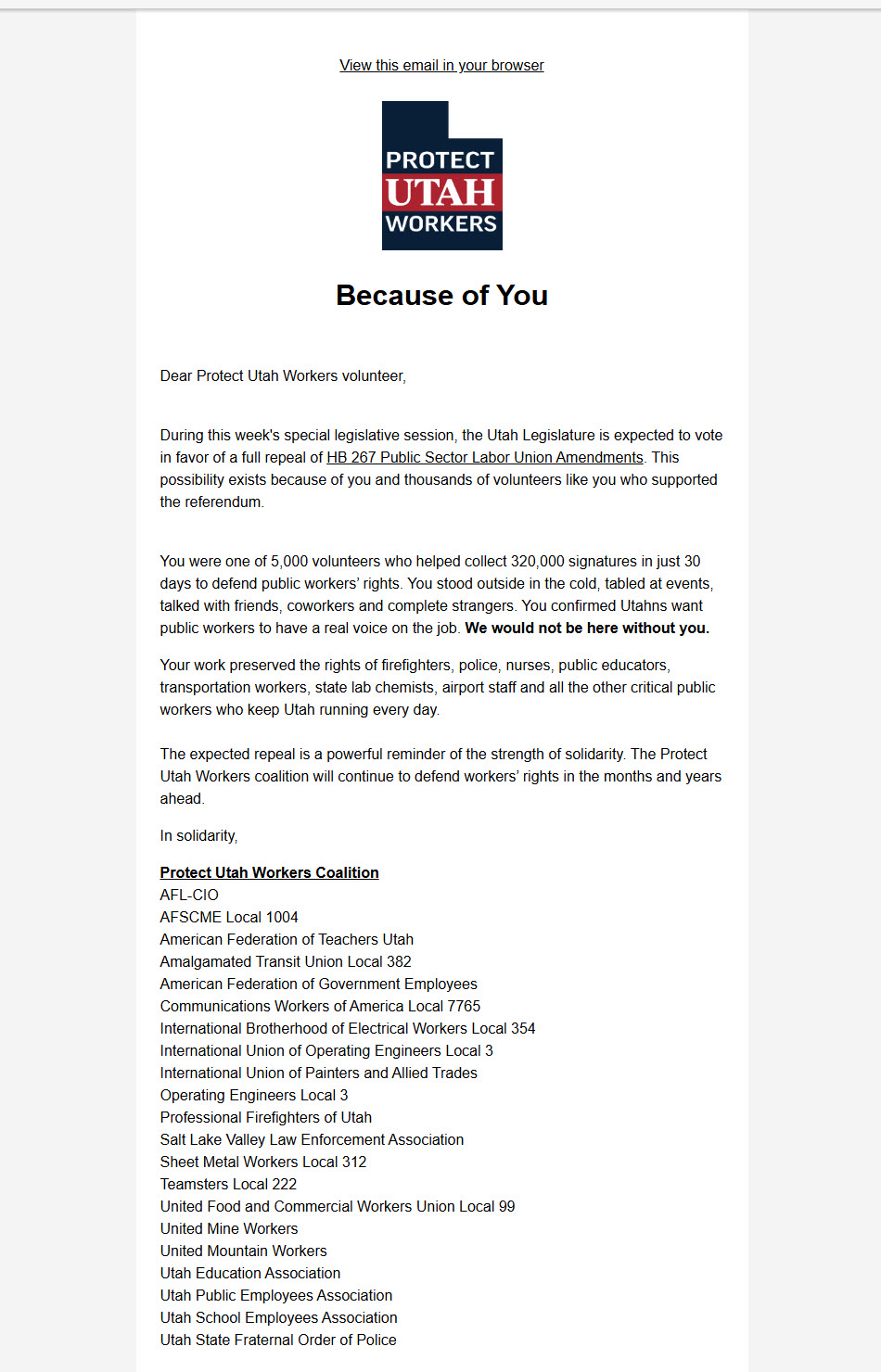
The Protect Utah Workers Coalition sent out the following email declaring a tentative victory, but only if the Utah Legislature votes for a full repeal of HB267 in a special session starting December 9.
I urge you to vote “No” on SJR2 Proposal to Amend Utah Constitution – Statewide Initiatives.
It is exceedingly clear that some members of the Utah legislature do not want to listen to Utah voters as they continue to submit bills that would make it harder for citizens initiatives to be passed. In 2024, HJR14 and its implementing statute HB284 failed when attempting to pass similar language. Sen. Lincoln Fillmore was the Senate Floor Sponsor for those failed bills, and is now the 2025 Bill Sponsor of SJR2.
Citizen Initiatives are literally a tool for “We the People” to have a voice when our representatives don’t effectively represent its citizens. The resolution introduced this week is seeking to take away legislative power from Utah citizens, and give that authority to the Utah legislature. Keep in mind that if this passes, state legislators are TAKING AWAY POWER from Utah voters. Powers to introduce important legislation. Powers to approve constitutional amendments. Powers that belong to us unless we give them away.
There is a REASON that Citizens Initiatives exist. Our LAST AND SINGLE MOST IMPORTANT privilege is to raise a vote to the people when our representatives either lack political will or (in Utah) suffer under a super majority that obstructs the people’s will. Republican leadership wants to change the Utah constitution to limit the will of the people, and effectively neuter Citizen Initiatives by making it harder for initiatives to pass, and allowing the legislature to override successful ballot measures.
Lincoln Fillmore is my Senator, and he does not represent my voice, or other voting constituents in Senate District 17 with this bill.
Gregory Green, Resident Senate District 17 South Jordan, Utah
Jordan Teuscher is back with the introduction of HB267 Public Sector Labor Union Amendments, with added provisions that effectively destroy public employee unions in Utah. Key language of the bill takes away collective bargaining rights, which is a fundamental characteristic of a union. He repeatedly submits bills attempting to dismantle worker rights, and he consistently targets our public employees every time.
Among other things, the 2025 bill language seeks to:
End collective bargaining – prohibits a public employer from recognizing a labor organization as a bargaining agent for public employees; and prohibits a public employer from entering into collective bargaining contracts. Because public employees are not covered by the National Labor Relations Act, Teuscher is targeting them.
Prohibit the use of public property – (think schools, parks, libraries, community centers, and the public employee workspace) for groups conducting union organizing or administration. For example, if teachers wanted to meet in the library at the end of the day to discuss topics that might include information about their UEA membership, they would not be allowed to do so.
Mandate reporting to the Labor Commission – (assumed the Utah Labor Commission although this is not defined in the bill) there is direct concern about why the labor commission would need any financial accounting or member count of a legally separate entity. The public employer could certainly provide information to the Labor Commission on the number of members with payroll deduction of dues, but members who pay directly and choose to remain anonymous should be allowed to do so without fear of retribution. Similarly, the amounts of spend by a labor organization for representation, lobbying, donations, activities, or giving should not require disclosure to the Labor Commission. The members are the stakeholders of the labor organization, not the Labor Commission.
Kills Retirement for Some Public Employees by forcing former public employees who were previously part of the Utah Retirement System to exit that system if they are later employed by a labor organization
Introduces ambiguous definition of “Political purposes” that can be broadly interpreted as any literally any conversation or action if it results in a decision or action. See lines 124-127 of Chapter 32, Part 1, Section 101(4).
Authorize the Utah State Attorney General to pursue compliance through civil actions if they fail to prohibit public employers from collective bargaining (although no mechanism of reporting a dispute is provided.) See lines 274-275 of Chapter 32, Part 3, Section 301(2).
Unions are one of the most important tools to address the disparity of wealth distribution, and a legitimate tool to manage the welfare and way of life for Utahns. Teuscher has submitted bills in past legislative sessions that work against worker rights. We are facing anti-union actions from a national level to degrade unions in Utah. Groups like ‘Workers for Opportunity’ and ‘Mackinac Center for Public Policy’ are engaging with conservative legislators to introduce legislation veiled as “worker freedom”, but in reality represent a furthering of “right-to-work” policies that weaken labor laws and tear down worker rights. Teuscher is a copy/paste legislator introducing right-wing legislation from ALEC that was also run in Texas and Florida. He’s doing the same thing working with the Foundation for Government Accountability (FGA) whose focus is to push, repackage and franchise conservative agendas. He literally takes his cues from national right-wing think tanks rather than representing the people of Utah.
This is the third attempt by Jordan Teuscher to push this form of union-busting bill through the legislature.
Each year that Teuscher introduced legislation to actively dismantle worker rights for public employees, it has been killed due to overwhelming opposition from the public.
A patent lie:
“Businesses have to make a profit or they go out of business. Government never goes out of business,” he said. “Because of that inherent obstacle with public sector collective bargaining, it really doesn’t make sense to continue to do it in our state.” – Rep. Jordan Teuscher, Fox 13 interview (Jan 22, 2025)
To suggest that public employees are tapping an unlimited resource of payroll funding simply because they work for a government entity is ridiculous. The ability to negotiate, (including collective bargaining) for a prevailing wage, let alone any wage, is material to any employee regardless of their employer or the industry that they work in.
Teuscher is an acolyte of the legislative supermajority. He is a primary sponsor of copy/paste legislation that works against the freedoms of Utah voters, including attacks on worker rights. We need to unseat people like him and fill those seats with candidates who will defend our rights and keep us free of the kind of government interference that we are seeing.
Throughout the election, I haven’t been a big fan of polls, mainly because numbers aren’t always what people think they are or want them to be. Perhaps the only poll that I relished was a GOP sponsored poll from Right Insight that went out via mobile, which was so messed up no-one who received it could respond properly. I was delighted that the Utah Republican Party had spent so much money that was botched from poor programming, a failure to test, and an incredibly bad rollout.
On the other hand, election results are the real data we campaign to see. Election night results will post on Tuesday. I may lose, but I revel in the progress we made in this district. The fight isn’t over, not by a long shot.
What We Face
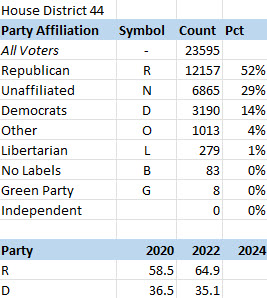
House District 44 is decidedly a very red district. With 52% of registered voters listed as Republicans, it’s daunting to think that a rival candidate could run successfully here and have a significant impact on the “safe seat” for the GOP that was carved out in 2020.
An uphill battle: A win would require most registered Democrats and Unaffiliated to vote for me along with a margin of Republican voters. A democratic campaign would have to focus on issues that would compel constituents to vote against their party line.
Sizing Up The Opponent
When Teuscher first ran for office in 2020 it was a Presidential election year and there was the COVID-19 pandemic. He ran in Utah House District 42 before the redistricting took place, and when Utah was experiencing the COVID-19 pandemic. In the second election in 2022, it was a mid-term election cycle with lower voter turnout in a newly defined Utah House District 44. The last election had also produced an odd strategy for voters outside the Republican party to register as Republicans in order to affect the closed primary of the Utah GOP. The idea had been to successfully promote more moderate candidates during the GOP primary to give better options for all voters in the general election. This also had the unwanted effect of bolstering the number of voters registered in the Republican party. Suffice to say, these two past elections would not provide substantial data for me to work with as a comparative example to build from. There was good data showing that Unaffiliated voters tended to lean Democratic though, and the influx of new voters in Daybreak community was appearing to make our District more purple than it had been.
There were (and still are) significant issues with the bills introduced by Teuscher since he has been in office. You can see his voting history in the Alliance for a Better Utah annual progress report, which grades politicians against comparable positions for Good Government, Equal Rights, Sustainable Future and Strong Communities. Teuscher received an “F” in 2024, 2023 and 2021; and a “D” in 2022. Teuscher votes against public education, is a primary sponsor of anti-union legislation targeting Utah public employees, and sponsors bills that weaken Utah voter rights. He is a source of bills from copy/paste legislation promoted by conservative right think tanks (when a particular legislative issue is trending across states, there is a good chance that Teuscher’s name is attached to the Utah version of the bill). Anyone who isn’t completely indoctrinated in Fox News rhetoric recognizes that he does not represent local issues or engage voters.
I decided to register as a candidate when the Salt Lake County Democratic Party had found no-one who was willing to run in our House District. It was January 4 (the night before candidate registration closed) that I made the decision, and I said then that if I registered I would not run as a “name-only” candidate; I would invest myself to run in earnest and fight for the seat. I was a first-time candidate, running as a Democrat in a primarily Republican district against an incumbent. I knew enough to know that I didn’t know what I was about to get into.
I knew that there were key issues for me to run on. Teuscher’s anti-union rhetoric, and his clear stance on de-funding public education were clear problems. I personally was upset at his regular comments about getting rid of students with learning disabilities because I happen to be a Special Olympics dad and proud parent of a kid with an Intellectual or Developmental Delay (IDD) who had successfully navigated through Jordan District public schools. I’m incensed by his willingness to lie in the face of constituents about the intent and impact of his bills, and his anecdotal stories that obscure data and real public sentiment.
I Was Told I Wouldn’t Win
In politics, it’s often a numbers game before the impact of issues, political climate or social sentiment are considered. In the early months of my candidacy I was told by a party officer who will remain un-named that I wouldn’t win, and should consider a smaller race in the future. Important races were selected not based on issues where we had to win, but on what districts were considered “flippable”. Essentially, they weren’t focusing on our message to voters, but put emphasis on these statistical outcomes. The difference here is in what you consider the return on interest (ROI) of the campaign. Did you win a seat? Did you help an upstream/downstream candidate? Did you affect a topic in a positive way? Did you recruit voters? Did you grow alignment to the party? In election races, the focus this year was on winnable seats, and mine was not one of them. It was a numbers game, defense of principals be damned. From the perspective of the county and state Democratic party, mine was purely a supporting role as they focused on other races.
I was slotted into the strategy of “contest every race” that sought candidates (often name-only) to run against opponents in every district, so that voters could feel like a choice was present – even if it was admittedly a false choice. I will die on the hill that candidates who register to run should be qualified, align to the democratic platform, actively campaign, and be supported. Elections are not a raffle, they are fought and won. If I was going to put my name in an election hat, then I would run a campaign. I was not going to sit by.
Endorsements and Fence Sitters
An important aspect of campaigns is the seeking of endorsements, which can be helpful in a number of ways. Endorsements can be visible. They can be financial or for in-kind support. They can be hands-on with the supply of volunteers to help during events and canvasing. Endorsements can even provide access to mentoring or education on topics. In most cases, an endorsement of any kind helps greatly. The lack of an endorsement can equally be to the detriment of the campaign. What bothers me about these groups is that they expect candidates who sought endorsement to infer future support for their cause when they choose to do nothing. As in any relationship, it becomes more guarded and tentative when you realize they don’t have your back.
I was disappointed by organizations that chose not to endorse me in order to hedge bets so that they could preserve future working relationships, but I understood the need for diplomatic decisions. Politics is politics. There were some organizations that made decisions with no transparency or feedback, and some that seemingly worked against their own best interests when endorsing candidates. In one example, an organization had sent out exactly one letter to its members in the election year, advocating against a piece of legislation that had been sponsored by the person they then later endorsed. And there were organizations that sought to extend requirements for endorsement by writing affirmations that extended beyond their platform or caucus, like a labor union that wanted unfettered 2nd amendment guarantees before they would endorse (I was not endorsed by that particular union).
What is important was that I was able to secure key endorsements from Labor, from Education, from Issue and Identity Caucuses, and for Freedom of Religion. These mattered greatly to me because the message from these backings was that the people in these groups were being disenfranchised, and wanted better representation. Teuscher was hosting or voting for bills that take away personal rights, that de-fund public education, that dismantle workers rights. Coming together to fight him for the legislative seat was appropriate and timely.
Monumental Screw Ups for Teuscher and the Utah GOP
There were several big events that took place over the summer where I gained advantage. The Utah legislature’s over-reach was finally getting checked by the Utah Supreme Court in four ongoing cases. The Utah GOP was making their clear over-reach visible, and were getting tied down in expensive legal battles that Utahns were footing the bill for.
1)Utah Supreme Court decision on LWV Utah vs Utah State Legislature In July of this year, the Utah Supreme Court passed by unanimous decision to allow the League of Women Voters Utah to proceed with their claim that SB200 violated Utahns’ state constitutional right to alter and reform their government. The court remanded the case back to the trial court where it will be decided. This was a major victory for Utahns, and the Republican legislature immediately lamented the decision, including Jordan Teuscher.
2)Injunction on Utah Trigger Law Upheld In August this year, the Utah Supreme Court rejected Utah’s request to overturn the preliminary injunction blocking SB174, the state’s abortion trigger ban, from taking effect. Again the Republican legislature blasted the “liberal Utah Courts” for having the audacity to check them (remember checks and balances)? Jordan Teuscher even wrote a note about it.
3) Citizen Ballot Initiatives Yet another Utah Supreme Court decision, this time to allow the case against the Utah Legislature’s willful disregard of the people’s voice for new district maps. The gerrymandering case is allowed to proceed at a lower court.
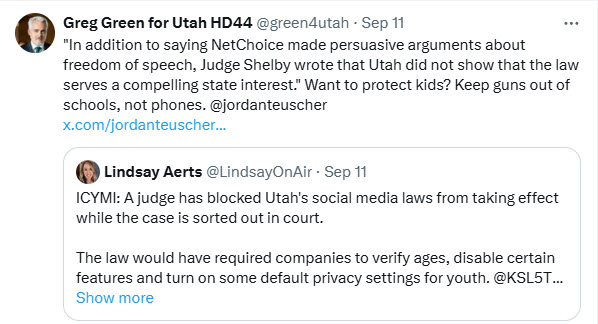
4) NetChoice Wins, Do You See The Pattern? In September, the courtsblocked Teuscher’s Minor Protection in Social Media Act with a preliminary injunction for violating first amendment rights. The plaintiffs gained significant ground in the case when the judge confirmed that the Utah law breached constitutional rights.
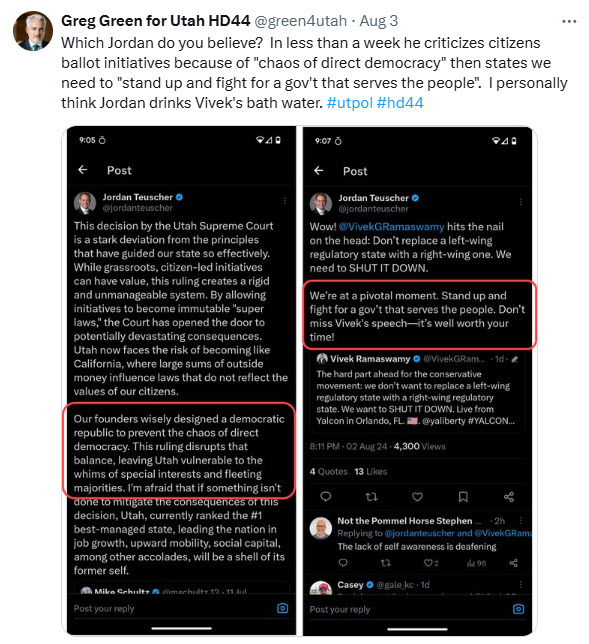
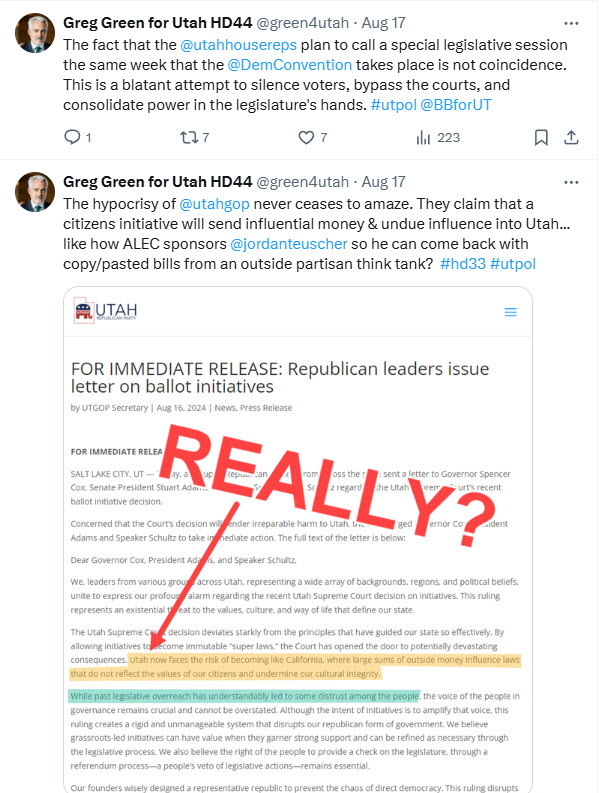
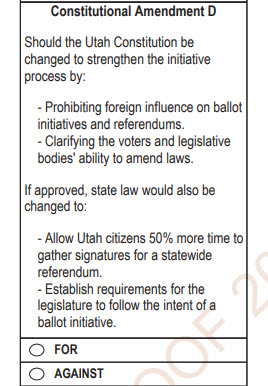
The “Emergency” that Wasn’t: How Amendment D Shaped Up It was during the Democratic National Convention in August that the Republicans decided to call an emergency legislative session to address the applied checks to their unbalance. The “emergency” was a ploy to bring Republican legislators together to craft a new ballot initiative that, if approved, would change the Utah Constitution and strip voter rights away from Utah constituents. Their problem was that to make this change, they needed voters to approve a constitutional amendment. Jordan Teuscher was the house sponsor of SJR401, which became Amendment D to strip Utah voters of legislative rights (This was blocked by Utah Courts on Sep 12, 2024 for deceptive language, and for not following due process). Teuscher was also the House floor sponsor of SB4002 ‘Ballot Proposition Amendments’ to jam through Amendment D, which was voided on ballots.
Ballots were printed before the Supreme Court decision that voided Amendment D took place, and the deceptive language of the ballot question became a public issue. The question implied foreign interference was a problem (it wasn’t, and never has been). The question failed to clearly state that the bill removed voter rights, and granted the legislature authority to override successful ballot initiatives passed by Utah voters. It was an outright sham.
Of course, Teuscher went online to defend the Amendment he was sponsoring. I broke the video down to call out the disinformation presented by Jordan and the Utah GOP.
Seeing Red? Vote Green
Jordan Teuscher is our representative, but he’s failing to serve constituents here. He is backing seriously flawed bills that end up in court. He’s an acolyte of the right wing and is a primary sponsor of the kind of cut and paste bill language from “foreign interests” that he accuses other parties as doing (every accusation is a confession). He doesn’t represent our values, he doesn’t serve our community, or the interests of Utah voters. My job has turned into asking you to vote for what’s best for you, what’s best for our district, and what’s best for Utah by helping me unseat Jordan Teuscher this election. I want to drop the rhetoric and focus on what’s best for Utahns. If you want to see my proposed 2025 legislation, take a look at https://utah44.com/proposed-2025-legislation/.
Get involved – to be anything other than a Republican in Utah means that you have to be active, and you have to make your voice heard. We need individuals who are dedicated, who can engage their party, become delegates, train to become candidates, and are committed to running in future elections. This has to start NOW to be qualified and ready.
Engage with active bills – you can follow legislation at https://le.utah.gov/bills/bills_By_Session.jsp. Learn who your legislators are, how to engage them, and how to testify when bills are being debated on the floor.
None of this is easy, but it matters greatly to be involved and to be part of positive change. If we don’t fight to defend our rights, and if we don’t actively engage, then we give ground.