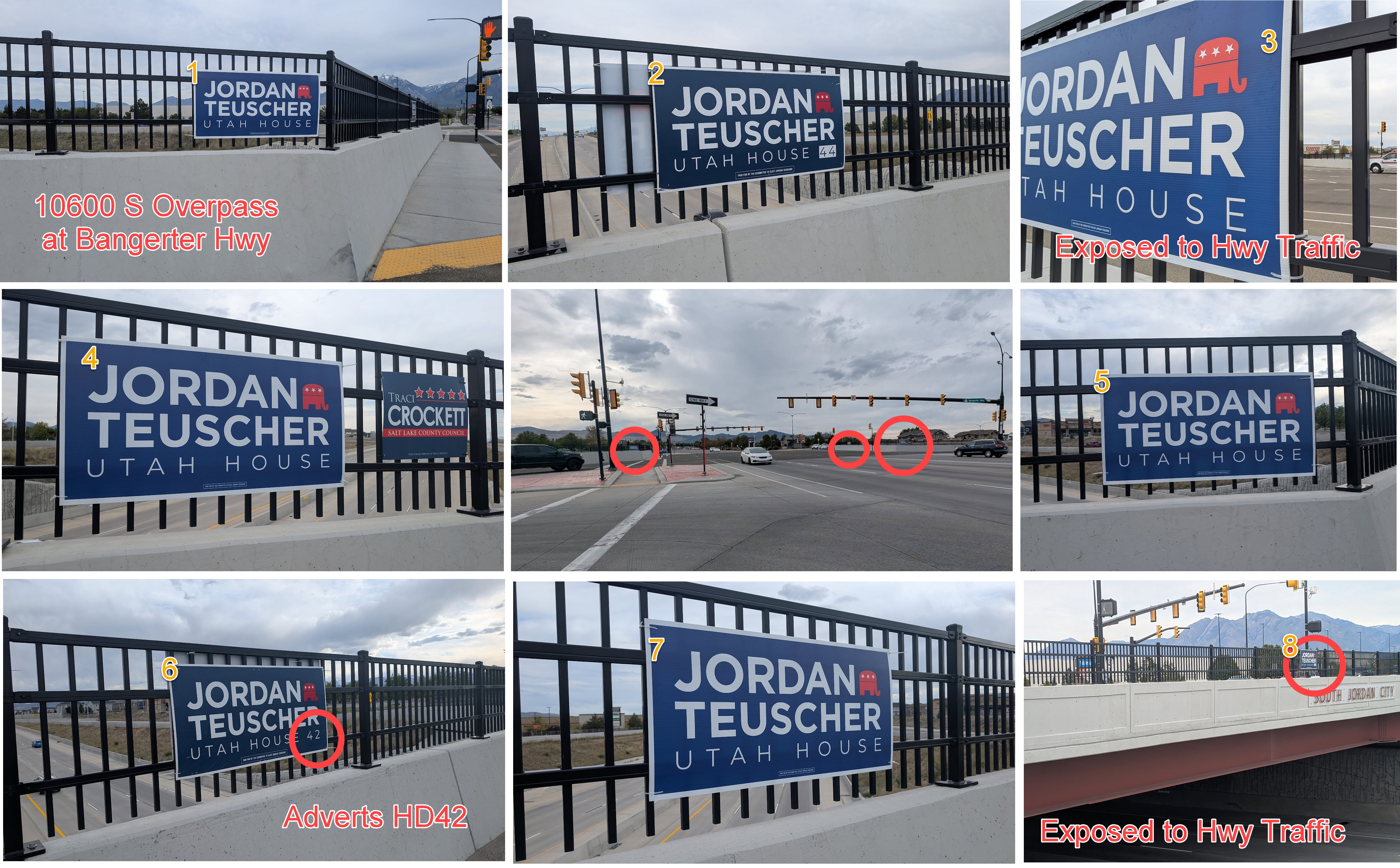
Jordan Teuscher is at it again – ignoring laws and benefiting from the inaction of Utah DOT, the Elections Office, and the Utah Attorney Generals office. Leading up to a very important Republican primary in June where he faces Scott Stephenson, the Teuscher campaign is rightfully worried that a conservative candidate running with extensive service in public safety could very well end his 3-term run. Teuscher is famously anti-union, but he’s also against public education and voter rights.
Ironically, Jordan Teuscher has illegally posted campaign signs on the overpasses at 11400 South, 10400 South, and 9800 South of Bangerter Highway (all within or near Utah House District 44). This is a violation of Utah State Code 72-7-503, which makes it a Class B Misdemeanor violation to post signs in the right-of-way for Utah highways. The irony is that the Jordan Teuscher is well aware that he is violating state laws in doing this – not only did he pass his own HB33 Political Signs amendments during the 2026 general session, but he also complained when I ran against him in 2024 and posted aggressively. Back then Teuscher leaned on the Utah Republican Party and the Utah Taxpayers Association to respond with his own signs and an aggressive mailer campaign that outspent me 3:1. In 2026 he knows that Stephenson represents a real threat. His signs are up before the Republican primary in hopes to curry favor with voters in our district – the main issue being that the other candidates have respected the law and NOT posted in violation of state law as Teuscher has. The problem is that no authorities are doing anything about it. Read on.
The Project “Ask”
I’m asking unions, caucuses, in-boundary candidates, and the Democratic party to participate in the visibility project “Signs on Bangerter & 10600 Overpass – A social disobedience project” by dropping off yard signs. If you have materials (blank corrugated vinyl, box cutters, zip ties) and want to donate those to the project – great!
On Saturday, May 23rd at 10AM we plan to meet in the parking lot on the southwest corner of the 10600 South overpass of Bangerter Highway to organize.
This is a drop-off event – we’ll be collecting yard signs with democratic messaging and plan to canvas the entire fence along the north and south sides of the overpass as a protest to the inaction of the Utah Department of Transportation to remove political signs posted by Republican candidate Jordan Teuscher. All of his signs were placed on May 2 in violation of Utah State code 72-7-503, but as in similar years, DOT acknowledges our complaints but takes no action to remove the signs. This only harms other candidates running fair campaigns, the voters of the district, and constituents who suffer under ill-representation of this legislator.
We are not allowed to remove signs. HOWEVER, we can post signs just as the Teuscher has done, and protest through social disobedience. The goal is to cover the fence with signs, giving space not to cover any posted sign but to create a situation that DOT will respond to.
Please bring corrugated plastic (yard) signs that have relevant messages, that are political but NOT derogatory. This is a drop-off event – SIGNS WILL BE POSTED BY SELECT PERSONS TO AVOID TRAFFIC ISSUES.
We want the signs to stay up as long as possible to communicate a message and raise awareness that candidates and office holders should not be allowed to circumvent laws simply because it is controversial for a department to enforce its public duties.
Building The Case of Inaction
To this date, no action has been taken by any authority listed below. None of these groups have been willing to enforce a Utah law or to hold Jordan Teuscher accountable for knowingly violating a Utah law. Jordan has been cc’d on all of my correspondence with these groups. He is well aware of the requests and has not taken any action, or responded.
The Utah Elections Office has been contacted. Their response was “The Lieutenant Governor has no enforcement authority over where signs are placed.” The office chose NOT to contact UDOT to request enforcement of existing Utah laws governing political signs that are illegally posted.
Utah Dept of Transportation has been contacted with multiple requests, which have all been acknowledged with no action taken. I have begun cc:ing contactudot@utah.gov on all email correspondence. They do not respond.
South Jordan Police received and accepted a supplemental report “UDOT SeeClickFix tickets #21671239, #21619660”, submission reference 260383 on May 14. The report requested that the police department contact Jordan Teuscher to request removal of the signs, and pending no action to charge him with a misdemeanor crime in violation of Utah State Code 72-7-503. There has been no update to the report.
The Utah State Attorney Generals Office was contacted on May 16, 2026 (CRM:0100332) requesting that they pursue the issue with Jordan Teuscher. A separate request (CRM:0100331) was submitted to push Utah DOT to enforce its right-of-way rule and to remove Jordan Teuscher’s signs. I have not YET received a response form the AG office.
Are we breaking the rules when we are the only ones abiding by them?
Teuscher introduced HB33 Political Signs Amendments to modify Utah State code 20A-11 and 20A-17 in 2026 general session this year. As a state legislator, and one who has recently written legislation on election signage, he is well aware of the state laws governing where and how signs can be posted.
Teuscher sits on the House Ethics Committee. As a member of the Ethics Committee, there is additional consideration to uphold the principles of law and decorum represented by an elected official. Teuscher is willfully choosing to ignore that.
There seems to be an overt display of unlawfully claiming space by his campaign.
This is why a social disobedience project is necessary.
On March 12 at approximately 5PM I was driving eastbound on Interstate 215 when I experienced a full tonic-clonic seizure. At 58, it was the first seizure that I have experienced in my lifetime. I hit the right barrier, accelerated across the highway and hit the left barrier, then traveled back across the highway to hit the right barrier head-on. This stopped the truck. I have no memory of the incident, but it was all captured on the dashcam. My daughter Natalie was with me as the only passenger in the vehicle, and aside from some bruising from the seatbelt and airbags, there were no immediate physical injuries to her. I broke three vertebrae in my back from the impact of the crash. Thankfully there were no other cars involved in the accident.
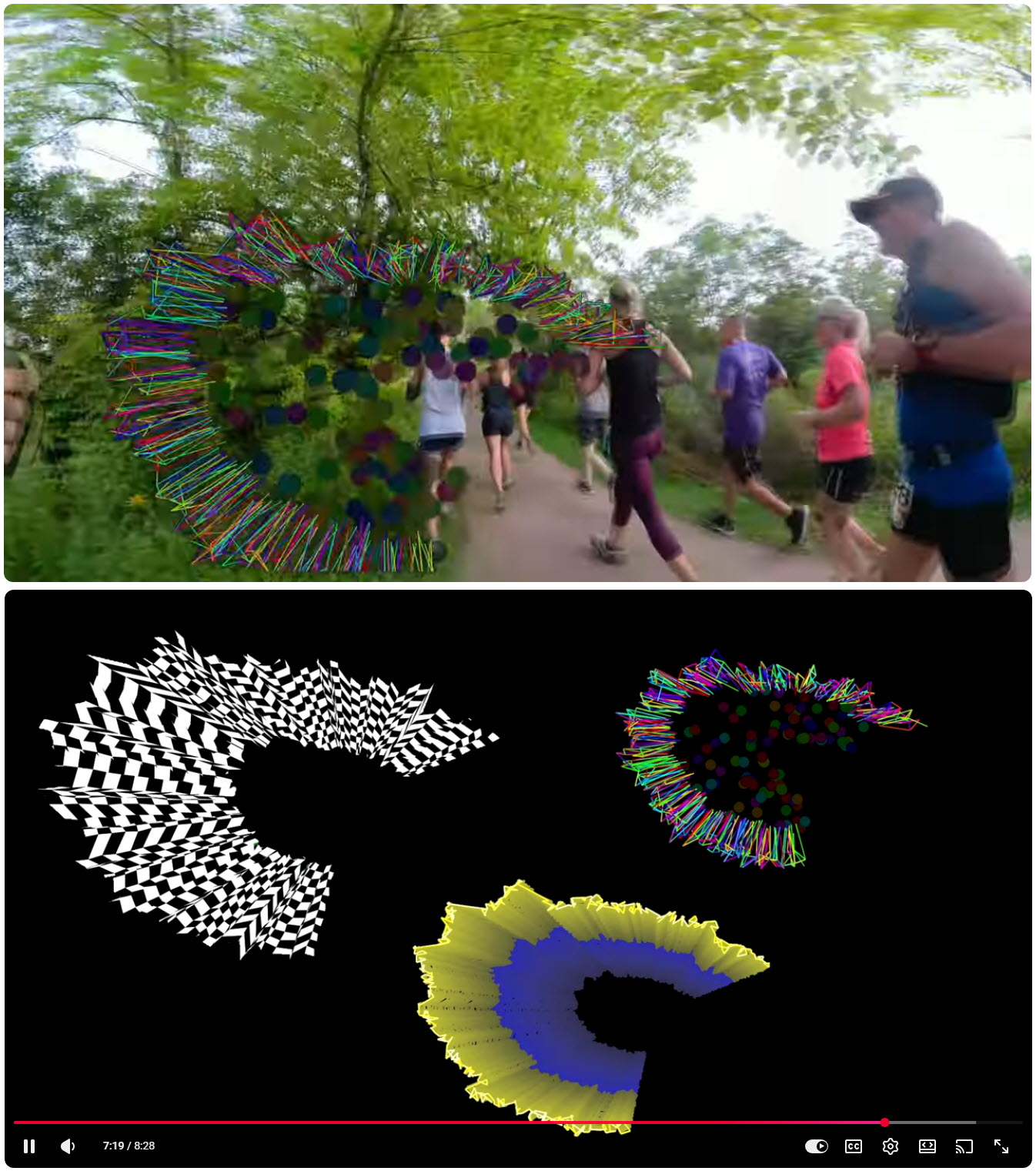
I have a history of visual migraines, or scintillating scatomas. The visual migraine looks more like the top left image (below) but is colorful, almost like a kaleidoscope. It appears in the center of vision and grows in intensity over one to two hours. Although not painful, it is disorienting, and typically leaves you in the same state of someone who has experienced a regular migraine when it is over.
Update: I found a video that does a pretty good job of showing what a scintillating scatoma looks like – now keep in mind this is what it looks like for 30 minutes to one hour while it’s happening:
In the past I have just resorted to waiting wherever I was until the migraine ended. I can’t see or focus while the migraine is occurring, so I rest (whether at work, or in a public space, or sitting on the side of the road in my car) until the event is over. It can take up to 1.5 hours before I’m able to revert back, and in most cases I’m just heading home to rest following one of these events.
Although rare, I have started to experience these slightly more frequently in the last year, and the visual migraines have begun to morph into more serious medical events.
Jan 6, 2005 (est) – first vision loss, dark scatoma
Oct 4, 2018 1PM – scintillating scatoma
Mar 1, 2023 at 1PM – scintillating scatoma
May 12, 2024 at 3PM – scintillating scatoma
Aug 30, 2025 at 12PM – scintillating scatoma
Sep 7, 2025 at 1:40PM (note that this is the first time two occurred in a year)
Feb 5, 2026 at 2PM (transitioned into a full shoot-myself migraine)
Mar 12, 2026 at 2PM (tonic-clonic seizure occurred at 5PM)
The March 12 event is where I learned that scintillating scotomas can act as “auras” for seizures (specifically occipital seizures) or neurological events like strokes; and a scintillating scotoma accompanied by migraine increases the risk of stroke. Those last two events in the list were significant then.
On the day of the seizure I was (ironically) at the South Jordan Health Center picking up a prescription and visiting Angela when the scatoma started. We were in the common area on the main floor and were able to hang out there for a while, so sitting there and having conversation was fine. We had run into some people we knew and there was conversation. I was mainly concerned that the scatoma might turn into another full migraine, so as soon as the visual distortion settled I headed home with Natalie so that I could lie down on the couch. Right before 4:30 Natalie reminded me that she needed to travel to a meeting in Murray that I had to drive her to. I still wasn’t feeling right but thought I could rest in the truck after she was at her destination. That, apparently is where my memory breaks.
What I don’t recall but can see from the dash cam: we were travelling a very regular route, taking side roads east along 6200 South to Redwood, then north on Redwood to the I-215 entrance from a brief jaunt on the highway to State Street, which we never reached. We were in conversation with my daughter’s MIL Monica, who was on speakerphone. Natalie was absently looking at her phone while the conversation carried. I was driving up the onramp of 6200 south to merge onto I-215 east when it looked like I needed to sneeze. Only the sneeze turned into a stretch, and that stretch became catatonic as the engine revved and the truck lurched into the first barrier. The seizure had started. Natalie was startled. The truck began to turn back onto the highway, and my foot was still on the gas pedal moving the truck forward. You can see cars avoiding us as we begin crossing lanes toward the center median. Natalie is now shouting at me. Monica, on the speakerphone, realizes that something is wrong. I am unresponsive. The truck hits the center median and the first airbags go off on my side. Now the truck has turned again, and is pointed more directly across the road. Natalie tries to grab the wheel as we accelerate across the highway once more, this time directly impacting the right barrier and stopping the vehicle. Moments later people appear on both sides of the vehicle to open doors and begin helping Natalie and assessing what happened.
For you creeps who like watching car accidents and the misfortune of others: dashcam link (warning: disturbing real life stuff)
One of the biggest concerns I have from this is that no-one coming into assistance would have known that Natalie had an intellectual disability. She was immediately under duress from the accident, and thrown into a situation where responders assessed that she was “okay” and being instructed to do things that she wasn’t readily able to respond to. For a brief period she was alone, watching her dad receive medical attention for something that had never happened before. It must have been scary, and confusing, and distressing for her. I don’t want her to ever be in a situation like that again.
One of the things that I’m thankful for is that Monica was on the line when all of this happened, because she was the one who reached out to the rest of the family to let them know what happened so that they could respond quickly. Angela and Marisa were at the scene quickly, and Ang was able to stay with Natalie while Risa followed the ambulance to the Murray IHC emergency room. They were there for Natalie, and kept things together at a critical moment. I don’t know what would have happened if they couldn’t be there. I’m grateful to Monica for thinking quickly, and for my family keeping it together when I was unresponsive and there were a bunch of unknowns for them.
The moment I remember was waking up on a gurney in the hospital. Someone says something like “he’s waking up” and a person over me says “Mr Green, I want you to know that your daughter is okay but you’ve been in a serious car accident and you were transported to emergency in Murray.” For just a moment I felt like I was waking up from sleeping, and then I was in pain. A lot of pain.
I won’t focus a lot on the hospital – I was there from about 5PM to just after 1AM the next morning before I was released. That eight hour visit accumulated $148,000 in ambulance fees, emergency room care, testing, labs, prescriptions and referrals; one totaled truck, a medical suspension on my driver license, and a new epilepsy diagnosis.
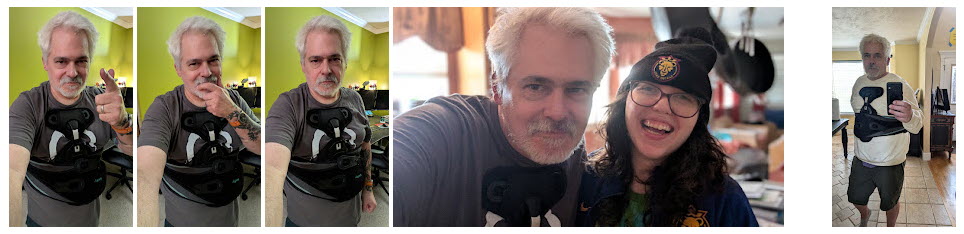
I left with three broken vertebrae and a back brace. I could barely walk, but I wanted to be home and back in a familiar space. I had been given 8 tablets of Oxycodone (enough for two days) and told to schedule with an in-network doctor to start follow-up.
Fun fact: I lost 25 pounds in the first 3 weeks because it was so painful to poop (think any pressure on your lower back) that I stopped eating. The combination of extreme pain, Topamax and complete lack of appetite is apparently a win-win for physical dieting. On a seriously positive note I haven’t needed to take any insulin since the accident because my blood glucose has been reliably in the green zone the entire time.
It’s worth mentioning at this point that I have barely rejoined the medically insured after Angela started a new job in February. After Oracle RIFd me last year, we have been medically uninsured since September 2025, and only gained insurance starting February 9th. My seizure was on March 12. Since the accident I have had to schedule new patient relationships with musculoskeletal, physical therapy, endocrinology, pulmonary, neurology, vision, radiology, and general medicine. It has been a scramble to find doctors who accept new patients, and who can treat new patients coming in from a recent accident.
The Recovery Timeline
The timeline is depressing, mainly because much of it can be expressed by me in periods of waiting. Waiting for my back to heal. Waiting for a call back. Waiting for my family to come home every day. Waiting for someone to take me to an appointment that I couldn’t get to on my own. Much of the time I’m alone. Angela is working two jobs to make ends meet. Natalie is working and has responsibilities with Special Olympics as an advocate and an athlete. I’m not able to perform roles I had running errands and chauffeuring. My independence is gone.
March 12: date of the accident
April 28: physical therapy begins (+47 days)
May 7: 8-week recovery date for vertebrae (can take 12 weeks) (+56 days)
June 4: “end” of mandatory 3-month medical suspension for driver license (+84 days)
August-October: estimate to be scheduled for a seriously backlogged neurology clinic (won’t drive before this) (+142 to 233 days)
This essentially means I won’t have a real diagnosis for at least six months, and will likely not be able to drive for the rest of the year. That impacts my ability to work, and my ability to function as a caretaker and member of a household. But whatevs. Everyone is safer if I’m not behind a wheel for now.
Transportation and Access
South Jordan is a public transit dead zone, meaning there is no real way to transit within the city unless you drive, use Lyft, or have access to a scooter or bicycle. Interestingly, it seems that SoJo has made it a point to purge any micromobility services (think Lyme or Spin) because its nearly impossible to find any rentals, anywhere. At this point I am walking, and I walk where I can.
Walking distances from my home:
0.9 m Harmons Daybreak
1.7 m Costco
2 m Trax SoJo Pkwy Station < this is the only public transit I have access to
2 m Smiths West Jordan
2.5 m Daybreak Library
2.6 m University Hospital
2.6 m Harmons District
3.1 m Smiths Daybreak (via Lake Ave)
4 m Lowes West Jordan
Taking the Day Back
Physical Recovery Walking seems to be the simplest thing I can do. Ang had a great idea to sign up for the U of U Health 50k in May 2026 – with a commitment to walk 1 mile a day in the month of May (31 miles ~ 50 kilometers) and benefit the Utah Food Bank at the same time. There’s other stuff but this is straightforward and gets me out of the house (important). I’m technically already doing this – yay for me – but now I have goals.
Get a Job, Ya Bum My ongoing mantra since I was RIF’d by the monster that is Oracle has been to return to work. It’s infinitely more complex now that my transportation options are limited, but I need a damn job, and the sooner the better. I’m so so good at Zoom calls and sitting in front of computers, someone should hire me. Like, now.
Name that Devil On Your Back At this point I’ve basically self-diagnosed with adult onset Occipital Lobe Epilepsy (OLE) because my symptoms match. I’m now on an anti-seizure medication so my only concern is whether and when I have another seizure. I need real professionals to tell me what’s wrong with me (womp-womp) so that means working through the U of U’s seriously waitlisted system in order to see neurology. I was able to complete intake and am currently waiting for a scheduler. Once I’m scheduled, I can request to be placed on the call list for any cancellations to move up on the list, but I have been told the typical wait is 4-6 months without an escalation, and that only happens if I have more seizures. Oy.
What I really hate is the whole “not knowing”. I will assume (because it’s the right thing to do) that because I had a serious seizure, and because I have a history of scatomas with evident worsening symptoms, that I have epilepsy and/or am a candidate for stroke. The problem with knowledge like that is that you still don’t know much. It’s the lesser version of “every day is a shitty version of Russian roulette; lets see how this goes”. You take your medicine and hope nothing goes wrong but if it does, oh well? Thanks for watching my show, sorry the ending was so short?
Whenever it occurs I have to wonder where I will be, how I will be able to find a safe space to wait it out, and whether I’ll have time to let my loved ones know in case something bad happens. I’m not worried about me though, it’s the people I leave behind that I’m worried about.
Following My Mother’s Medical History
I’m having similar symptoms reported in my mother’s medical history, and it’s why I have concerns. Her diagnoses were more significant (Multiple Sclerosis, seizure disorder, and dementia) but I am my mother’s son. Notes from her medical records (incomplete):
1958 (18) First complaints of a “visual field defect” related to diagnosis 1981 (41) First seizures (2) – no known etiology 1983 (43) Noted “tangential thinking, inability to be precise, labile affect” 1992 (52) Prolonged major seizures 2004 (64) Seizure, tonic clonic
Most of every day is seeking positions, filling applications, writing cover letters, researching companies, networking; then supporting other peers; then supporting my family. I try to be transparent, and I want people to hear it from me when things aren’t going well because I think it’s happening in a lot of our worlds right now. I’m not alone.
There’s a lot here. The layoff wasn’t entirely unexpected, based on the number of rolling layoffs that took place before I was part of one. My notification took place on March 3 in the morning. I was at a medical appointment when I was pinged by my skip manager (a senior director) to meet for a brief update. I took the call on my cell phone in the medical office while the nurse had stepped out. She was a relatively new reporting manager in our organization, and I didn’t know her that well. She read from a script and asked me to verify my personal email to receive exit documents. I was upset and told her that it was on file and to do the work of looking it up, and hung up on her. I started notifying my teams that I was selected to RIF and that I would not be able to meet, but was limited to responding to anyone because I was on mobile. My slack access was cut off during my drive home from the medical appointment. I got to my home office and was able to back up some personal files from my workstation before it went through a force shutdown/reboot and locked me out of the system (it’s an encrypted laptop, so all they had to do was remove my encryption key). In under two hours I was locked out of my workplace and given no real time to notify anyone that I was let go. Unfortunately, this is the way that most of us are termed from Oracle. Employees who remain are not notified who was selected for the RIF. Because we are still in the system for 14 days following the notification, we still appear in the company directory (Aria) but our VPN/Network, SSO, Slack and Email are all disabled. Remaining employees have figured out that if an employee’s Slack account is disabled, it typically means they have been let go, so for most of those still working that’s how we “discover” who was RIF’d. The rest is shared by whisper network. There were some community channels in Slack like #watercooler and #wtf that were privatized and moved under HR to shut down employee discussion about what takes place.
Oracle decided several years ago to stop announcing org changes, and limiting manager communications about reductions like this because there were posts in thelayoff.com or blind about the layoffs, and they didn’t want to see those. There is effectively no organizational change management taking place. Projects go on hold to figure out who’s left and to assess re-planning. Entire teams disappear, and managers tell us that the function was eliminated but there is no contact for support, or for process. It’s hellish for the people who remain working because they are expected to pick up work, or are forced to escalate issues they can’t handle. In most cases, reporting managers don’t know who from their team will be let go, or if they will be let go. There is no consideration about tenure, contribution, performance, active roles; one day you’re just “gone”.
I was the person who created https://oracleworkersunion.org/, but I hadn’t really promoted it until after I was RIF’d. I had started building this after a group of employees created “Employees for Ethics” back in 2017 in response to the first Trump administration’s attacks on foreign workers and the trans community. I was upset then that Oracle’s response to employee concerns was to minimize and control by throwing HR and legal into our conversations and subtly suggesting ramifications. Safra Catz is somewhat famously referenced as saying to employees that if we didn’t like working at a pro-Israel company, we should leave (paraphrased). Excessive campaign contributions to far-right, the hiring of notable figures in the administration of the times (namely from Devin Nunes’ campaign) were bothersome. Many of us were truly disappointed in the leadership and the direction of the company as a whole. When they effectively dismantled our DEI programs and replaced them with “Culture and Inclusion” that included consolidating (i.e. reducing) ERG budgets and blocking employee-matches for LGBT programs through Benevity, it was clear what they were doing.
I started in the tech industry about 26 years ago. I worked at PeopleSoft, and that company was acquired by Oracle in 2005. At the time it was the largest acquisition that Oracle had made, and I really hoped our culture would have some influence there, and I was sincere about that. 20 years in, many of the people who I cared about are being let go, including myself. I’m not happy about the direction of Oracle. I wasn’t happy with the leadership of the company. But people matter, and I truly wanted to see change. At this point I just want to find a company that has integrity and stands for human principles. I don’t think that kind of company exists anymore though.
The current socio-political climate has really hurt a lot of people. It started with companies like Oracle that were more interested in profit margins and less about cost of goods or services that began profiteering – i.e. “restructuring” – essentially laying off workers regardless of performance or contribution. Oracle tech workers are a foundation of knowledge, code and process in the organization, and Oracle intends to replace them with nothing, or bridge the gap by introducing AI. The clear problem is that AI is new technology that requires a regularly updated knowledge base to train on, ongoing maintenance and tuning. AI isn’t autonomous. AI is a tool, and like a hammer it’s useless without someone who can drive a nail with it.
This year is going to be extremely difficult for many of us who are actively looking for work. The reality is that the number of in-field jobs is shrinking, and the number of applicants for those same jobs has grown exponentially.
I was let go 7 months ago. Most of the people I know here are employees at the same company I spent the last 26 years working at. Most of us are looking for similar roles in this reduced field.
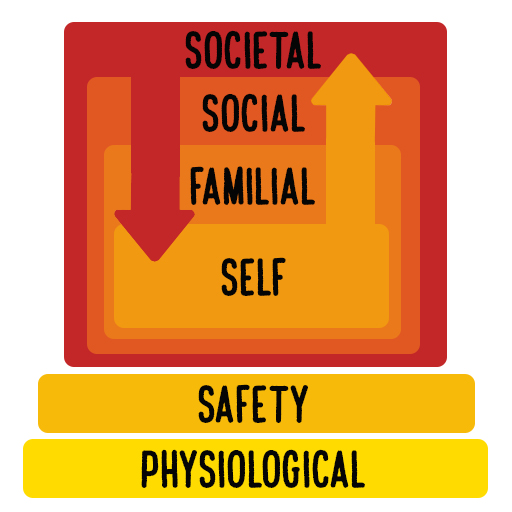
I started thinking about Maslow’s Hierarchy of Needs a while ago, and have been playing with variations of its theme to make it relatable to American politics and identity. With the onboarding of the Trump administration in 2025 we have begun to see attacks at every level, and I’m questioning how we can sustain ourselves through another three years when the first year is technically not even over yet. Keep in mind that DJT wasn’t inaugurated for his second term until January 20, 2025. I’m writing this on January 4, with more than two full weeks left before his first year in office is done.
The most concerning attacks are at the foundation of our hierarchy; specifically on the physiological wellbeing, and the safety of our people.
The Foundation is Under Attack
Physiological
Physiological needs are our fundamental needs for survival. If we can’t meet the basic needs of housing, shelter, food, and rest we don’t tend to focus on much else. One of the main problems we’re seeing are ramifications of a failed economy. Homes are unaffordable, and rent increases are pushing families out of markets. US Courts reports that bankruptcies have jumped 10.6 percent in the past 12 months. Food and product prices continue to go up due to inflation and tariffs passed on to consumers. We are actively in a recession, and there isn’t a positive light to shine anywhere.
Real and perceived threats are growing too. It used to be that having a safe place to rest your head at night mattered, but there is increased vitriol online and notably partisan divisions in media and news that grow a divide. Driven by fear-mongering and contempt, we are seeing attacks on the moral character of good people that lead to physical abuse and violence.
Safety
Safety is a broader term that includes health and wellbeing, stability, financial security (income and savings), and programs that provide aid, like health insurance, or the availability of medical vaccinations.
In Bankrate’s 2025 Emergency Savings Report, 32% of U.S. adults have less emergency savings now than they did at the beginning of the year, while 31% have the same amount and 18% had no savings at the start of the year and still don’t have any now. That means 8 out of 10 people in the US have not improved their emergency savings at a time when growing job losses, increased likelihood of medical issues and other problems are far more likely to happen.
In terms of health and wellbeing, Americans are far less likely to be able to afford insurance, or even have insurance now. Premiums continue to rise. Employees who lose work are likely to not able to afford insurance on their own, at the same time that state (Medicaid) and federal (Medicare) programs are removing expansion coverage and making it harder to qualify for care.
Changes in HHS and CDC policies have been detrimental to US citizens, particularly on the availability of vaccines, recommendations for preventative care, and on research and reporting of disease and outbreaks.
Rollbacks of regulatory procedures and audits are causing environmental and food-related illnesses.
From a financial perspective, the Trump administration attacks against the Federal Reserve and Department of Labor are creating problems with interest rates, labor reporting, and reports of economic growth. In the last two quarters, the Bureau of Labor Statistics is no longer generating trusted numbers that reflect our true market. Groups like the Center for American Progress and Real Economy Blog are providing summaries that reflect signs of weakness—particularly among groups that often foreshadow broader labor-market cooling, such as workers of color and older workers.
More than 300,000 federal employees lost work in 2025, and more than 1.1 million private sector jobs have been lost in the same time. Infrastructure jobs gained during the Biden administration have been erased. Tourism is down. International travel is gone. Regardless of warnings that the US economy is headed for recession, many think that the US economy is already in recession. There is a huge wealth gap divide that is growing.
There is a relationship between self, family and culture, social, and societal groups that is under constant adjustment, but overall determines our view of self and others. The entire model is collapsing around us.
Our Critical Thinking
With the loss of trusted media sources it seems that we have lost the capacity to think critically and understand how to interpret media… and we only have ourselves to blame.
We have lost focus in a mobile-friendly, short-format publication system, where everyone is a publisher.
We have lost context in news that is mixed with entertain and sales. Establishments are no longer selling news, they are editorial boards and infotainment.
We have lost criticality and skepticism for what matters in local, national and global events.
We have lost reality, particularly with loss of awareness in bias and spin (see where you source your information within the Media Bias Chart), and with the introduction of AI-generated articles and deepfake imagery and videos.
We’re at a point where sarcasm can’t be used because the source has to be thoroughly investigated to know if they are truly using sarcasm, or has “jumped the shark” to present an otherwise irrational statement as conviction. News stories give equal weight to two sides when only one is rational, or true. Publishers are reticent to call out factual lies, or provide fact-checking services for their followers.
Social Media Algorithms and Addiction
It’s been clear for a long time that social media capitalizes on scroll time, and its profitability is measured by how long its audience spends in the app, and how durably it can track your actions across sites. Social media analyzes the amount of time you spend on any given media, search history, cookies, and how you react or comment in posts to determine what to populate your feed with. It isn’t based on “likes” so much as it is based on engagement. And one thing that engages is rage-baited content, rabbit-holes and trolling.
If you have questioned whether social media is healthy for you, the short answer will always be ‘no’. Be careful if you stay because the apps offer an echo-chamber that validates who you are. Watch for the number of negative engagements, whether it is you or someone else trolling. Pay attention to the total time spent in-app. Look for advertisements in your feed based on recent conversations and searches that you may have performed in or out of the app. When you are the product, you have to be extremely careful with how you interact, and how much time you spend in these apps.
The reason that its a problem: Cambridge Analytica proved that targeted influence campaigns can be run on social media to intentionally drive behaviors of social media users. Social Media companies consider you a product. They sell your time in their app, they sell your demographic data to (any and all) advertisers, who target you with curated content to sway decisions you make, whether to make a purchase, or how to vote.
The Undue Influence of AI
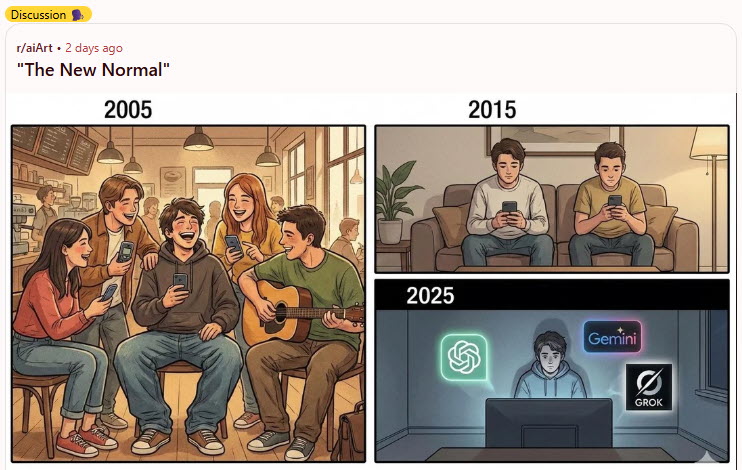
There is an unrelenting hype-cycle of what AI can do online, and a lot of money being spent right now on artificial intelligence and their underlying large language models to prove capability and influence investment in more AI. The problem should be obvious but apparently isn’t: AI isn’t a creative tool – it only renders likely answers and images based on what it is trained on. It steals the intellectual property of large groups, is programmed algorithmically to respond in certain ways that can be adjusted up or down (the presumption is to remove bias but it is definitely used to increase bias, avoid facts, and particularly to promote ideology and platforms). AI has no consciousness. AI has no morals. AI is not intelligent, but can utilize layers of decision making filters that give the appearance of intelligence. AI is not creative, but can utilize the same layering method to “predict” what a requestor is asking for. All of this machine learning is built on the stolen data of real people. In worse cases, the machine learning is based on unclean data, or utilizes data pools that include AI-generated content that in turn feed the language model.
As an example, Reddit began charging for large-scale API access in July 2023, and part of the justification was that companies were using data on the site to train LLMs. Two years later Reddit is filling up with AI-generated content. We have AI companies paying Reddit to train their LLMs on AI-generated content, that will influence the results of AI-generated content we see on Reddit, that in cycle train new LLMs. We are at the cusp of an AI circle-jerk of the magnitude which we have not seen.
There is rapid societal change in that technology is becoming a primary source of news and interaction. Our US government is structurally degraded and moving further into a state of collapse. Our media sources are becoming more consolidated and biased. Our educational institutions are being attacked. Our economy is falling apart. Job loss, the overall mental and medical health of US citizens is worse, and the disparity of wealth is overwhelming.
As a person living in 2026, where are you now in all of this? How are you meaningfully engaged to your family, to your local community, and to the nation-at-large? If you are the heads-down, jesus-take-the-wheel, job-hugging sort… that may be your coping mechanism to get through all of this. But for the rest of America, we’re in a hole that’s growing deeper, and it won’t be long before the bottom falls out.
If you’re with me, know that we’re all feeling the pressure.
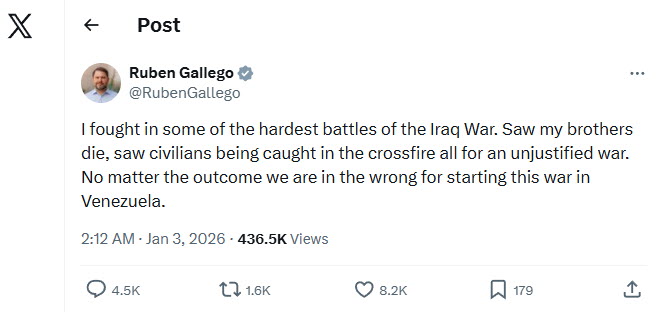
On the evening of Friday, January 2, 2026 the United States invaded the country of Venezuela in an act of war and in violation of international law; and arrested Venezuelan President Nicolas Maduro along with his wife Cilia Flores. The act has already been condemned by our allied governments in Mexico and Brazil. The European Union has called for de-escalation. Russian, Iran and Cuba have all condemned the hostile invasion of a sovereign nation.
Brazilian president Luiz Inacio Lula da Silva called the U.S. actions a “serious affront” to Venezuela’s sovereignty, the AFP reported. He said the strikes and capture of Maduro “cross an unacceptable line” and threaten “the preservation of the region as a zone of peace,” according to the AFP
The War Powers Resolution (50 U.S.C. ch. 33) is a federal law intended to check the U.S. president’s power to commit the United States to an armed conflict without the consent of the US Congress.
There was no threat from Venezuela, and regardless of Trump’s effuse arguments in the press conference, there were no actions that could have been interpreted as an assault by Venezuela against the United States. There was absolutely no criteria that would have legally granted the U.S. any right to invade another country, or depose its ruler.
U.S. Aggression
The United States and the Trump administration have bypassed Congress and violated international law. That is what is happening right now in the United States.
Invaded a sovereign nation
Engaged the military of another nation, and killed citizens of another nation without provocation
Deposed its leaders
Taken over economic operations of the country
References
2026-01-03: Headfirst Into War (contrarian.substack.com) “The dangers to Americans in Venezuela and elsewhere, the potential for chaos or the ascension of an equally bad or noxious figure, international isolation and rebukes, and magnified economic uncertainty are all possible.”
I think the most prescient topics to address in 2026 all deal with digging ourselves out of the mire of the first year of a Trump administration, defending ourselves from another 3 years, and ensuring that our political processes are intact for a fair 2028 federal election cycle.
There are just so many bad things here, and it’s not just a Trump sighting in the Whitehouse. The long game of the conservative right is in view, and they act like there is nothing we can do about. 2026 must be our reckoning through mid-term elections. 2028 is far enough away that it will not matter if we do not win seats this year.
The absolute ugliness of 2025 is remarkable. Internally we are divided. What made America great – our diversity, our people, our freedom – is dead. Externally our (then) friends are our (now) enemies, and our (then) enemies puppet our leader by taking advantage of his hubris.
We have some of the most inept, deceitful and profiteering people at the helm of critical government structures, and we’re watching them tear apart those institutions. We literally have Trump tearing down the Whitehouse while he tears down our economy, while he tears down our people, while he sends AI videos of himself pouring shit on US citizens.
There are WAY TOO MANY egregious violations by this administration but we can start by naming a few things:
Health and Human Services, Medicare and Medicaid
Education programs and funding
Immigration policy
US AID
Labor, Equal Opportunity
FCC, Public Media funding, and license allocations
EPA
National Park Service, BLM
Federal Reserve, Dept of Treasury
I haven’t even mentioned the US as a good neighbor, or the US as a representative of global democracy. The ability of the Trump administration to turn the US on its heel to become an antagonist in global government is profound and of long-lasting negative consequence.
We are no longer a nation that can be trusted. Trump doesn’t care. His cohort are all thugs and monsters and sycophants. Americans need to be sick of his shit and shamed that it got this far.
The Impact of AI to Intellectual Identity, Environment, and Economy
The emergent threat of artificial intelligence cannot be overstated.
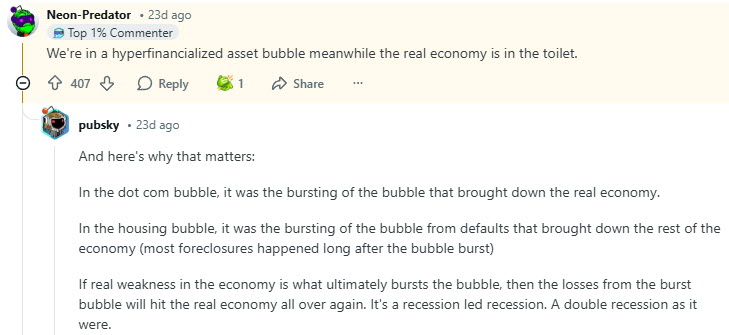
There is an AI-hype bubble designed to siphon money, land, water, power, and data (all things we should be incredibly reticent to give away), with the express intent of stealing intellectual property, surveilling citizens, and controlling narratives. AI has a unique capacity to algorithmically produce bias at scale. There are no regulations governing AI in the US, and even though the European Union has produced its EU AI Act: first regulation on artificial intelligence it does nothing to control what takes place in technology to the west of the Atlantic.
AI is being used to build rhetoric, create dissension through rage and misinformation, spew AI-generated deepfakes, and most importantly keep you engaged. AI is the “Soma” that Aldous Huxley describes in Brave New World; a drug to escape reality, ensure constant happiness (or constant rage), a means of self-validation, and effectively act as a tool for social control.
Regulations for Block-Chain and Crypto
Crypto is highly susceptible to fraud and abuse, and it’s appropriate to protect consumers with financial regulation in digital currency and digital payment platforms like Venmo, Paypal and Stripe. Entities that offer accounts with financial balances, linked institutions, transfer capability, debit or credit card type instruments or allow any form of account management in fiat OR cryptocurrency platforms should be regulated and insured in the same way that banks and credit unions are currently insured. Because crypto value is purely speculative, create floors and limits that will protect investors from
Controlling Rabid Reaganomics
Trickle-down economics is a fantasy, and one that built on the lie that deregulation and lower taxes for the wealthy would result in investment and economic growth. Reality shows that the wealthy simply consolidate their wealth and move to control the levers of power (policy, media, and monopolization).
The odd thing we keep hearing is how government would be more effective if it were run like a business; but the purpose of government is to better the lives of its citizens while the purpose of business is to seek profits for its owners. These entities are diametrically opposite of one another, and there is no business model that would administer both. You can be fiscally responsible and a humanitarian, or you can run a business. It’s an either/or situation.
In short, there is no philanthropy in capitalism.
Re-Balancing Ethics and Power
There is a willful disregard by elected officials to not fend our republic from oligarchy. Holding officials accountable to their actions, enforcing or calling-to-reign the authorities of the executive, legislative, and judicial branches, and supporting the independent authority of organizations empowered with investigative, health and regulatory commissions is a minimum requirement of any office holder. We are sorely lacking in both backbone and integrity for this to happen, and the obvious response should be to vote them out. We need candidates who will compete in races, that will stand up for what it right (not what is convenient, or what is profitable to them personally) and represent the Constitution of the United States they took an oath to defend. That document is going on 239 years in the making – here’s the reminder that “freedom isn’t free”.
The sheer grift in politics has to be curbed at the same time.
This means ending Citizens United. End corporate money. End dark money. End PACs and PICs without traceable sources. Impose sever limits on corporate lobbyists.
This means governance and rules on financial instruments that currently have no regulation (and I’m primarily speaking of crypto, but includes membership in distributed autonomous organizations (DAO) that use block-chain to obfuscate its members).
This means ending trading and investments of elected officials, their families and entities during a candidacy, tenure and following exit from public office.
This means full divestiture of any conflicts of interest, whether noted or “found”.
This means imposed limits on any form of gift or exchange to a public official or their family members
and this means the authority to prosecute and convict individuals who are found in violation of any of these breaches of policy.
Campaign financing needs reform as well.
Cap campaign spending. Limit sources of contributions, and establish standard limits for campaign contributions. Allocate a public square to level the playing field for candidates within a campaign. Stop commercial ads on television, radio, streaming media, and social platforms.
Tax, Tax, Tax the Rich
We’re watching the ultra-wealthy influence our administration through bribes and flattery to gain controls in data, media, and investments.
Implement a flat tax for the ultra wealthy, simple as that. Instead of using their money for influence peddling, let them pay taxes.
Defend, Defend, Defend Voter Representation and Rights
There are fraudulent schemes across states and nationally to strip voter rights away through gerrymandering, constitutional changes at the state level, willful misinformation by conservative parties, and by sowing distrust in reliable voting systems, including vote-by-mail and the voter ID system. One of the greatest threats to our system is allowing one party to usurp the power of voters by articulating the boundaries of voter pools and strip voters of their constitutional rights to vote for their elected officials. We need to fight like hell to make sure that our inherent citizen rights are not lost to a group that would otherwise manipulate and control its constituency for its own advantage.
It will be interesting to see how this develops (update: Stephenson filed as a candidate on January 6). The Utah GOP typically want to work through the caucus process to nominate their candidate. I suspect that Stephenson will be on the ballot using the signature-gathering process due to the conflict of ultra-conservative caucus delegates who are likely not going to support anyone other than the incumbent. What’s principally at issue for Stephenson is labor support and Teuscher’s opposition to it. He really needs to be on the Republican primary ballot in 2026, and to do that it’s necessary to bypass the rife-stridden caucus system.
My real question here is whether sheer ignorance from voters in HD44 keeps Teuscher in office this time. They have a viable Republican challenger in front of them. What resonates about Teuscher that his constituency would keep him in place? There isn’t much.
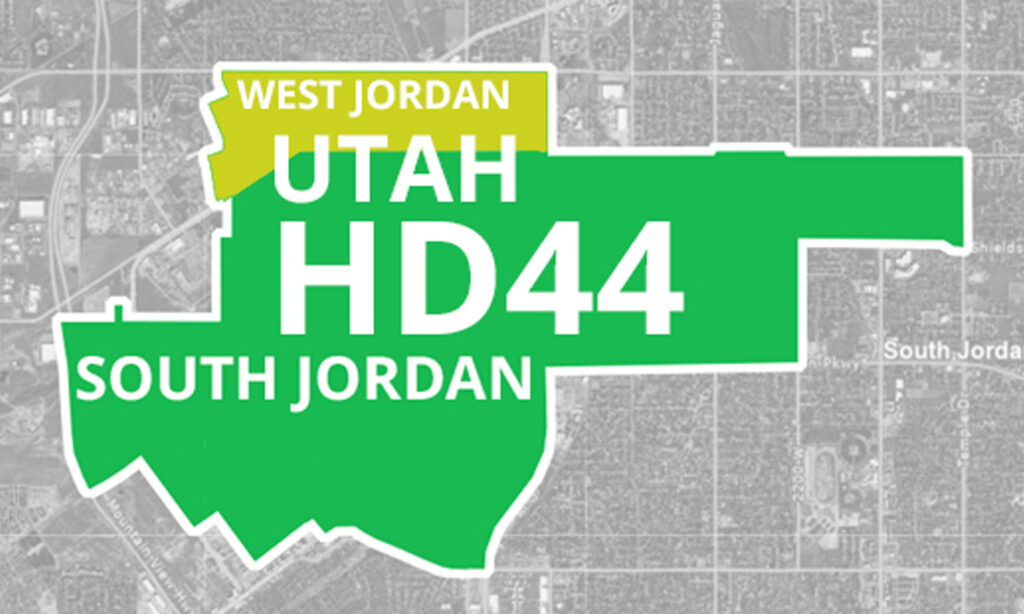
Utah House District 44 is a primarily residential district that carefully carves out a portion of the Daybreak community in South Jordan, and combines that with the north and west of the city, and the southwestern edge of West Jordan city. Jordan Teuscher is the current Utah state representative of HD44, and has been successfully elected by the constituency there in the past 3 election cycles.
House District 44 is primarily white, older, and conservative.
There is strong interest in undeveloped real estate, managed growth for the city, preservation of “neighborhood character”, opposition to high density housing or adopting zones for additional family units
Limited taxation.
There is only a single fire station, but no other municipal buildings.
There are no federal facilities.
There are eight public schools (elementary and middle schools) and one public charter school. Jordan Education Foundation, part of the Jordan School District, recently moved its operations within the district boundaries after relocating to the old Walmart shopping center across from Elk Ridge Middle School.
Three red-line Trax stations sit within the district boundaries (Ballpark, South Jordan Pkwy and 4800 W Old Bingham Hwy), but there are no significant UTA public transit routes, except those that border the north boundary of the district along 9000 South. HD44 is essentially a public transit dead zone.
Teuscher is the principal of the Conservative Millennials PAC. Note his working group includes House Representatives Candice Pierucci, Anthony Loubet, and former House Representative Kera Birkeland.
Teuscher is propped up by Real Estate (see his disclosures page), and you can bet that will be a point of contention between him and Stephenson. Valuation, Zoning, Land Use, and “Neighborhood Character” are going to come into play with South Jordan residents
Teuscher plays ball with the Miller family (pun intended) with financial contributions from The Larry H. Miller Company and through close work developing the new Salt Lake Bees stadium in Daybreak (and now the principal commercial development within House District 44)
Teuscher is an incumbent, and that means his lines of support will run deeper than normal. He has tangible supports from US Rep. Burgess Owens, Utah Senator Lincoln Fillmore, Utah Senate President Stuart Adams, Utah House Speaker Mike Schultz, former Utah House Speaker Brad Wilson, and Utah AG Derek Brown, among others.
Teuscher has supports within the Utah Tech Leads (UTL) / Silicon Slopes policy groups – note that the groups are defunct but the people who ran them are active – based on his advocacy and advancement of DAOs, block-chain and crypto policies in Utah (see the Blockchain and Digital Innovation Task Force)
Some of the biggest in-kind donations for Teuscher in 2024 came from the Utah Taxpayers Association, and the Utah Republican Party.
Don’t Forget His Endorsers
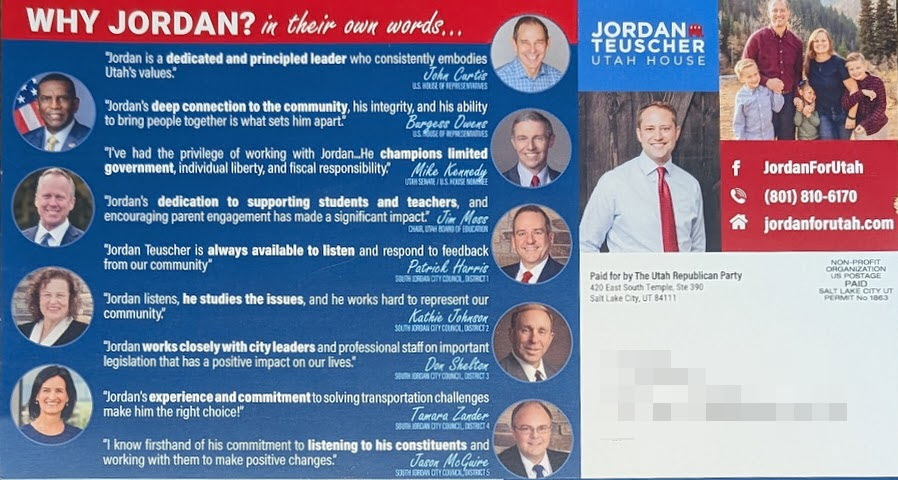
Late in the 2024 campaign the Utah Republican Party sent out this flyer with named endorsers who voiced support of Teuscher. This is the level of embeddedness that Stephenson will need to uproot during his 2026 campaign to replace Teuscher.
John Curtis, US House of Representatives
Burgess Owens, US House of Representatives
Mike Kennedy, Utah Senate (now US House of Representatives)
On December 31, 2025 NPR published an article under its “What it Takes” series at His brother’s mental illness isolated his family. Now he’s helping other caregivers. My family is part of the story. We were picked up after answering a survey on caregiving that NPR posted a little over a year ago to “tell us your story: How did caregiving change you? How do you cope with the hard parts? What have you learned that you’d like to share with others?”
My Advice from the NPR Survey
What lessons have you learned that you want to share with other caregivers?
Take care of you. It’s easy to be overwhelmed, frustrated, ashamed, sad, or angry. It’s also easy to let your physical and mental health slip. Look for spaces where you can give yourself priority. Incorporate activity in your day, and find things you love. If you have depression, talk about it.
Seek out your tribe. Find and surround yourself with people who understand the diagnoses you are caring for. The ability to talk with others who not only understand, but can empathize and respond meaningfully matters.
Find local resources (Parent Center, Disability Law, Legislative Advocacy Groups, Charitable Support Groups) to be involved with. They will help you with valuable advice, direction and resources when you need them.
Plan far ahead for what your person may need. Medicaid qualification, Dependent Services, Social Security benefits, Guardianship, Housing, Estate Planning all requires extensive documentation and may have extensive wait periods.
It’s critical to allow your person to self-determine, but know that you are also their best advocate if/when they can’t represent themselves
Learn about the condition, and options for treatment. Be open with treatment providers. If you are a parent/guardian or have permission from the patient to talk with doctors or counselors, use that to discuss concerns. If you don’t have authorization to receive information about a patient relationship, you can still provide information to treatment providers to better help them understand an issue or concern.
Journal relevant thoughts, and look back. Journals can be for your feelings, progression of treatment or documenting a condition. These notes can be invaluable when you talk to a doctor or are qualifying for a resource.
What has been the hardest part of being a caregiver?
Dealing with depression, and having no-one to talk to. Frustration when you can’t get treatment or support. PTSD from events that happen as a care-giver. Anger at “the system” whether it’s insurance coverages, hospital policy, or legislation/funding that negatively affects your loved one, or having resources taken away that you depended on unexpectedly.
If you’re new to caregiving, what questions do you have about it?
I’m definitely not new. My primary advice here would be that friends who knew the “healthy” you, or before you became a caregiver will often disappear. People will say incredibly insensitive things, or make opinions where they have no understanding/expertise to say anything at all. Be critical of advice (not skeptical, but critical) and confirm with qualified research and/or professionals, even if the advice is from within your tribe/group. Be willing to look for new ways to do things. Look into clinical research.
Featured Voices of the Article
My family’s role in the story is to be the “stranger in the story” and to provide an anecdote illustrating what the other subjects offer: data, experience or action. I’m familiar with and a strong supporter of NAMI, and for the Caregiver Action Network.
⬆️ Christine Crawford, National Alliance on Mental Illness (NAMI) https://www.nami.org – NAMI works to educate, support, advocate, listen and lead to improve the lives of people with mental illness and their loved ones – See: Mental Health Education, particularly the NAMI Family-to-Family course. – Consider: NAMIwalks 2026 is a friendly, low-barrier way to connect in your local community. You can register and attend an upcoming walk in your area.
⬇️ Mitul Desai, The CareHack https://www.thecarehack.com – Based in New York, currently working with a multi-state practice and launching a Medicaid-funded project in New York. CareHack is focused on working with “big players in for-profit health care systems”, i.e. insurance companies and large practices – their solution is based on a framework with predictive AI and human coaching
Additional References
I would really recommend checking out these links, and supporting the work of these groups. If you take anything away from this, recognize that there are three absolutes of care: face the difficult topic, keep your heart, and always advocate.
✅ Film: No One Cares about Crazy People, by Gail Freedman https://noonecaresfilm.com/ – a feature documentary film about the tragedy, crisis and chaos of severe mental illness in America, and a national crusade to do something about it
✅ Film: UNSEEN: How We’re Failing Parent Caregivers & Why It Matters https://caregiverdoc.com – Many caregivers for children or adults who are disabled or medically complex are exhausted and isolated. The mental, physical and financial struggle of family caregivers costs us all.
✅Film: The Case for Kindness https://caseforkindness.com/ – Case for Kindness explores the profound impact of kindness on our physical, mental, and emotional well-being.
✅ Organization: National Shattering Silence Coalition https://www.nationalshatteringsilencecoalition.org/ – The National Shattering Silence Coalition (NSSC) is dedicated to dismantling the walls of stigma, isolation, and shame that surround critical public health and social challenges. Silence is not a passive state but an active barrier to healing, understanding, and progress.
🆕 Company: MyWhatIf Foundation https://mywhatif.org/about/ The company provides a self-help AI tool (chatbot) for mental health services.
My reading of late has been moving away from the traditional analytical non-fiction that I typically read, and is moving into what might be discovery, or distraction, or something like that. I realized recently that I’ve been interacting with an author on social media for a little bit – without having read any of her books – and solely by association through Jennifer Miller-Smith (who I owe thanks to). And that’s how I decided to read an urban fantasy book.
Before I start, I want to comment how there are three related topics that circulate in the book that really made me pay attention:
Facades, and whether we use them to charm, “shimmer” or repel others — particularly the way we try to blend and hide ourselves; — our inability to see ourselves as others see us; and the glimpses we gain of ourselves that can be startling and revelatory; — and, of course, the obvious characteristics and flaws we can’t hide from ourselves and others, that can be problematic to our own vision of who we are. — I associate this with the totems we create for ourselves? We either anthropomorphize or attach to stereotypes that ground and connect us. We want to look a certain way, or be perceived a certain way, so we work really hard to create the illusion of ourselves using things around us.
Our desire to find meaning through others’ stories and connection — using other people’s histories, and finding some reflection and acceptance of personal stories in your own past matters greatly; — how it takes time to process and cope with tragedy – that too often you have to be able to get through and turn around to look back to know what it was that you went through; — escaping suicide and its ideations by understanding that pain isn’t escaped, rather it is spread out
The idea of death, and moving between worlds, and what it means to be in between — there’s a lot to explore here that Arcadia gives room for; — some interesting comments, like p.85 “Lisa is still dead?” that just… raises questions.
It wasn’t just faeries and mythology either. I really admire the level of detail woven into the characters.
delving into physical rehabilitation and the use of prosthetics;
learning about nuances of BPD, with some reflections that felt too harrowingly close to how I have interpreted interactions and mentally processed my life so far;
the acts of compartmentalization; coping; distracting and the benefits of therapeutic practices at work, and the reason mind and the emotion mind;
what it’s like to work in systems with unknown rules and suffer consequences; and
the need for psychological constructs, familiars, muses, and echoes.
I also really loved the neurodivergence on display. I encourage you to go find Abigail and her one-liner.
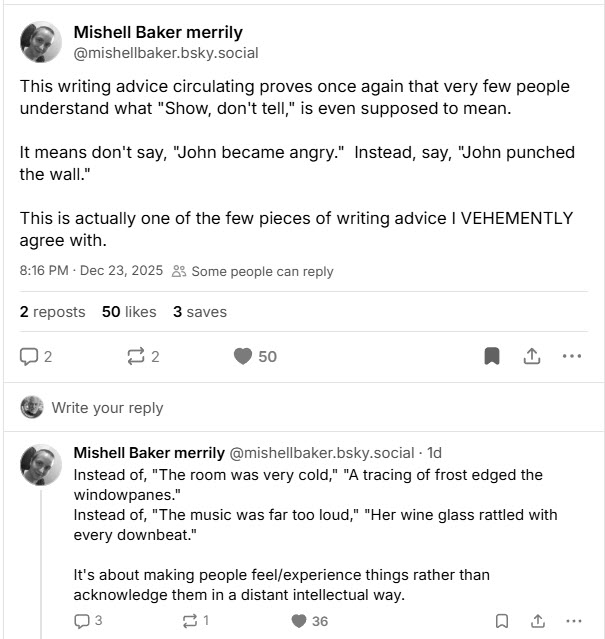
It’s surprising how much a book can draw you into its space, and that’s improved when the author shares really insightful comments about how she writes to improve a reader’s perception and experience.. a little of that brilliance shared on BlueSky:
An Interwoven World
The interweaving of folklore, faeries and mythology was actually fun to read. I’m not generally a fiction/fantasy reader by default, so Baker’s descriptions and character’s postulating on “what makes the world” created some nice interconnects. As a new reader in the genre I appreciate that she took time to explain some things that wouldn’t have held glue in my mind.
Some Savored Quotes
I really don’t want to ruin anything, but I really need to impress the thoughtfulness and reflection in the story writing. These page references are from the Saga Press softcover, first edition:
p33. “Suicide is not a way of ending pain; it’s just a way of redistributing it.“
p112. “I’m not inclined to elect you arbiter of normal.“
p134. “…the Borderline apology that means I’ll lie and say I was wrong, just don’t leave me.“
p302. “Long after you quit feeling that glorious rage, your words linger.“
p302. “Memory is a sketch artist, not a camera. People add and subtract whatever detail they need to. They say they forgive you, but they don’t. “
Millie’s Work
The Stone Guest (Millie Roper) – is a movie created by Millie Roper that received attention before her life profoundly changed. P222 describes it as a story of a young heroin addict trying desperately to connect with her estranged mother after her father’s death.
If there’s any sort of knock-off from the Arcadia project, that’s a storyline I’d love Baker to flush out.
David’s Work – The Cotton “Trilogy”
Blue Yonder (David Berenbaum) – Millie is 10 when her dad (still living) takes her to see this
Red Cotton (David Berenbaum)
Accolade (David Berenbaum)
Black Powder – work in post (David Berenbaum) – Millie is 26
I’m including the movie titles and some ages for Millie to give us an idea of the works referenced. I’m honestly not sure what to infer from the movie titles. There are indications of a much more expansive career to Berenbaum’s timeline but these are the notable films for the book. I think it’s interesting that the intended “trilogy” ends with Accolade, which is noticeably less well-received than the first two films, and followed by a fourth unofficial return-to-namesake movie titleage. I’m pretty sure I’m missing something important.
Summary (of Sorts)
I really don’t know how to do reviews for fiction, but I thoroughly enjoyed this book; and I plan to read more of the series. Her stories are well-constructed and provide plenty of circumstance to self-apply and be thoughtful about.
FWIW, it’s now shared in the Little Library in my front yard. Good books are always worth sharing.
Reference
The Arcadia Project series is made up of Borderline, Phantom Pains, and Imposter Syndrome.