Believe We Can Win This

It would be unusual. Utah House District 44 is a red district carved out in 2020 specifically to make it a safe Republican district. Jordan Teuscher has won two elections, first in the old District 42, then in the new District 44. He is the incumbent, a native Utahn, a lawyer, a member of the church, and a Republican. All of these traits bode well for a politician seeking votes from the voter base in South Jordan and West Jordan. It would take monumental effort, or possible re-districting, to move constituents towards another candidate.
But 2024 is not a usual year. Partisan politics have become historically raucous. Natalie Cline, then a member of the Utah State Board of Education, was censured for social media attacks against a high school athlete who she insinuated was transgender (the player is not, and that shouldn’t have mattered regardless; the fact that Cline would go after a high school student and draw dangerous attention towards her was unacceptable). The legislature holds the ability to impeach a public official, and although there were vocal calls that Cline should be impeached, the GOP majority could not muster the backbone required to impeach one of their own. The Utah GOP moved decidedly right at convention while the Republican base grew weary of the rhetoric – more moderate candidates like Spencer Cox and Celeste Malloy collected signatures to guarantee that their names would survive convention to appear on Republican primary ballots. The Republican convention produced a number of hard-right candidates like Phil Lyman and Trent Staggs who would eventually lose against their more moderate opponents.

General Session kicked off with bills attacking individual rights. At the beginning of general session this year, Utah House Speaker Mike Schultz started the legislative agenda to drive through GOP-sponsored bills whose language originated from outside of Utah: an anti-trans bathroom bill; shutting down DEI in public schools; and book bans. Utah followed a string of conservative states like Oklahoma, Missouri, Florida and Texas that pushed the same copy/paste legislation.

Jordan Teuscher also re-introduced his signature anti-union legislation that actively worked to dismantle worker rights for public employees, but this was killed due to overwhelming opposition from the public. Teuscher was also the sponsor of HB185 ‘Primary Ballot Requirements’ to remove candidates who qualify through signature gathering process, which also failed. This would have affected all parties, but particularly the Republican party. The Republican delegates are much further right than your regular Republican in Utah, and in a closed primary they were attempting to change the rules to make it more difficult for moderate Republican candidates to participate in Utah’s election process.

It was not a good start. Someone commented that the six weeks of general session was six weeks of responding to bad ideas.

Thankfully, there are checks and balances. It was after a number of Utah Supreme Court decisions (first to uphold an injunction against the legislature’s anti-abortion trigger law, and shortly after determining that the gerrymandering case against the legislature had legs and could continue to be actioned in a lower court) that the Republican-led House decided to call an emergency session. What was the emergency? The will of the people, apparently. During the session, Jordan Teuscher was the House sponsor for SJR401, which would change the Utah constitution to remove the people’s legislative power of citizen initiatives. Teuscher was also the House floor sponsor of SB4002 House Sponsor of ‘Ballot Proposition Amendments’ to enable jamming through Amendment D, and Amendment A in 2024, which were both voided by the Utah Supreme Court. The worst part? In what should be called an ethics violation, Senate President Stuart Adams and House Speaker Schultz wrote particularly misleading ballot language that described Amendment D as the opposite of what it was; a power grab by the Utah legislature.

What was the emergency? The will of the people, apparently. Rep Jordan Teuscher leads when it comes to taking away the rights of voters and obstructing candidates from public office.

Utah voters are frustrated by the extreme partisanship of the Republican legislature. Their inability to self-manage outrageous behavior in their party, followed by egregious attempts to dismantle personal rights of Utahns, then disrespect voters with outright lies and a request for us to vote against our personal interests, is pushing constituents to look closely at their representatives and claimed party values. The Republican party even admitted to its own over-reach as it attempted to gaslight voters.
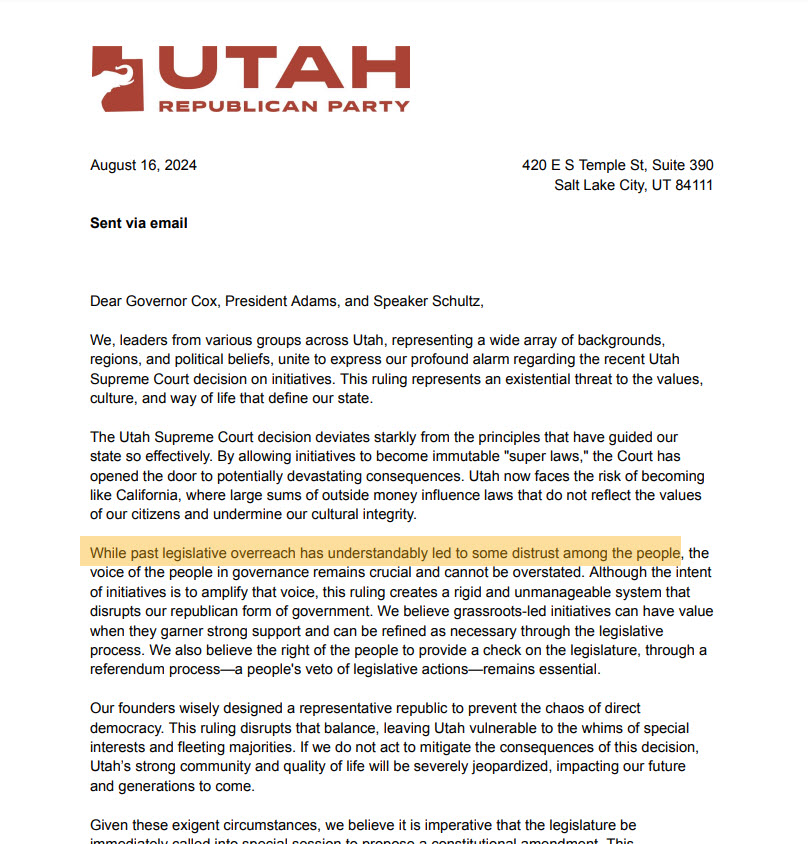
The Utah GOPs under-statement of the year.

We need real representation. The Republican legislature is betting that they will survive the 2024 election cycle so that they can continue to introduce more bills sponsored from out of state, that work against the better interests of Utahns and don’t reflect who we are.

There were no Republican candidates who challenged Teuscher this year. Third parties decided not to back a non-partisan candidate in this race, likely because they didn’t see an investment in what was considered a safe red seat. I joined the race as a protest vote, but have found support after the series of events (above) that were hand-delivered to me by the Republican party. In fact, they are nervous enough to start throwing money at the end of the race to stabilize their (now questionable) candidate.

We are closing in on the last week of the election cycle. Less than half of the voters in the House District have cast their votes so far (filter on HD44), and I will be lucky to see narrower margins than were in the past against my incumbent opponent. I’m here to say that we could win, if enough voters are tired of the litany of bad bills, expensive litigation, constitutional violations and breaches of individual rights that the Utah Republican party has produced this year. Teuscher is a primary sponsor of some of the worst bills. We can continue to fight his bad ideas in the legislature, or we can unseat him and bring in a new representative who will defend voter rights, and begin to work for the people of Utah.

We can win this. One of the constitutional powers you have is to elect representatives. That power can also be used to unseat a legislator who doesn’t represent your issues and values. Please use that power. I’m asking you to use your voice and vote by Tuesday, November 5… and I would truly appreciate your vote.

Be well (represented)!
Notes of Thanks

When I started running for office on January 5 this year, I was starting a long learning curve to onboard as a candidate in the Utah political scene. Every day was something new for me, and at times it was overwhelming to consider what was left to accomplish before it was over. As we get to the end of this campaign I want to give thanks to the people who were my tribe for this work. I would not be here without them.

First and foremost, my family Angela, Risa, Natalie and Aaron deserve recognition for putting up with me throughout this whole thing. Campaigns are stressful, and they have seen every side of me since I filed to run. Thank you for your support, and your patience, and for putting up (to here!) when I could only take so much sh!## during the campaign (that’s a Eurovision Song Contest reference). Angela was always the one to tell me to hold on and think about it before I pressed the ‘send’ button. Natalie was and is my manager of social media. Risa and Aaron were the willing volunteers at every corner of the campaign.

Dr. Lori Taylor – without Lori’s mentorship and guidance I would not be here. Without a co-commiserator and planner of things, I would not have any of my wits left. Lori’s commitment to the party, her persistence in fighting for principals, and the immense respect I have for her are what led me to joining to become a house district vice-chair, then a candidate for the Utah House District. I have leaned on, texted, called and spent time with Lori more than anyone else throughout this campaign. She is always clear, she is willing to say the things I don’t want to hear but need to hear, she is honest, and she truly cares about what we’re doing; and that makes her invaluable to me. Thank you, thank you, thank you Lori.

Rep Ashlee Matthews – who calmed my panic and doubt, who talked me through the first days and shared her story, then encouraged me to find my voice so that I could build a message that would resonate with voters. I am deeply grateful for her time (all during the 2024 general legislative session) to speak with me as I was starting my candidacy.

Catherine Voutaz – whose always-positive and always-pragmatic outlook offered fresh perspective when I needed to hear it, and whose organizing capacity for the southwest region candidates was astounding. She shared her experience and brought candidates together so that we could leverage our campaigns more effectively for city and county events. She helped me understand that positive, consistent outreach was critical is setting paths for conversations to build.

Wendy Davis – who first shared her experience in her book The Fight You Don’t See, then provided one-on-one discussion about outreach and data analysis so that she, Lori and I could design a strategy for outreach in HD44. Her education, political background, experience, empathetic guidance and assurances were invaluable to me. I’m indebted to her kindness and willingness to talk.

Darlene McDonald – who embodies the spirit of democracy. Darlene connects my community together like no other because she has gone before me and made the road that I follow. She and I have a bunch of connections, the least of which I look like Michael McDonald, and she’s married to a Michael McDonald. Seriously though – I’m indebted to Darlene for being someone that I can talk to at any time, and she’ll be there.

Amber Hendrix – from the Salt Lake County Democratic office, who I found trust and alignment with. Amber navigated me through questions and concerns about party operations, and was a voice of reason throughout the campaign. Amber did a lot of the lifting in the campaign with her outreach and engagement on behalf of the Democratic party that was essential to getting things done.

Jennifer Miller Smith – who is an absolute gem because her cause is true, her commitment is high, and because she is straightforward and plainly speaks her case. I admire her integrity and the number of roles she fills in places across the democratic party. She truly embraces democratic values. She supports her causes with a passion I have yet to see from anyone else.

Jade Velazquez – from the Salt Lake County Democratic office, who has a plan and the persistence to see it through to a successful end. He also works with grace and humor, and is an example that we all can follow.

Sen Luz Escamilla – whose gift was to spend time with me at a Union meet and greet to clarify my message and better understand how to communicate with voters. She didn’t know me, she corrected me when I thought she was Angela Romero, and she was graceful enough to still give her time and some highly needed instruction to a new candidate. I am sincerely grateful, and I won’t mistake her again when I meet her.

Jacob Lawson – who has the ridiculous capacity to always, always engage where he needs to be. Jacob was my outreach and my eyes in voting districts. He constantly asked what could be done, and was essential for lit drops and canvassing in South Jordan and West Jordan. In my campaign, Jacob is the face of the new generation of politics coming to Utah, and I can’t be more proud to have him as part of the team.

Olivia Anderson and Elliott Kauffman – from the Utah State Democratic office, who created training and delivered candidate fundamentals to me and a host of new candidates at all levels. I really started to get a better picture of everything that needed to be done as we walked through weekly trainings and Elliott’s fun storytelling.

Scott Bell, who literally brought the bell. Best volunteer and hang-out partner for sign pickups. He has a great background story, and there’s even a story about the bell. He’s engaged and supports area candidates, and he shares ideas. We need more people like Scott who jump in and help out any time. He is also a great Sunday coffee house partner.

Kate Staples, who I have mad respect for. She began in a 3-way race for HD39 and had to deal with some brutal political BS at the start regarding staying in the race as a Democrat or working with a campaign strategy to back an unaffiliated candidate. She made a difficult decision to withdraw, but one she was able to be comfortable with. She was ethical, she earnestly campaigned, and her decision was based on what was best for her and for flipping the district. I know that was difficult, and she did it with grace. She also has the best shoes of anyone in this list.

Joel Frost, Sheila Srivastava, and Kent Setterberg – part of the Fantastic Four for county elections, these three were regular engagements for me in campaign events, and I needed a little of their good energy. Joel is the consummate dude, Sheila has the engagement, and Kent is the warmth and heart of good politics. I appreciate all of the work you have put in, yet still had extra to share on the campaign road.

Mimi Setterberg – who deserves recognition on her own for starting and running a campaign from scratch. She is the person behind Kent’s campaign, and truly is up and coming with the work that she has put into things. I’m excited to see what she does in the future.

Eli McCann and Skylar Westerdahl – for opening up your family to meet with me, and giving me an opportunity to talk with Republicans in my District. Your level of trust, and willingness to introduce me to neighbors is something that I’m grateful for. You work in the principal of kindness first, always.

Brad Asay, who was the first person who told me that he thought I could win. I didn’t say it then but I was truly grateful that you got behind me and supported my campaign. Those words mattered greatly then, and your hands-on support afterwards was motivating to me. Thank you.

These are individual thanks, and there are rightfully more who aren’t here. I will probably publish this and realize who I left out (and I apologize for that).

My message here is to recognize that this campaign, and my work is a collaboration. Almost everyone I mention here are new to me since January, but they have leaned in and offered advice, or their experience, or their support and their hours to help me get here. I can’t do this alone. It’s 10 days out from the general election today, and I’m counting on your votes to finish this. Regardless of where the election goes, know that I am grateful to those who stepped up.

Your voice matters, and your voice is your vote. Please vote this election cycle.

Teuscher is No Friend to Teachers

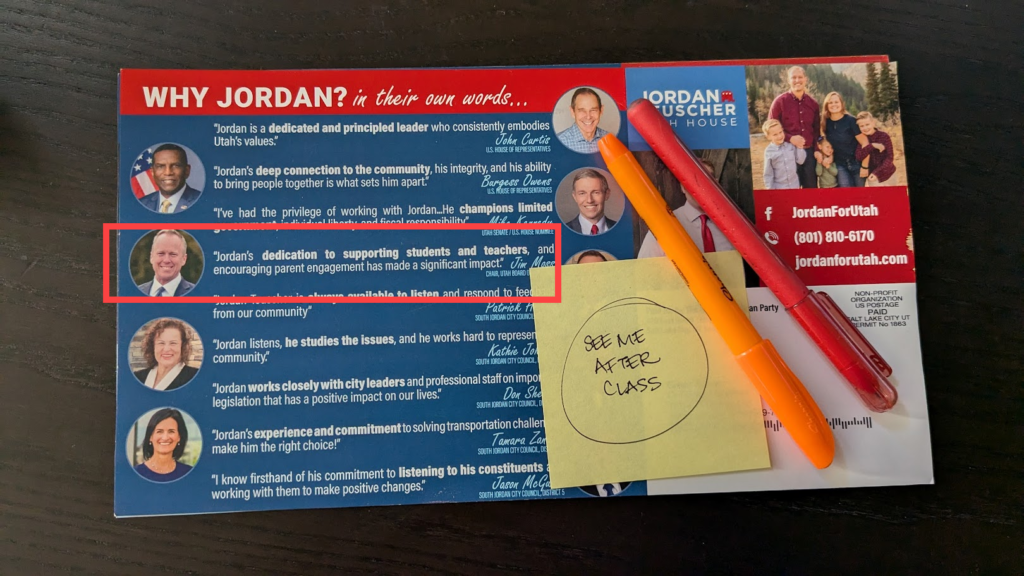
Recently, I was surprised by a tone-deaf endorsement of Teuscher from Jim Moss @epsomjrm, Chair of the Utah Board of Education @utboardofed. Jordan is no friend to teachers or to public schools. Why Jim endorsed a legislator who attacks public employee interests, defunds public schools, and hasn’t bothered to be present at any of the public schools in his district during his entire tenure in the House is the poorest and most partisan thing he could do as a board member of USBE.

Jordan’s dedication to supporting students and teachers, and encouraging parent engagement has made a significant impact.” – Jim Moss, who clearly doesn’t know what he’s talking about

Teuscher is no friend to teachers

Jordan has repeatedly attacked public employee associations, including teachers associations like the Utah Education Association (UEA). During general session this year, Teuscher wrote HB285 to make it more difficult for public employees to organize and collectively bargain for safe working conditions, decent wages and benefits, and legal protections. In 2023, he wrote HB241, an anti-union bill designed to starve public unions of money and kill their ability to operate at all in the organizations they serve. Both bills failed to pass due to overwhelming opposition.

It’s worth noting that I have endorsements from the Utah Education Association (UEA), Jordan Education Association, Utah Parents for Teachers, and the American Federation of Teachers (AFT).

Teuscher wants to defund (not defend) public education

This is what Jordan Teuscher said when talking about the 2023 HB215 Utah Fits All Scholarship voucher program:

“as these students come out of public schools, a lot of time, and I’ve heard this from teachers, a lot of times they’ll have to spend, you know, 80% of their time on 20% of the students because it’s just not the right fit. You know, maybe they have a disability or, you know, a learning challenge or something, they don’t learn the same way. And so if we can get those students into schools that focus on that need, and then the teachers can spend all their time dealing with the other 80% of the teachers [sic] it’s a total win-win for everyone. And that’s what I intend, that’s what I hope to see as it moves forward.“ – Jordan Teuscher

Teuscher writes poor legislation that gets tied up in courts

  • Teuscher wrote HB464 to allow parents to sue social media companies, and SB194 (i.e. the Utah Minor Protection in Social Media Act) that successfully passed but was immediately challenged in courts and subsequently blocked for violating first amendment rights. In the court’s response they stated “The court recognizes the State’s earnest desire to protect young people from the novel challenges associated with social media use,” … “But owing to the First Amendment’s paramount place in our democratic system, even well-intentioned legislation that regulates speech based on content must satisfy a tremendously high level of constitutional scrutiny.”

Although it’s good to protect our children from online harms, we need competent authors for legislation who aren’t simply showboating for votes, then leaving us with costly court fees.

Teuscher wants guns and religion to replace diversity and free expression in schools

  • Teuscher supports book bans. HB029
  • Teuscher supports muzzling teachers first amendment rights (HB303 and HB477)
  • Teuscher voted against diversity training (HB111) and against DEI initiatives (HB261)
  • Teuscher voted for guns in schools (HB119)
  • Teuscher voted for the anti-trans bathroom bill (HB257)
  • Teuscher voted for indoctrination in public schools (HB269 and HB514)

The bottom line: Teuscher doesn’t care about public employees, including teachers. He doesn’t care about our system of public education and is willing to undermine its funding and supports. How a USBE Board member could endorse him as a candidate is antithetical to the interests of public education, and disrespectful of the community of educators who represent and defend public education in Utah.

As a Republican Party Member, Here’s Why You Should Vote for Me Instead of Jordan Teuscher

Hello – 

I’m writing to you because you are an important member of the Republican Party in Utah House District 44.  I know that you are a committed member of your party, but I’m asking you to consider voting for me – a Democrat – in this election.  There is good reason.  

For the past two elections, the incumbent Jordan Teuscher has represented South Jordan and West Jordan communities in House District 44, but he’s failing to serve constituents here. He doesn’t represent our values, he doesn’t serve our community, or the interests of Utah voters. I’m asking you to vote for what’s best for you, what’s best for our district, and what’s best for Utah by helping me unseat Jordan Teuscher this election.  I’m reaching out because I want to drop the rhetoric and focus on what’s best for Utahns.  

Teuscher leads, and actively works against Utah voters better interests, including yours: 

  • Teuscher was the House floor sponsor of SJR401, which became Amendment D to strip Utah voters of legislative rights (This was blocked by Utah Courts on Sep 12, 2024 for deceptive language, and for not following due process) – he now says that he will run it again
  • Teuscher was also the House floor sponsor of SB4002 House Sponsor of Ballot Proposition Amendments to jam through Amendment D, and Amendment A in 2024, which are both voided on our ballots. 
  • Teuscher voted for HJR14 to make it more difficult for Citizen Initiatives to pass (Failed/Not Passed)
  • Teuscher sponsored HB185 Primary Ballot Requirements to remove candidates who qualify through signature gathering process (Failed/Not Passed). This affects the Republican party, and as much as you may be vested in your closed primary, he’s attempting to change the rules to make it more difficult for Republican candidates to participate in Utah’s election process. 

Teuscher is writing bills poorly that are caught up in expensive legal battles that Utah eventually loses:

  • Teuscher sponsored the Minor Protection in Social Media Act (Blocked by Utah Courts for violating 1st amendment rights) – this was a good idea but executed poorly because it ignored first amendment rights in the bill language.
  • Teuscher defends Amendment D (which I tear apart here) with misinformation and lies. The cost for taxpayers to write the bill, publish on ballots, defend lawsuits and ultimately lose BADLY is not just embarrassing, it’s expensive. 
  • Teuscher also decries the Utah Supreme Court decisions to allow the Gerrymandering case to proceed in the lower court, as well as the injunction upheld by the Utah Supreme court on Utah’s trigger law.  Checks and balances are expensive when Jordan is involved. 

Teuscher actively works against the better interest of our public (state, county, municipal, school and first response) employees 

  • Teuscher was the sponsor of HB285 Labor Union Amendments to weaken public employee rights (Failed/Not Passed).  
  • He repeatedly submits bills that dismantle worker rights, and he consistently targets our public employees every time. 

Teuscher doesn’t care about religious freedoms

  • Teuscher was the House floor sponsor for SB150 Exercise of Religion Amendments to protect discriminatory acts based on religious belief (Passed)
  • Teuscher voted for HB269 to add Ten Commandments to public school curricula (Passed, expect civil liberties groups to file suit)

Teuscher doesn’t support our Public Schools

At the very minimum, find out what I want to do as your state representative, if I’m elected. https://utah44.com/proposed-2025-legislation/

If you made it this far, thank you.  We need a better voice in the Utah legislature. I’m asking you to consider making a vote for me based on your conscience and for better engagement. 

Be Well, 

Greg Green
Candidate, Utah House District 44 running against Jordan Teuscher

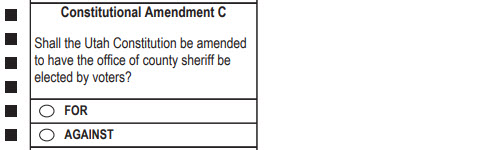
What About Amendment C?

The best explanation is that Brad Wilson sponsored the bill before he left for his Senate race so that he could curry favor with rural Republicans, who embrace the idea of a Constitutional Sheriff. Of course, Brad lost any more opportunity when his campaign didn’t survive in the Republican Primary to John Curtis.

The bill originated as 2023 HRJ010, and was one of the last bills that Brad Wilson sponsored before he left office last year. In the October 4 podcast of City Cast Salt Lake, Robert Gehrke of the Salt Lake Tribune opines that it was downplayed.

Wilson says it doesn’t really change anything, but there is this undercurrent, this philosophy in conservative circles of a constitutional sheriff, which says that the sheriff is the supreme law of the county. This kind of plays into that. You can’t have a constitutional sheriff unless your sheriff is in the constitution. – Robert Gehrke (paraphrased)

The Constitutional Sheriff movement is about sheriffs having the power to interpret and enforce the constitution. Amendment C has nothing to do with sheriffs enforcing the constitution or giving sheriffs extra power. But it does embed the election of the Sheriff in Utah’s constitution, rather than simply have a law in Utah code. And Gehrke’s line of thought supports this idea of a Constitutional Sheriff in Utah.

Another suggested explanation for Amendment C was that Republicans were angry with Salt Lake County Sheriff Rivera, and threatened to change the law to make Sheriffs appointed instead of elected so they could remove her. However this doesn’t make much sense. The appointment would be by the local authority, and Salt Lake County is predominantly Democratic. By election law, impeachment is still possible. Republicans in the legislature know this, and with Brad Wilson and Stuart Adams as sponsors, there is zero chance that they were seeking to preserve Sheriff Rivera’s electability.

2023 was a tumultuous year for the Salt Lake County Sheriff and UPD. It’s worth noting that 2023 HB374, sponsored by Rep Jordan Teuscher, removed the Salt Lake County sheriff as CEO of the Unified Police Department and ultimately dissolves the agency in 2025, leaving Holladay, Midvale, Millcreek, Kearns, Copperton, White City and Magna to find new law enforcement services.

Rivera opposed the Teuscher bill to separate UPD from the Sheriff’s office in 2023, then decided she was okay with it. I’m wondering if this is another case where the GOP did something and she was like, what the hell but okay.

For the record, the Salt Lake County Democratic Party does recommend a “For” vote. I requested more information, and this statement was provided:

“As the Salt Lake County Democratic Party, our primary role is to support Democratic candidates who serve our community, and we are proud to stand behind Sheriff Rosie Rivera. Voting “Yes” on Amendment C is crucial because it ensures that the position of sheriff remains an elected one—decided by the people, not appointed by officials. By doing so, we protect the democratic process and safeguard the accountability that comes from direct elections. This is not only important for Sheriff Rivera, but also opens the door for more diverse candidates, including women and people of color, to compete fairly for the role. A “Yes” vote on Amendment C would enshrine in the state constitution that every county will elect a sheriff to serve four-year terms. This maintains the voice of the community in choosing its leaders and supports a fairer, more inclusive system of representation.”

Both side provide similar arguments on how elections or appointments make the community better. Elections allow anyone who meets qualifications for the office to run and hold the position, and are considered “safe” from political disputes while in office. This also means that an elected sheriff can run off the rails (think Joe Arpaio in Arizona) and not suffer consequences. Appointments make a sheriff more accountable to leadership and the community but can become tangled in political controversy. Appointments are more likely to be a cis-gendered white male, so if diversity is your thing you may want to elect your sheriff.

We don’t have a clear picture of the “why” behind this amendment, but it’s safe to say that the need to transform how a sheriff takes their role in Utah counties isn’t at risk today, and has little chance of being altered as a law in the future. Changing Utah’s code so that the election of a Sheriff is written into the Utah Constitution seems to only serve the narrow purpose of making right-wing conservatives think they are one step closer to having their version of a Constitutional Sheriff within Utah’s borders.

There isn’t a clear picture on whether to vote “For” or Against” Amendment C, but I am voting against it without a compelling reason to change the existing law.

References

Salt Lake Tribune 2024 Legislative Candidate Survey


For transparency, I am providing my answers to a survey from the Salt Lake Tribune so that my positions on these questions can be shared with constituents.

The Salt Lake Tribune is reaching out to competitors in this year’s election to help voters understand candidates’ policy positions in the Salt Lake Tribune 2024 legislative candidate voter guide.

To make this easy for candidates and readers, we’ve created a simple Google form with open-ended and yes/no questions. The open-ended questions have a character limit to ensure fairness in answer length for each candidate in the race. Questions that require written answers will be edited for grammar and clarity.

Jeff Parrott, The Tribune’s politics editor, can respond to any questions, concerns or comments and can be reached at jparrott@sltrib.com.

Responses will appear in https://www.sltrib.com/politics/voterguides/


1) Utah’s largest electricity provider has canceled plans to replace its coal-fired power plants with nuclear power and has walked back comments about investing in clean energy. Should Utah be looking for more sustainable and less fossil fuel and carbon-dependent energy sources? If so, how? (150 chars)

Answer: We need to embrace clean energy by investing in development of clean energy tech & producing jobs to replace economies built on fossil fuel industry.

2) Water scarcity continues to be a challenge for the state. Recent legislation has attempted to conserve water and to get more water to the Great Salt Lake and Colorado River. Should Utah do more to subsidize homeowners’ efforts to conserve water? What other steps should be taken to deal with water scarcity? (250 chars)

Answer: Water rights are coming to a legal loggerhead, and we need to prepare for a revision on shared water resources. Reshape ag with less water intensive crops and stock. Revise community plans to support water conservation and more shared spaces.

3) What policy changes would you support to address Utah’s affordable housing crisis? (250 chars)

Answer: Infrastructure (public transit/broadband) to incentivize suburban growth, revised permitted use for combination business/residential, improve multi-generational tenancy & ADUs, home improvement programs, small home (<1200 sq/ft) and starter incentives

Oct 8 update (not part of my survey response): I met with some homeowners who had concerns about zoning changes in South Jordan residential properties that could negatively impact lifestyle and traffic in their area, and agree that these are legitimate concerns. Planning commissions are a first point of contact for residents to discuss city and county strategies, but there should be priority given to existing residents who wish to keep existing zoning laws that protect their investment in spacious communities that afford privacy and quiet space.

4) Following the Utah Supreme Court’s recent decision to keep a near-total abortion ban blocked, anti-abortion lawmakers and advocates called for additional legislative action to circumvent the court-ordered injunction. Would you support banning abortion after six weeks? (Y/N)

Answer: No

5) Would you support a state constitutional amendment to ban abortion? (Y/N)

Answer: No

6) Should there be other restrictions on reproductive health care — especially fertility treatments like in vitro fertilization? (150 chars)

Answer: Services need to be generally available to the public that start with appropriate sex education in schools, and no bans on reproductive health care.

7) Are you voting for or against the constitutional amendment that removes the requirement that income taxes be used for education and social services? Why? (250 chars)

Answer: Against. Legislators want access to spend that money, and force public education to compete in the general fund. This is one more step to dismantle public education in Utah.

8) A Utah judge has voided Amendment D and said votes for or against it cannot be counted, but the state is appealing. Do you support changing the Utah Constitution to guarantee that the Legislature can repeal or amend ballot initiatives? (Y/N)

Answer: No

Bingham Creek Library Republican Townhall

PREFACE

On Saturday, September 28, Sen Lincoln Fillmore, Rep Susan Pulsipher, and Rep Jordan Teuscher held a townhall at Bingham Creek Library in West Jordan. The recording we captured is below, and starts at question #3 because we arrived late. I start with my own comments before linking audio, and leading into a summary of the discussion.

MY TOP PRIORITIES
My obvious first objective is to unseat Jordan Teuscher. Having said that, my top priorities for 2025 would be as follows, noting that in the past Utah’s General Session is 6 weeks of responding to bad ideas:

  1. Support redress following a court decision on LWV Utah v. Utah State Legislature by re-implementing the Independent Redistricting Commission, then implementing maps based on their recommendations before 2026 elections begin
  2. Address government overreach (citizen initiatives, defend constitutional checks and balances, private access to medical, first amendment)
  3. Address Prioritization of bills
    • When infrastructure bills are seconded to who is allowed to use a bathroom, we have a problem. When books are banned in public schools, when phones are banned but guns aren’t, we have a problem
    • When “good enough to get by” isn’t, we have a problem
  4. Support our public schools
    • Support their funding, support the teachers, support the librarians to do their jobs.
  5. Improve cost and quality of living
    • cost of living (rent/affordable homes), clean air, public access, transit, services
    • infrastructure project funding and provisions
    • address wait lists for disability programs (DSPD, Medically Complex Children’s Waiver, Assistive Technology)

AMENDMENT D

On Amendment D, the Utah Supreme Court said:
“The peoples’ right to alter or reform the government is constitutionally protected”

  • There are no “superlaws”. There have never been any foreign interests introducing legislation through Citizen Initiatives into Utah
  • The Utah Supreme Court noted that the Legislature cannot overturn or repeal an initiative without a compelling reason
  • Utah is 2nd to Wyoming in the nation for restrictions on passing a citizens initiative
  • In 2018 there were 3 ballot initiatives: Redistricting, Medicaid Expansion, Medical Marijuana. None of them were implemented as passed.
  • There is a national trend in Republican states to make it harder to pass initiatives.

LWVU v. LEGISLATURE
“Therefore, we hold that when Utahns exercise their right to reform the government through a citizen initiative, their exercise of these rights is protected from government infringement. This means that government-reform initiatives are constitutionally protected from unfettered legislative amendment, repeal, or replacement. Although the Legislature has authority to amend or repeal statutes, it is well settled that legislative action cannot unduly infringe or restrain the exercise of constitutional rights. Consequently, when Utahns exercise their right to reform the government through an initiative, this limits the Legislature’s authority to amend or repeal the initiative. This does not mean that the Legislature cannot amend a government-reform initiative at all.Rather, legislative changes that facilitate or support the reform, or at least do not impair the reform enacted by the people, would not implicate the people’s rights under the Alter or Reform Clause. Legislative changes that do impair the reforms enacted by the people could also survive a constitutional challenge, if the Legislature shows that they were narrowly tailored to advance a compelling government interest.”

2024 BALLOT QUESTIONS

  • County Proposal 8 – FOR – reauthorization of the 0.1% ZAP tax
  • SLCO Bond $507M ($60/YR over 25 Years) – FOR
  • Amendment A – voided by the Utah Supreme Court on October 9, 2024
  • Amendment B – FOR – State School Fund from 4% to 5%
  • Amendment C – AGAINST – County Sheriff elections (currently elected in the state, not necessary to enshrine in Utah Constitution)
  • Amendment D voided by the Utah Supreme Court on September 25, 2024

FEDERAL LANDS
I think my time in office is going to be better spent on helping constituents in a more direct way like mental health services, education, housing etc.

Responding to comments from Sen Lincoln Fillmore about reclaiming the 70% of federal lands in Utah:

  1. Does getting back the 70% mean they want to get rid of Utah tourism money to the National Parks? How do we pay for the management of the lands?
  2. Does the 70% figure also include military bases like Hill and Dugway? Are we getting rid of those too?
  3. How will we keep lands public and at the same time increase our tax base?
  4. How will Federal jobs be affected? What is the plan to help all the people affected?
  5. Where is the money to cover lost resources? Are we going to buy them or rent them back? Like the 31 engines and multiple firefighting helicopters from the BLM? https://www.blm.gov/programs/fire/regional-info/utah

TOWNHALL QUESTIONS (RECORDED)

Q3: On Citizen Initiatives

  • Pulsipher – Legislative Process doesn’t mention appropriations and rules
  • Audience comment: “open” is not truly open when a supermajority owns priority and calendar
  • Fillmore – we’ve spent time on this, lets move on
  • Teuscher – brings up Social Media bill, thinks its a high risk. Wasn’t there in 2018 for the passing of initiatives, but legislature “compromised” the bill after it was passed, same with medical marijuana

Q4: On Better Boundaries
There is no parity for Utahns with redistricting where districts became “safe for Republicans”, that disenfranchised voters

  • Fillmore: who thinks that Prop4 Redistricting was going to be fair? Prop4 created the independent legislature, but no provision to adopt. Did the legislature following the intent of the voters? Fillmore scuttles the question
  • Fillmore: Medical Marijuana would have legalized recreational marijuana
  • Fillmore: REDIRECTS TOPIC – talks about Federal govt, Federal deficit, issue is 70% of land owned by Fed, no property tax, tries to tie this to education and property taxes.
    What about Amendment A?
    Audience comment: Federal Lands has nothing to do with Better Boundaries decision by Utah Supreme Court
  • Pulsipher: the legislature voted on it
    Audience comment: The *Supermajority
  • Fillmore: We answered the question
  • Pulsipher: something, something, “my reasons”
  • Teuscher: go to your legislator, worked on Salt Lake County, it’s a puzzle, didn’t like that his street could have been split but acknowledges others are impacted in exactly the same way.

Q5: Why is there such a disconnect between citizen initiatives and the legislature? Why would the Citizen’s Initiative pass, then have such little relation to what the legislature passes?

  • Pulsipher: In my years I have never had anyone approach to work with me beforehand (???) Why would she be approached if she won’t be friendly to the bill?
  • Fillmore: power allocation; “Voters elect, have initiative and referendum power” Doesn’t mention that the Utah Constitution says that legislative power is shared with the legislature AND the people. Doesn’t mention the Utah Courts disagree with Legislative overreach.
  • Fillmore: Federally, marijuana will likely reschedule in 2026 from schedule 1 to schedule 3 (note: marijuana has been available for several years as a prescription for epilepsy, it’s called Epidiolex)

Q6: Utah best qualities? Gov Cox says its the people of Utah

  • Fillmore: culture, families, volunteerism, charitable giving, good state policies. Likes to think it’s the church’s influence. Legislative staff is non-partisan, works for both houses.
  • Teuscher: Social capital. Good state processes, staff
  • Pulsipher: balanced budget is constitutional

Q7: On Amendment A
Education account – wants it to be used for other purposes, why?

  • Fillmore: voted to place it on ballot. The “problem” is income tax is growing, faster than population. General fund doesn’t have enough. Cut Medicaid or building roads, or public funds? (this is a lie) Gas tax, sales tax is shrinking.
  • Pulsipher: 2008 downturn of economy, taxes down so education cut, income tax is volatile. If you lose your job you still have to buy food, pay property taxes, more stable. (another lie about instability driving the trust fund – the fund has grown from $18 million in 1983 to over $3.3 billion in 2024)
  • Speaker: you’re changing the constitution, trying to open money to other spending

Q8: Venezuelan gang related shootings, suppressed in news, 100 ESL students in Jordan District schools that required the hire of additional staff, Utah as a sanctuary state, what are we doing about immigration?
Note: I’m sorry, but what?

  • Teuscher: Thinks it’s an issue. Emailing for details with Jordan School District but they are only providing aggregated data due to privacy concerns.
  • Audience comment: proud that we welcome immigrants who want to better their lives

Q9: Education: money going in vs audit of outcome?

  • Fillmore: Auditor monitors performance, this is measured
  • Audience comment: Graduation rate for Salt Lake County? (Jordan District was 88% – 2023) and more recent behavior problems in schools?
  • Note of interest: vouchers weren’t mentioned, but are not audited once funds are distributed.

Q10: On Traffic

  • Need infrastructure to accommodate growth, need East/West commute capacity
  • Fillmore: Bangerter to remove lights, MVC will take longer
  • Pulsipher: Bangerter is fast-tracked with extra money from COVID spending
  • Teuscher: looking for expansions on Redline Trax, bus services (improvements in public transit). There are 2 lines in South Jordan, but no bus service in Herriman or Bluffdale

Revolution Roadtrip

I started this campaign for Utah House District 44 on January 5 as a first time candidate. I’m running for positive change and better representation. Your vote on Nov 5 can be revolutionary.

Stay Diligent, Stay Active, Vote, Vote, Vote

Sirsy “Revolution” – lyrics here

2026 is going to be another politically charged election year, the foundation of which is being laid now. Amendment D was made void by the Utah Supreme Court yesterday, but expectations are that we’ll see it resurface in 2026. Another impactful decision made this week is for a district court hearing date of April 2026 to decide the suit on Utah’s abortion ban. This means that the injunction that allows abortion up to 18 weeks will remain in place through April 2026 when the case is heard. The other big issue that will carry over to the next election is the August decision by the Utah Supreme Court to allow a lower district court to rule on Redistricting, which is expected to pass.

Here’s What to Expect

Supermajority leadership is probably freaking out right now. You can expect four things to come from them in the next two years:

  1. Amendment D is not going away. At the soonest opportunity, it will come back as a ballot initiative in 2026 if the current leaders can make it happen. Republican leadership wants to change the Utah constitution to limit the will of the people, and effectively neuter Citizen Initiatives by allowing the legislature to override successful ballot measures.
  2. As a result of recent court decisions, the legislature will also look at ways it can reduce or limit judicial authority. They aren’t happy that their over-reach was checked. Their contempt is obvious in recent letters that unfairly admonish the courts, who reminded the legislature that they are accountable for government over-reach.
  3. The 2025 general session is expected to be filled with bills that introduce additional bans on abortion. These bills will attempt to affect the injunction in some way
  4. Once the redistricting suit is settled (expect that the lower courts will judge in favor of redistricting, and that will be appealed to the Utah Supreme Court), the legislature will do everything in its capacity to delay the redistricting process. A new independent redistricting commission will have to be set up and funded. New maps will be proposed, and the supermajority will drag its feet to make sure that the redistricting doesn’t happen before the 2026 election cycle. It’s very likely that we’ll have to submit another lawsuit against the Utah legislature to implement the court decision in time for new boundaries to be published for 2026 elections.

The supermajority in our Utah legislature believes that it isn’t beholden to anyone, and they have plans to keep scrapping with everyone, picking fights with the Feds, picking fights with Utah courts, and picking fights with Utah voters. Their goal is autocratic power for their vindictive, thin-skinned, power-hungry coalition of legislators. But we can stop them.

Vote Them Out

We are at the end of the 2024 election cycle, but the most important act you can do as a citizen is still pending – to vote up and down the ballot. Be informed, know the candidates, and vote for all of the races on your ballot, and be willing to vote out the bad actors who are actively working against the interests of We, the People.

  • Teuscher is an acolyte of the legislative supermajority, and needs to be voted out. He is a primary sponsor of copy/paste legislation that works against the freedoms of Utah voters, and he was the floor sponsor of the bill for Amendment D that would have stripped our voter rights. We need to unseat people like him and fill those seats with candidates who will defend our rights and keep us free of the kind of government interference that we are seeing from them.
  • Talk to your neighbors about important votes that will appear on the ballot, and make sure they know what’s at stake in this election. If you need talking points, you can refer to https://utah44.com/decision-time/
  • If you have time, volunteer with a campaign at https://mobilize.us/utahdemocrats, or contact Utah State Democrats or Salt Lake County Democrats to find ways that you can help.

Stay Engaged

We are winning battles, but the fight isn’t over.

None of this is easy, but it matters greatly to be involved and to be part of positive change. If we don’t fight to defend our rights, and if we don’t actively engage, then we give ground.

I started this article with a video of one of my favorite bands Sirsy playing “Revolution”.
Make it take an army to back you down / ‘Cause life’s marching on it’s not waiting ‘round/ So get up, get off it, and break some ground / Make your own revolution

Don’t lose the focus. When we fight, we win.

Let me say it again. When we fight. we win.

Now let’s go fight.

Life Lessons

1987. St George, British Columbia on my way to California

I was talking to someone today about “moments that change who you are”. I want to share a few experiences of mine that shaped who I am.

Lesson 1: Know Who You Are

My formative years were spent in Wasilla, Alaska. I was taking a US History class with Jeanne Krause as a student at Wasilla High School, and it was in her class that a challenge was given that I will never forget. She asked the class to describe one of our political beliefs. Then she asked why we believed it, and she kept asking us why. This is a concept of business inquiry called the “five whys” that attempts to discover a root cause/issue of a problem. I didn’t know that back then, but I eventually understood what she was doing. She was pushing us to really think about political stances we had adopted, and question whether those stances would, in fact, hold water when compared against our actual values. I was able to listen to other students describe their justifications, whether they actually explored the reasons or simply held firm without reflecting on “why”. I also had to think about my own stances, recognize what I was familiar with, what I might have simply accepted because it was convention, what I knew, and more importantly what I didn’t know but had assumptions about. It was an uncomfortable discussion, but I learned that I was responsible for questioning and testing my own perceptions. I learned that my opinion mattered. And I learned that part of growing up was becoming critical of assumptions and making choices based on my own values, that might conflict with others. I’m grateful to Ms. Krause for pushing us to look inward and outward.

I mention it here because we are in a really polarized election period, and it’s important that we (all of us) are thinking about our root values and making decisions based on what matters most to us.

Lesson 2: Do Something

When I was 12 my mother was diagnosed with an aggressive form of Multiple Sclerosis, and it had devastating impact on her life and for our family. One of the biggest changes for us was the relative abandonment of my mother’s friends, and of our church family. My mother had always sought a church where we lived. She started as a Methodist in her home town, and my earliest recollection was attending a Lutheran church when we lived in Minnesota. When we moved to Alaska she started at the Lutheran church in Petersburg, but found services uninspiring. We eventually settled into a membership with the Assemblies of God, and after another move to the mainland, found another AOG church. She loved to sing, and the song worship was one of the best parts of going to there.

When my mother was diagnosed, it seemed like everything changed. Friends would check in at first, but eventually dropped away. The church offered to help drive us to services, but it wasn’t dependable. My mother, with a wheelchair and kids in tow, were too much for any long commitment from other churchgoers. When we attended, one of the key messages that we would repeatedly hear was that if my mother truly asked god for forgiveness for her sins, he would heal her; that the endowment of the holy spirit upon her was a sign of her faith, and it was through god that she could live again. We heard this from the pastor, from the visiting pastors, from faith healers, and from the churches we were directed to when theirs didn’t work. In one of the last visits to a church, they were laying hands on my mother and yelling at her, commanding the demons to leave her body so that she could accept Christ. They tried to pick her up from her wheelchair to walk, but she couldn’t. As her 14 year old son, it was heartbreaking to watch this. When they were done the pastor told me that I had the patience of Job. I have never felt the urge to punch someone in the face more than at that time.

It was during this very difficult time in my life that I learned how cruel people can be, even when it’s unintentional. The church was not an answer. I was forced to become a caretaker for my sick mother at a very young age, and I also became a caretaker for my younger siblings. I learned by going through my own very difficult childhood that if I didn’t do the work, there would be no-one to do it for you.

I learned that bad things can happen to good people. I also learned that prayers only go so far. Prayers, if you believe in them, should lead to reflection, which should lead to resolution, which should lead to action.

The lesson here was and always will be to do something. For me, that meant running for office; and this year it means being informed and voting for change you want to see.

Lesson 3: Kindness Exists

When I was 19, and after my mother was moved to a long-term care facility, I wanted to escape by moving to California to attend college. When I left home, my father told me that I would “come crawling back” and refused to say goodbye. I was angry when I left home, and I was determined that I would not go back. Within a semester, my roommate who traveled with me gave up and asked his parents to come back home. I was alone, poor, working part time and trying to go to college. I couldn’t afford the apartment, and a room rental I had arranged after my roommate left fell through unexpectedly, and I suddenly had nothing. I found a room to rent from Helen, a bar owner who rented to divorced dads and heroine addicts who were in recovery, and I was grateful for the space because I had a room with a lock on the door, and it was my safe space. A friend of one of my sisters showed up unexpectedly; she was supposed to stay with me for two weeks and travel home. After several months, a disconnected phone for hundreds of dollars in long-distance calls, and wrecking my car, she was gone.

I was young, and poor, and angry. I had to drop out of school because I had to earn money for rent and food. I didn’t have a car. I had no friends, and felt like anyone who I met wanted something. The situation changed, but it wasn’t overnight.

  • My first job in California was working night security at Eden hospital. On my first night I was holding doors for the ambulance arrival of a vehicle accident that took place on the San Mateo bridge, and there were several injured that arrived and needed to be unloaded. A nurse was triaging patients and asked me to hold a baby (uninjured) that was in the party. The baby stopped crying as I held her, so she told me my job was to continue holding the baby. Seeing the trauma, but holding this infant was unforgettable.
  • Another job was working mornings as a stable person/groomer/trainer at Fairview Arabian Farms. The owner Marilyn was another parent figure who I learned to trust and talk with. She was kind, and she was someone who encouraged me to stick with it and be hopeful.
  • I was offered a job at a bank after working a couple of nights as a temp to conduct a phone survey. The bank manager heard me talking to customers and decided I was worth investing in. It was the first time that worked around other employees who really cared and looked after each other. It was also where I succumbed to watching soap operas (specifically Loving) so I could keep up with office chatter.
  • At that job, a bank manager who checked in on me as a father figure. He was Hindi. I knew nothing about his background, but he made sure to talk to me about life and our passage through it. I am grateful for him recognizing that I needed someone who could counsel and guide me.
  • I met an insurance agent who became a father figure to me when he recognized that I was struggling to make ends meet. He had a sardonic sense of humor (his regular joke was “better you than me, @$$hole” when he was listening to clients filing claims) but he was always kind, and he looked out for others.

It took a long time to get my feet under me, and I wouldn’t be where I am without the people who stopped to see me and do more than look past me. I am truly grateful for their kindness, and what it meant to me.

Lesson 4: Life Happens

Things go well, until they don’t. How you respond when things don’t go well is a testament to who you are as a person, the burdens you carry, and what shaped you. How you respond to others when things don’t go well for them is about your empathy, willingness to listen and understand, maturity, patience, with very likely some tolerance thrown in.

You have heard about #disagreebetter in Utah politics. That hashtag is used with sarcasm more than for encouraging real discussion. Know that how you respond, and how you respond to others matters.

Summary

Today is September 19, which means there are 26 days until mail-in ballots are sent out, and 47 days to the November 5 election. We’ve had some crazy turmoil in the elections, some of it good, some of it bad.

  • Know Who You Are, and know what matters most to you.
  • Do Something. Learn about candidates (it’s why I’m writing this) and what they stand for.
  • Seek to be Kind. Don’t make decisions based on fear and anger.
  • Know that Life Happens. This year has been a travesty in Utah politics. But there is something that you can do about it.

Be informed, and get ready to vote.