My reading of late has been moving away from the traditional analytical non-fiction that I typically read, and is moving into what might be discovery, or distraction, or something like that. I realized recently that I’ve been interacting with an author on social media for a little bit – without having read any of her books – and solely by association through Jennifer Miller-Smith (who I owe thanks to). And that’s how I decided to read an urban fantasy book.
Before I start, I want to comment how there are three related topics that circulate in the book that really made me pay attention:
Facades, and whether we use them to charm, “shimmer” or repel others — particularly the way we try to blend and hide ourselves; — our inability to see ourselves as others see us; and the glimpses we gain of ourselves that can be startling and revelatory; — and, of course, the obvious characteristics and flaws we can’t hide from ourselves and others, that can be problematic to our own vision of who we are. — I associate this with the totems we create for ourselves? We either anthropomorphize or attach to stereotypes that ground and connect us. We want to look a certain way, or be perceived a certain way, so we work really hard to create the illusion of ourselves using things around us.
Our desire to find meaning through others’ stories and connection — using other people’s histories, and finding some reflection and acceptance of personal stories in your own past matters greatly; — how it takes time to process and cope with tragedy – that too often you have to be able to get through and turn around to look back to know what it was that you went through; — escaping suicide and its ideations by understanding that pain isn’t escaped, rather it is spread out
The idea of death, and moving between worlds, and what it means to be in between — there’s a lot to explore here that Arcadia gives room for; — some interesting comments, like p.85 “Lisa is still dead?” that just… raises questions.
It wasn’t just faeries and mythology either. I really admire the level of detail woven into the characters.
delving into physical rehabilitation and the use of prosthetics;
learning about nuances of BPD, with some reflections that felt too harrowingly close to how I have interpreted interactions and mentally processed my life so far;
the acts of compartmentalization; coping; distracting and the benefits of therapeutic practices at work, and the reason mind and the emotion mind;
what it’s like to work in systems with unknown rules and suffer consequences; and
the need for psychological constructs, familiars, muses, and echoes.
I also really loved the neurodivergence on display. I encourage you to go find Abigail and her one-liner.
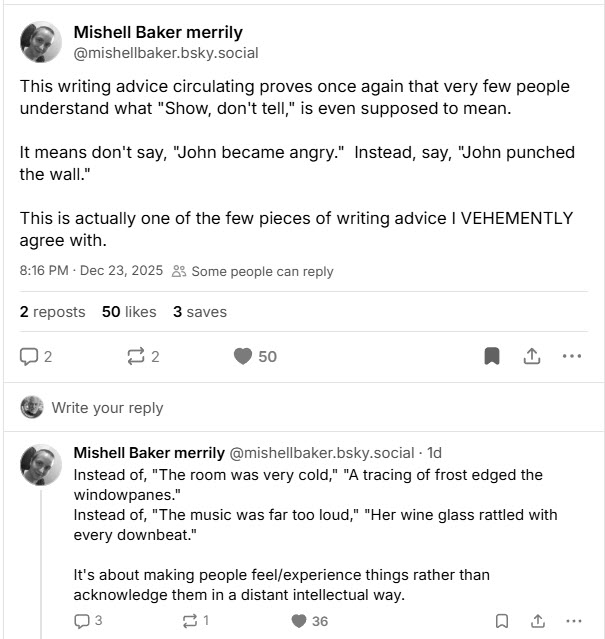
It’s surprising how much a book can draw you into its space, and that’s improved when the author shares really insightful comments about how she writes to improve a reader’s perception and experience.. a little of that brilliance shared on BlueSky:
An Interwoven World
The interweaving of folklore, faeries and mythology was actually fun to read. I’m not generally a fiction/fantasy reader by default, so Baker’s descriptions and character’s postulating on “what makes the world” created some nice interconnects. As a new reader in the genre I appreciate that she took time to explain some things that wouldn’t have held glue in my mind.
Some Savored Quotes
I really don’t want to ruin anything, but I really need to impress the thoughtfulness and reflection in the story writing. These page references are from the Saga Press softcover, first edition:
p33. “Suicide is not a way of ending pain; it’s just a way of redistributing it.“
p112. “I’m not inclined to elect you arbiter of normal.“
p134. “…the Borderline apology that means I’ll lie and say I was wrong, just don’t leave me.“
p302. “Long after you quit feeling that glorious rage, your words linger.“
p302. “Memory is a sketch artist, not a camera. People add and subtract whatever detail they need to. They say they forgive you, but they don’t. “
Millie’s Work
The Stone Guest (Millie Roper) – is a movie created by Millie Roper that received attention before her life profoundly changed. P222 describes it as a story of a young heroin addict trying desperately to connect with her estranged mother after her father’s death.
If there’s any sort of knock-off from the Arcadia project, that’s a storyline I’d love Baker to flush out.
David’s Work – The Cotton “Trilogy”
Blue Yonder (David Berenbaum) – Millie is 10 when her dad (still living) takes her to see this
Red Cotton (David Berenbaum)
Accolade (David Berenbaum)
Black Powder – work in post (David Berenbaum) – Millie is 26
I’m including the movie titles and some ages for Millie to give us an idea of the works referenced. I’m honestly not sure what to infer from the movie titles. There are indications of a much more expansive career to Berenbaum’s timeline but these are the notable films for the book. I think it’s interesting that the intended “trilogy” ends with Accolade, which is noticeably less well-received than the first two films, and followed by a fourth unofficial return-to-namesake movie titleage. I’m pretty sure I’m missing something important.
Summary (of Sorts)
I really don’t know how to do reviews for fiction, but I thoroughly enjoyed this book; and I plan to read more of the series. Her stories are well-constructed and provide plenty of circumstance to self-apply and be thoughtful about.
FWIW, it’s now shared in the Little Library in my front yard. Good books are always worth sharing.
Reference
The Arcadia Project series is made up of Borderline, Phantom Pains, and Imposter Syndrome.
What happened today could very well be a death knell for my son. The system does not care. The system is broken.
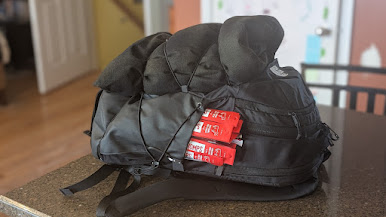
I received a call shortly after 5AM that my son has been arrested in south Salt Lake county for trespassing. My morning was talking with dispatch, one of the officers, and communicating to the rest of the family. My son has a mental illness and is homeless. When he was arrested they confiscated his backpack and sent it to the PD evidence room because he couldn’t bring it with him for booking at metro jail. I called the Metro Jail to try intervening and was on hold for more than an hour. In that time they completed processing him and “released him” (let him walk out) without a phone, without transportation, no money, and without his belongings. When I spoke to a person at the jail he had been released for more than 30 minutes. I spent the rest of the morning driving around looking for him, and couldn’t find him. I ended up buying a new backpack, warm clothing, a blanket and food so that I could give it to him if I found him. He will be outside tonight without his things. The PD office won’t open to the public until Monday so even if he was able to get down there again he wouldn’t be able to get his stuff.
I am broken. I’m overwhelmed because I don’t know where he is and I’m worried about his safety. This is what it’s like to have a family member with a mental illness.
Timeline
Sunday, Dec 14
5:15 AM – Received call from Riverton Police (I was asleep) that my son was arrested at approximately 5:12AM on Sunday Dec 14, 2025. He was in a construction site, likely trying to stay warm. He has a warrant for arrest (I didn’t know he had a warrant, I’m guessing this is due to a failure to appear for his previous trespass in SLC).
10 AM: Salt Lake Valley Communications Center (Dispatch) took my information and will have an officer call
10:14 AM: Officer callback. My son was charged with interfering with police (borderline resisting arrest). He walked up to a car with an undercover officer at the construction site, and asked for a cigarette; he was initially confrontational when the undercover officer turned on his police lights, and was swearing at the officer. This is why they charged him with interference. He was handcuffed, and “easier to deal with” after that. Note that my son is typically cooperative in police interactions.
I’m surprised that he told them to call me. He typically doesn’t want me involved in things.
The backpack is in Riverton PD (office is closed for the weekend). We will need to call and schedule with technician to retrieve his property.
I am informed that the jail will typically discharge after processing (later in the day)
10:22 AM: Attempt to call the Salt Lake Metro Jail. My call is disconnected unexpectly while in queue (twice); will try again later.
10:29 AM: Attempt to call the Salt Lake Metro Jail. The hold time: 58 minutes. I wanted to ask:
Is it possible for a Clinical Mental Health Therapist to refer him to a mandatory hold for mental illness? He is a danger to self due to inability to care.
Otherwise, will he be held in jail for a court appearance, or released?
10:41 AM: (While on hold with the Metro Jail) Email to admin@rivertonpd.org with info sourced from rivertonutah.gov/police to request that we obtain my son’s backpack from Riverton PD. Email bounced (email not valid). I forwarded to admin@rivertonutah.gov, ask them to fix the bad information on their site.
11:30 AM: Agent for the Metro Jail picks up, takes information. My son was released on his own recognizance at 10:55 AM – literally while I was on the phone trying to reach the jail.
11:55 AM: I drive down to Salt Lake Metro jail. I don’t see my son anywhere. While in the parking lot, I call Riverton PD and it goes to voicemail. I leave a message that I need to get my son’s backpack.
12 PM to 3 PM: I’m driving east-west on 3300 South, and north-south on Redwood Road looking for where my son may be. I stop at a store to pick up another backpack, warm clothing, an outdoor blanket, towelettes, cigarettes and food. At the end I drive through a couple areas where I have seen him before, but am unable to find him.
3:30 PM: I prep the backpack so that I can hand it to him if I find him. He doesn’t need to unpack anything, it will be ready for him to take.
I check for activity on his debit card and his SNAP card to see if I can locate him based on transactions. There is no activity. I don’t know if he has his cards and ID with him after they took his backpack. He does not have a phone.
I’m second-guessing myself, but I buy a Tile Pro to place on his backpack. In the event that I give it to him I may be able to at least know where he is, for as long as he has the backpack. It’s not hidden. This wouldn’t help me find him today if he already had one, but I may be able to use it in the future to locate him.
9 PM: No update. I’m hoping to hear from him, that he will stop by the house. At this point I don’t know where to look to find him. He could be downtown. He could have tried to walk back to south Salt Lake county, or just got on Trax.
Monday, Dec 15
I have not yet heard from, or found my son.
8:19 AM: Contacted Riverton PD and was routed to voicemail for the Evidence Manager. An appointment is required to pick up the backpack. I made the request and am waiting for a call back.
11:44 AM: Called the Riverton PD Evidence Manager again, went to voicemail (again). I stated that whatever was in the backpack is probably stuff that my homeless son needs to survive on the streets. I’m still waiting for a call back.
12:51 PM: Got the call back. I’m heading over to pick up my son’s backpack.
1:16 PM: The back pack has been retrieved. It had his social security card and his SNAP card. Now all that’s left is to find my son.
Thursday, Dec 18
9:54 AM: Call from Mountain America Credit Union, it’s my son. He wants to know if anything came in the mail for him because he’s trying to get a replacement debit card. I head down to his location, and we are unable to get a new card issued because he doesn’t have any valid ID with him. I have multiple expired IDs with his picture with me. I have my letter of Guardianship. They will not issue a replacement debit without a valid ID.
My son agrees to go with me to the DMV so that we can get a new ID issued for him. We get the ID, then to my bank so I can pull some money out for him, then return to his Credit Union so that we can (finally) get the replacement debit card issued. While there I deposit funds to his account so there is some money for him. I am also able to return his SNAP card and his Social Security Card, which were both in the backpack at the Riverton PD. I don’t know what happened to his original state ID or his debit cards.
He accepts the new backpack, but doesn’t want the jacket or the blanket I brought – he says it’s too much to carry around with him. He asks me to drop him off at the library because that’s where he wants to go. We finish up by just after 12PM and I let him go.
Saturday, Dec 20
1 AM: My son rings the front doorbell in the middle of the night. He wants to know if I can take him down to the police department to resolve his tickets. I tell him that the offices are closed, and we need to go down during the week when they are open. I encourage him to come back in a couple of days, or to call me where I can meet him so we can work things out. He does not have his backpack but at the hour I don’t notice, and only realize after he is gone.
10:30AM: I call the Huntsman Mental Health Institute to qualify when a mandatory commitment can be decided through their crisis intervention team. The person states that there is no condition other than “immediate harm to self or others” that might qualify. A wellness check can always be requested, but my son’s location would need to be known. Gabe’s vulnerability is his inability to care for himself, and his avoidance of shelters. He is currently sleeping outdoors on the ground and has no coat, and no blanket.
Monday, Dec 22
I confirm with the Riverton PD that their case went to Herriman Justice Court, and will not be adjudicated by Riverton. I contact Herriman Justice Court and confirm there are two case numbers pending disposition for Gabriel. I will travel down to Herriman Justice Court Clerk’s office to see what I can find out, but am hoping to bring Gabriel with me.
Gabriel does not come by during the week
Saturday, Dec 27
6:50 PM: It’s my son’s birthday. He stops by to ask if it’s his birthday, and laughs when I confirm that it is. I Invite him into the house, and he opens a card sent from his grandmother. There is money in the card, which he takes, but he doesn’t bother to read the card. I ask him if he’s going to read it and he says he can’t read. I offer to read it to him but he says no.
I give him a couple of packs of cigarettes, which he takes. He goes out to the front step to smoke. I call his grandmother and make some food in the microwave. He comes back in and sits down to eat. He partially converses with his grandparents on the phone. He is laughing, he has some ticks/clicks, and he has a cough.
I ask him about shelters and he says he just wants to sleep in the house tonight. I tell him he can’t stay here (past violence). He asks if I knew he was tased by South Jordan police. I ask him if he was talking about the time he walked up to a car to ask for a cigarette, and he confirms (it was the Riverton undercover PD, not South Jordan). I tell him we can go down to the courts during the week but he has to check in during the day when the courts are open. I ask him about his backpack. He says it was stolen. I ask him if he still has his ID and debit card, and he says those were stolen.
Update: I have submitted a GRAMA request for bodycam and vehicle footage from Riverton PD
Because I asked about shelters he thinks I’m getting angry. He doesn’t finish the food that I made and says he wants to take the soda. He is leaving. On his way out he says his name is ‘Rose’ now.
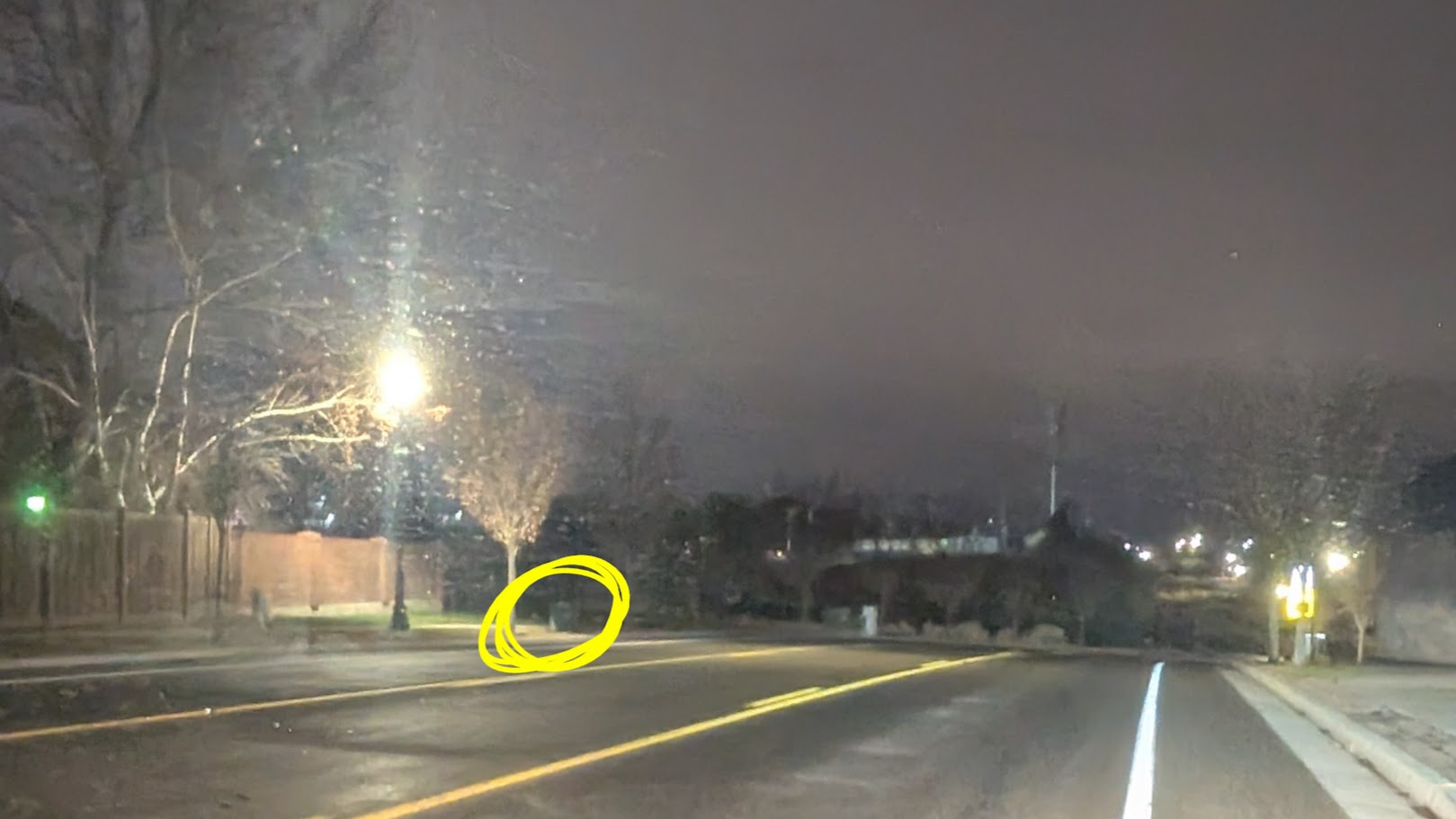
I had placed a Tile on the backpack before I gave it to him, so I look up the Tile and find it pinging where it appears to have been located for the past week and a half. I drive down to the location, and find the Tile on the ground. There is no backpack.
This is why more than CIT training is needed
The arresting officer very likely knew my son would be without anything when he took the backpack.
The metro jail did no assessment – at all – for his condition. He should have been referred to mental health services, but wasn’t.
When he was released, they literally told him to leave the building, with nothing. In December.
He was released on his own recognizance, with the understanding that he would show up for court later. He has no means of communicating (no phone, no email). He likely doesn’t know where to look for court records that will show when a hearing is scheduled. He is not accountable for schedules – and this is a condition of his diagnosis. He doesn’t have a case worker. I’m his father and legal guardian and most of the time it’s incredibly hard to find him.
The PD office is closed to the public on the weekend. He has no way to get his stuff back.
Because of his diagnosis he avoids people. He will not go to a shelter, especially when he feels vulnerable.
For context, I have an adult son with mental illness who is homeless, so much of the report resonated with me. It’s worth noting that my son is not a reliable source of information for his own medical history.
Here are a few observations:
Hospital Facilities don’t share information in local networks In four months, my son used emergency room visits that resulted in referrals to mental health hospitals.
None of the receiving hospitals had access to any continuity of care for my son. They didn’t know what medication had been used in prior visits.
They didn’t know if he had any medications in his system before treating him, and
They didn’t inquire to see if he had any history of hospitalization in the the local area so that they could coordinate services.
Case Workers and Care Givers have the same problem of zero notification If my son is receiving treatment elsewhere and/or has a case worker assigned, that person is typically not aware of any out-of-network activity. That means that hospitalizations for medical or mental treatment are unknown. It also means that violations, arrests, jailing, or court appointments are “unknowns” with particular impact to the protected individual, who is neither represented, cared for, or defended at critical times.
Hospitals use the “we can neither confirm nor deny” about patient admittance This is particularly aggravating. When I know that my son is admitted, I typically cannot see or speak to him because they won’t do so without a prior authorization from my son. I have called simply to provide them information, or to ask them to query my son for his approval. However they don’t want to even relay a message to the staff or to my son because that would be stating he was a patient. I typically have to say something along the line of “I know he’s there and I know you can’t confirm or deny that. What I’m asking you to do is take my message, and if you can route it to him, or to his treatment team, to do so. I don’t need you to respond one way or another, but I’m requesting you to take an action that will benefit a patient in your facility without acknowledgement otherwise“
I obtained legal guardianship of my son, and it’s still difficult to talk with care providers One of the main reasons that I sought limited guardianship was so that I could communicate with health providers, and assist in coordinating care. This does not mean I am notified at any time when he is admitted for treatment, so there is still a discovery process. Often times there is a delay while I provide paperwork/evidence of the guardianship, and I still receive pushback about what I can and cannot do based on interpretations of the limited guardianship.
Status of a Protected Individual should be a flag for hospitals to seek Care Coordination I don’t want there to be a “list” of protected individuals, and this scares me. I really don’t like that, at all… but there can be processes in place for treatment providers to create routine prompts with patients to determine if there is someone they should be talking to. This is complicated but needs to be discussed further.
There needs to be some separation about communication with caregivers, coordination of care, and decision-making ability on behalf of a protected individual. I am aware that this makes things more complicated, generally – and I’m also aware that risk-averse companies seek to protect themselves from possible violations of HIPAA law when processing privacy-related information. But the HIPAA laws are actually making treatment worse in some cases, and that needs to be addressed.
I am calling out the bullshit of Devon Kurtz, Policy Director at The Cicero Institute. Cicero Institute is responsible for pushing to get rid of housing-first solutions THAT WORK, and replace them with institutionalization through civil commitment and incarceration. I live in Utah where he/they have been actively working with legislators to push their agenda.
This is the Utah Homeless Services Board (UHSB) policy recommendation letter. Randy Shumway (Chair) wants a civil commitment facility (bad bad bad)
Note that this letter was heavily influenced by “wants” from Utah Senate Leader Stuart Adams and Utah House Speaker Mike Schultz that incorporated the July 24 Presidential Executive Order policy changes to move away from a housing-first policy that Utah has traditionally been a leader for, and previously shown great success in implementing.
the right-wing think tank Cicero Institute was involved in advocating for the policies that ultimately shaped the Presidential Executive Order “Ending Crime and Disorder on America’s Streets”
The executive order shifts focus from housing-first to institutionalizing homeless individuals with mental health and substance abuse issues
Critics argue the order fails to address root causes of homelessness and may increase untreated mental illness and incarceration.
The Executive Order represents the most sweeping federal pivot toward compulsory treatment and criminal-justice integration since the 1965 Community Mental Health Centers Act redirected asylums toward the community.
In isolation, the order risks exchanging tents for jail bunks and psychiatric wards without tackling the root supply constraints of therapy, housing, and peer support.
The recipient org (https://homelessutah.org/) is comprised of city and county mayors in the Salt Lake area. However I also recognize Wayne Neiderhauser from Utah Office of Homeless Services, who is a Non-Voting Advisor. He sits on the board of Utah Homeless Services Board Members (UHSB) along with Randy Shumway (executive committee chair), who is also the CEO of the Cicero Group.
“State officials have long followed a policy of getting homeless people into housing first, but now officials are weighing a system that focuses on behavioral health care and forcing more people into help. Such a pivot would put the state in line with a summertime executive order from President Donald Trump.”
When Gov. Spencer Cox was quoted in The New York Times saying Utah’s proposed partially involuntary homeless shelter is “a statement of who we are as a state,” Rev. Brigette Weier all but balked. “My Lord,” the minister said. “I pray that is not true.”
Shumway’s recommendations to respond to Trump’s executive order, calling for a “certified community behavioral health clinic” on the campus with 300 to 400 beds reserved for people who are civilly committed — or court ordered into mental health treatment. His proposal drew criticism and concern from some homeless advocates, who worried it would be wildly expensive and could create a chilling effect by building a civil commitment facility in direct proximity to homeless shelter beds.
Stakeholder presentations included Devon Kurtz of The Cicero Institute, who proposed to reallocate grant funds from SAMHSA Protection & Advocacy for Individuals with Mental Illness (PAIMI), and request engagement of the US Dept of Justice to build a framework for expanded civil commitment.
“With the Utah Homeless Services Board’s proposal of a new homeless services campus in the area we represent, we are concerned that this decision was made without any significant input from the public. As leaders and champions on issues of homelessness, we know how critical it is for our unhoused neighbors to have access to safe shelter and the services they need to regain stability. This campus is an important step in addressing the state’s homelessness crisis, but it must move forward in partnership with the people who will live alongside it.”
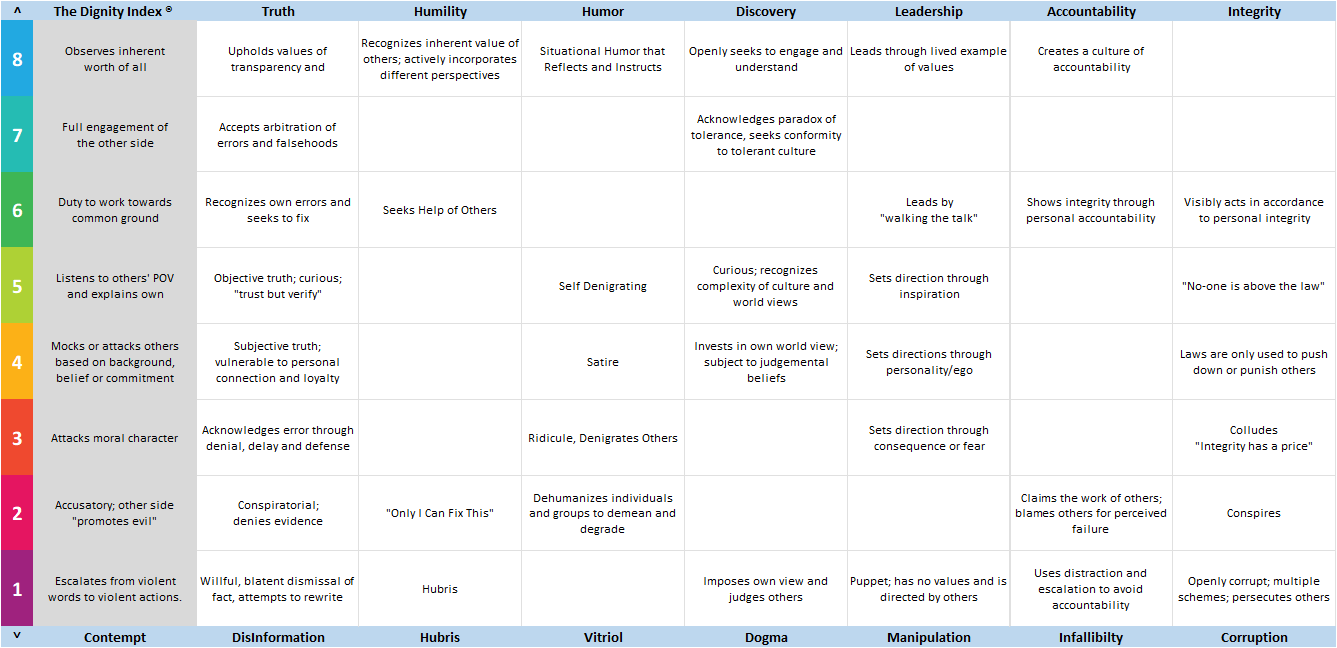
This is a continuation of thought after reading On “Dignity: Its Essential Role in Resolving Conflict”. The Dignity Index doesn’t address accountability. It makes no remark of the uses of power, or willful corruption, or malice. Dignity alone is suffering, and it makes no road to end that suffering except to endure.
There is so much more to address, and I don’t think that a dignity index is sufficient to resolve a root problem: people suffer from both words and acts; and there is no justice or safety found unless words make accountability from action.
I personally am confounded by the lack of response in the dignity movement about disinformation, corruption, conspiracy; and I’m not the only one struggling to understand how dignity alone can be a diplomatic bridge.
The success of a Dignity Movement is based first upon personal exemplification of Dignity. It is based on a hope that others will recognize that inherent dignity, then learn to see it in themselves. It is a desire for cultural adoption of a basic tenancy of human-ness in ourselves and others. It is a thought that shapes words, and it is an influence game.
But dignity does not solve problems. It is a bequest to treat others as you would like to be treated, a call to let go of umbrage towards your fellow man.
It does not fix aggression, or genocide
It does not resolve hunger, or suffering
It does not address corruption, or malfeasance
It does not address greed, or despotism
It does not address misinformation, or falsehood
The Dignity Movement will call as example the trials of Desmond Tutu, but it does not call out the sacrifice of Alexei Navalny. Dignity alone can just as easily amount to suffering as it can for change.
It’s More Than The Measure of a (Single) Man
What we need is more comprehensive than what a Dignity Index alone can provide. It is not sufficient to say the elements of dignity withstand when it does not address suffering, or complicity, or all the other things unaddressed.
We are imperfect, yet we strive to be better than who we are today. We can be personally accountable for who we are and how we act, but as social animals we recognize that there are constructs to society that must also be defended for all of us to find safety and opportunity.
I started a table of indices that matter. It’s just a start… but please, let’s start a conversation about this.
A society must agree on the limits in which it operates, but a society must also trust its members to act in ways that protect each others liberty; and in ways that promote general well-being. For this, we need to recognize the conditions of man, or more specifically the conditions that present themselves in absence of fulfilled need.
“It is an affirmation of values and hopes that I share with millions of Americans that sustain and motivate each of us to do his best, that give vigor and moral direction to our representative institutions. Public service has confirmed my faith in the potential of the human spirit, its generosity, its idealism, its capacity for growth, its resilience, and its infinite resources.”
Dignity is a thought that inspires words. For dignity to thrive, there must be actions that deliver its affirmation to all of us.
Why it Matters
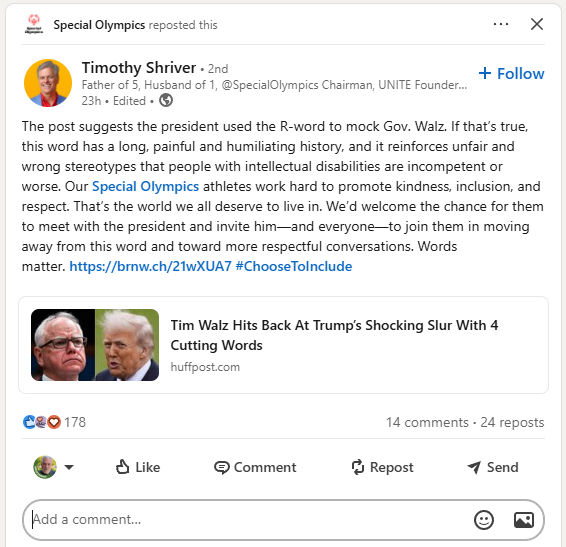
Language matters, but on both sides of the conversation. In reference to a Thanksgiving post from Donald Trump, the response from Tim Shriver was to use indeterminate language like “the post suggests” and “if that’s true”. There is clear evidence that it’s real.
What does the dignity index rank Trump’s own language? Why would that alone matter?
Did the response from Shriver make Trump accountable for his language?
Did it challenge his leadership in making such remarks?
Is there any question of the hubris required for Trump to say these things?
Trump’s cruelty is like a callus that needs to be torn off. We are hardened by it, and in permissing the language the callus (and the callousness) grows. Our responses should be direct when addressing the slight. If words are wielded as a cudgel by one party, we do no service in coddling our response to it.
Our clarity in the definition of egregious behavior matters
We model appropriate responses using language that is precise and remains dignified, and
We back up our words with actions that respect humanity and values
This is why we need more than a Dignity Index. Our measure cannot simply be of the language – because we are not trying to shape language, we are trying to shape a culture and a movement (i.e. action).
This is a 2025 review of “Too Much and Never Enough: How my Family Created the World’s Most Dangerous Man” by Mary L. Trump PhD. I’m saying that, but I want to start this review by quoting another book, which led me to this one. In “Dignity” by Donna Hicks, PhD in her chapter on Safety p.55 she says:
“What is important here is to know the dignity violations we experienced. To know them is to name them, to give them legitimacy and validation. And knowing them is the first step toward healing. The problem… is our strong loyalty to our caretakers, especially if they are parents, which makes it difficult to view them as anything but good.”
Family loyalty is so often the source of what makes us broken.
Introduction
“Too Much and Never Enough” starts in prologue to say some really prescient things for DJT’s second term in office. Observations made in 2017 were that his administration and his party are subsumed by his politics of grievance and entitlement. It goes on to say “He continues to be protected from his own disasters in the White House, where a claque of loyalists applauds his every pronouncement or covers up his possible criminal negligence by normalizing it to the point that we’ve become numb to the accumulating transgressions.“
A contemporary case in point: with hundreds of billions of dollars on the table, on September 4, 2025 oligarchs cluster around DJT to offer their platitudes and flattery.
Near the end of the book, Mary L. Trump concludes on p.203 that “The through line from Donald’s early, destructive behavior that Fred actively encouraged to the media’s unwillingness to challenge him and the Republican Party’s willingness to turn a blind eye to the daily corruption he has committed since January 20, 2017, have led to the impending collapse of this once great nation’s economy, democracy, and health.” This was published before the January 6, 2021 United States Capitol attack . It was before DJT’s second term, and before the existence of Project 2025.
She goes on to say “The deafening silence in response to such a blatant display of sociopathic disregard for human life or the consequences for one’s actions, on the other hand, fills me with despair and reminds me that Donald isn’t really the problem after all.“. And she is right for saying that.
The House Down the Hill
In the Netflix fictional horror series The Haunting of Hill House, a fractured family confronts haunting memories of their old home. Starting in Chapter 1 “The House” of Mary L. Trump’s book I can already see parallels. The profound incapacity of empathy from Fred Trump, the emotional withdrawal of Mary Trump, reinforced by a lack of self-awareness; or observance of profound character flaws creates unfulfilled needs of the children, and a “kind of grievance and behaviors – including bullying,… aggressiveness, and disrespect – that served their purpose in the moment and became problematic over time.” (p.27) The family is successful and yet completely dysfunctional. And there are layers to the story. Generations are described to lead us to the present day.
“Everyone in my family experienced a strange combination of privilege and neglect.” (p.140)
Much of the book describes the Trump family growing up “white poor” wealthy, self-absorbed, and chronically disconnected; with a father’s narcissistic interest in the boys becoming “killers” through showmanship, entitlement, misogyny, outright lies, fear, and enablement.
Relationships are transactional. Outside their circle, there is more than one reference to other people as “the rubes”. Without a prerequisite paradigm shift, members of the family were often “rubes” without knowing it.
Religion
Possibly a side note, I find it interesting how religion is and isn’t brought up in the book. There is never any discussions of faith practiced in the home. There are mentions that Mary L. Trump’s aunt Maryellen converts to Catholicism for her first marriage, and DJT’s daughter Ivanka converts to Judaism for her marriage to Jared Kushner.
Friedrich Trump and Elizabeth Christ (paternal great grandparents) are both from Germany, which was primarily Protestant then.
Fred Trump (paternal grandparent) is born in the US. His wife Mary Anne MacLeod is from Scotland, which was primarily Presbyterian (a reformed version of Protestantism) then.
In the early 1900s, the Jamaica Estates area of Queens, New York, was primarily home to upper-middle-class Protestants.
Norman Vincent Peale (mentioned below) was a Protestant
I make a guess that the family was Protestant, but not practicing? The 2016 gaff by DJT about “Two Corinthians” instead of referring to that book of the bible as “Second Corinthians” really makes the case that the household wasn’t well-versed in religion.
Where I would hope to see a sense of awe, or reverence, there is none.
The real influence of religion appears to be of the Prosperity Gospel. Norman Vincent Peale’s book “The Power of Positive Thinking” appears to have a powerful influence on Fred Trump in the 1950’s. It was enough for Fred Trump to join the Marble Collegiate Church in Manhatten, although Mary L. Trump notes that he and his family rarely attended. This is the church where DJT married his first wife Ivana.
“Believe in yourself! Have faith in your abilities!… A sense of inferiority and inadequacy interferes with the attainment of your hopes, but self-confidence leads to self-realization and successful achievement.”
Norman Vincent Peale, The Power of Positive Thinking
The problem of the quote aside, with hubris and self-confidence a monster is made.
The First Son, Sacrificed
Much of Mary L. Trump’s book focuses on the relationship of Fred Trump and two of his sons: Freddy Trump (Mary’s father) and Donald. As archaic as it sounds, as the eldest son and namesake, Freddy was the heir apparent, and subject of intense focus and scrutiny from his father.
“Fred hated it when his oldest son screwed up or failed to intuit what was required of him, but he hated it even more when, after being take to task, Freddy apologized. “Sorry, Dad,” Fred would mock him. Fred wanted his oldest son to be a “killer” in his parlance… and he was temperamentally the opposite of that.” (p.41)
As Fred continually hyper-focused and dismantled his older brother, Donald was able to observe, and learn to give Fred what he wanted.
It would be remiss to fail mentioning the accountability of the family in this. Mary, the mother, chose to withdraw and do nothing. The other siblings learned to operate outside the gaze of their father, and say nothing about their own inattention, or the vexing attacks to the eldest brother’s self esteem. But Donald leveraged it to the father’s delight. And rather than fight, the family gave in. Donald became the “killer”. Donald is described on p.75 as having “all the confidence of a bully who knows he’s always going to get what he wants and never has to fight for it.“
The attacks by Fred Trump, Sr and DJT against Freddy Trump are incessant. This really is the heartbreaking story in the book.
The other story, then, is of DJT. I am reminded of the Native American parable “Which wolf you feed“. “Not only did Fred and Donald share traits and dislikes, they had the ease of equals” (p.84)
“When things turned south in the late 1980s, Fred could no longer separate himself from his son’s brutal ineptitude; the father had no choice but to stay invested. His monster had been set free. All he could do was mitigate the damage, keep the cash flowing, and find somebody else to blame.” (p.103)
“That’s how it always works with the sycophants. First they remain silent no matter what the outrages are committed; then they make themselves complicit by not acting.” (p.108)
Fred is gone, and we are dealing with that same monster (and his claque of sycophants) today.
Simply (Minded) The Best
I will let these quotes from the book speak for themselves. There are plenty of examples of hubris and self-aggrandizement to be found in the book and everywhere else (of late).
“Over time that attitude – that he knew better – would become even more entrenched: as his knowledge base has decreased (particularly in areas of governing), his claims to know everything have increased in direct proportion to his insecurity, which is where we are now.” (p.133)
“Every time you hear Donald talking about how something is the greatest, the best, the biggest, the most tremendous (the implication being that he made them so), you have to remember that the man speaking is still, in essential ways, the same little boy who is desperately worried that he, like his older brother, is inadequate and that he, too, will be destroyed for his inadequacy. At a very deep level, his bragging and false bravado are not directed at the audience in front of him but at his audience of one: his long-dead father.” (p.202)
My Personal Vent
In the chapter titled “The Debacle”, Mary describes the cruel tactics that her family exerted on their eldest sibling’s progeny after his death. In particular, Mary’s brother’s youngest son was born with a genetic mutation called KCNQ2 that required extensive medical care for seizures. Mary’s aunts and uncles took away their family medical insurance through the Trump Management company as leverage for them (Mary and Fritz) to sign away their inheritance after Fred Trump Sr’s death.
There is much, much more to this story than what is covered in the book. I will suffice to say that anyone who questions the humanity of another person, and would use their life as in part to negotiate for anything does not understand the basic, inherent right of dignity.
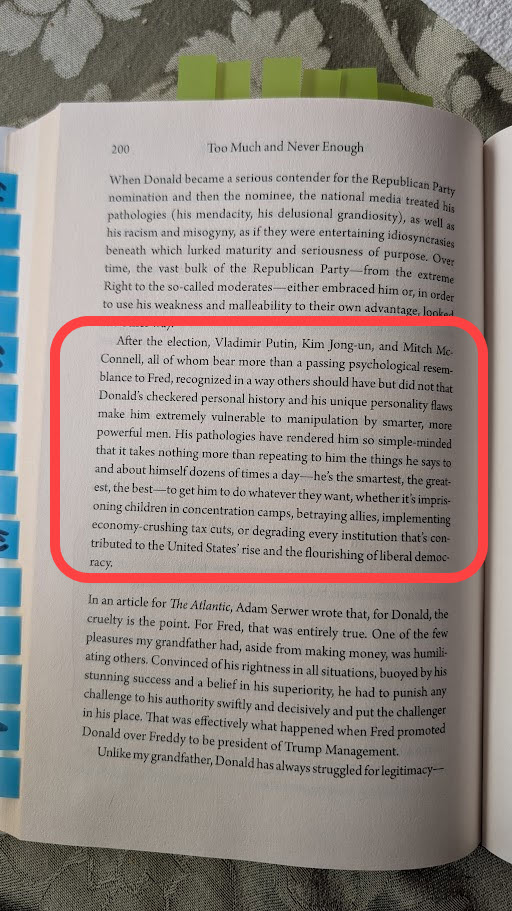
Consider this p.200 quote from David Corn followed by Mary Trump’s own words in her book. Speaking of Donald:
“”Everything is transactional for this poor broken human being. Everything.” It is an epic tragedy of parental failure that my uncle does not understand that he or anybody else has intrinsic worth.”
A Summary and a Warning
The Epilogue is aptly named “The Tenth Circle”, which I believe is a reference to Jodi Picoult’s 2006 novel of the same name that draws heavily from the nine circles of hell described in Dante’s poem, the Inferno. The “tenth circle” symbolizing a kind of suffering not described by Dante.
When the book was published, I’m not sure if the gravity of a possible second term for DJT could be articulated then. It took the Heritage Foundation’s Project 2025, concerted Republican partisanship, a “hype cycle” and social media to bring him back; and we are suffering greatly for it. Trump has a twisted vision of his place in 21st century politics, and will likely never realize how profoundly his flaws have allowed him to be manipulated and used by others for their own purposes.
The real question for us is whether we realize the threat that his administration presents to us now – the real “We the People” – and do we react? Or do we remain silent enough that he manifests his chaos and we truly are just what he calls us all – “the rubes”.
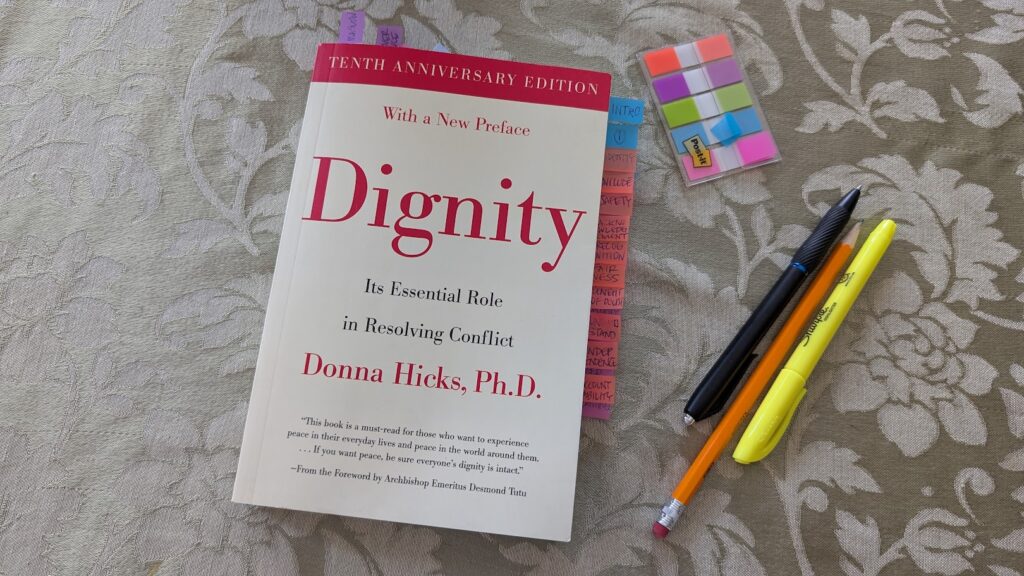
I’m currently reading Dr. Donna Hicks’ book “Dignity: Its Essential Role in Resolving Conflict” leading up to her keynote address at the Dignity Leadership Summit taking place in Salt Lake City, Utah. I’m conflicted on the topic, mainly due to the helplessness I feel in the socio-political climate of the US and the world at large. I thought I would share my thoughts as I read through the book.
My preface is that these are simply notes of mine as I read the book. I make observations, ask questions, and reference what is in my known world to connect to what the author writes.
Dr. Hicks presents what she calls the Dignity Model, with ten elements of dignity; and she expands further by writing about the ten temptations to violate dignity. In the preface she includes the opening words of the Universal Declaration of Human Rights:
“Whereas recognition of the inherent dignity and of the equal and inalienable rights of all members of the human family is the foundation of freedom, justice, and peace in the world…”
United Nations, 1948
After reading the book, my question is how we can embrace dignity in ourselves but know that we will suffer indignity, and watch our communities suffer indignities that we cannot control. My question is how loss of rights, of curtailed freedoms, lost opportunity, and of loss of lives does not result in a loss of faith? There is a certain amount of jadedness, of bitterness I have that I can’t seem to let go of, in part because I have lost faith in the general goodness of people that I once trusted was there.
I am starting to believe that corruption is a rust that goes through our societal values. I am concerned that ignorance, hate and greed is more prevalent than humility, understanding and empathy.
I am concerned that partisanship, tribalism, and righteousness get in the way of humanity, a broader sense of belonging, and a sincere desire to help one another.
Our fight is real, and it has become existential. We are experiencing literal genocide, displacement and suffering take place in front of us, and watch as our leaders give praise to the perpetrators. Our own leaders show only hubris, and seek unfettered power by planning and taking action to harm anyone who does not contribute to their corruption. Where does our dignity fit in all of this?
There is an assumption that we have a common emotional vulnerability, and I’m not sure that I believe that premise.
A Foundation for Dignity is a Common Reality
My first assertion is that dignity cannot exist without a common reality of what values we hold, and how worth is measured. The book’s focus is on dignity, but words like worth, and honor, and respect show up and rival it. On p.3 respect (earned) is differentiated from dignity (a birthright of value and worth). Both require care and attention.
In order to have dignity:
Safety and trust are essential
Science as a method of understanding the world around us is essential
Logic prevails over illogic, and critical thinking is necessary
Truths may include different viewpoints but must be separated from deceit
Bias exists. We must be able to recognize it in ourselves as quickly as in others
“Awareness requires self-understanding and acceptance. It requires work” (p.15)
Last, I would add that humans are social animals, meaning we are of this earth and are part of it. We do not hold a “special status”.
“It’s not just our indignity; it is the indignity of those who we love and care for. It is the loss of well-being of a community of people.”
– From my book notes
A Hierarchy of Needs
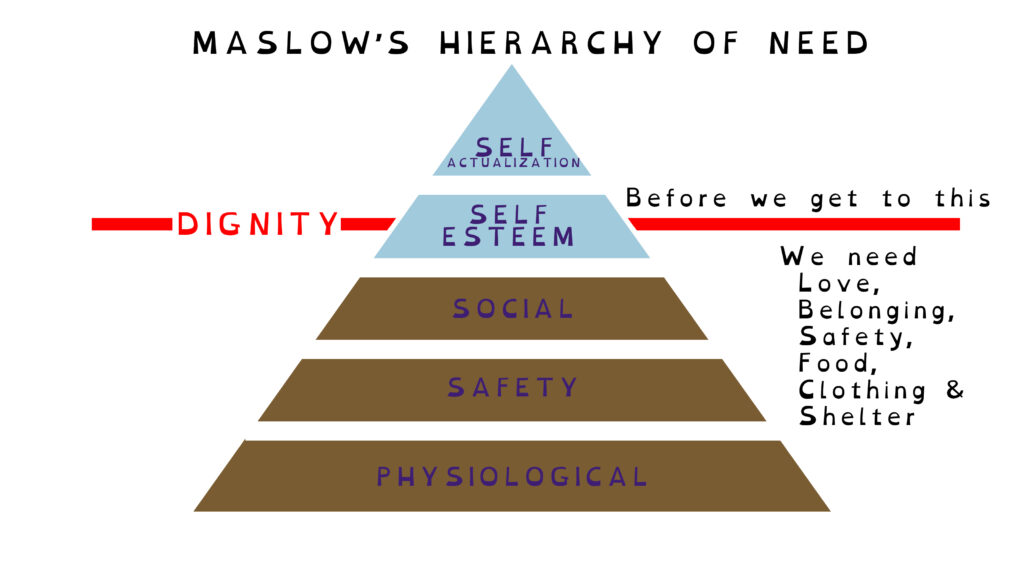
Dignity is not easily found when food and shelter are gone, or when we are without safety, or when community is taken from us. We can choose to be dignified in our thoughts and actions, but dignity can be stripped away from us. It is not our self-worth that I’m speaking of here; dignity is more closely related to esteem than it is to worth.
Taking away the foundation does not attack our individualism, rather it attacks our humanity. Inherent self-worth can be had without dignity, which is a societal value.
Burton’s ontological needs (p.27) of identity, recognition, security and belonging are part of the foundation in Maslow’s hierarchy. Fulfillment of these needs is essential to create a foundation for which dignity can be built upon.
Categorical Imperatives
On p.4 Immanuel Kant is referenced as introducing the idea of the “categorical imperative”; i.e. to “act in such a way that you always treat humanity, whether in your own person or in the person of any other, never simply as a means, but always at the same time as an end.”
Kant surmised that it is “unethical to exploit people or treat them merely as instruments to further one’s own personal goals and interests.” I would go further to say that it is morally wrong to treat others as chattel, or worse, to have no consideration for humanity whatsoever.
On p.10, Hicks summarizes Lindner and Ury in saying “We are becoming aware of our outdated acceptance of humiliating ways of ordering society, and a new human rights culture is taking shape; the value of each and every human being is being recognized.” My response to this is that we are aware, but re-ordering. I agree with Hicks, but I am skeptical.
My concern is that we have actors in today’s society who act with malice, who are willing to deceive and sow distrust for the purpose of acquiring and maintaining power over others. They are driven by greed, fear and hate; and view ruthlessness as strength.
There is an ethical dilemma when the actions of a malevolent person trump the dignity, security and existence of others. How can we value redemption of one individual whose actions may cause harm to many? How do you negotiate with someone who carries no shame?
Sidenote: Speaking outside of this review, I challenge Kant’s notion that suicide is morally wrong. Calling suicide a moral issue speaks more about society’s willingness to ignore personal suffering, and its failure to support and accept individuals who struggle for connection within our society.
It is Connection That Drives Us
Connection is understanding, empathy, acceptance and support. Connection is listening. Connection is contextual. Connection is allyship, a word that I do not see in Hicks’ book.
Connection > Respect
Connection > Esteem
Connection > Dignity
See Lost Connections, and Stolen Focus both by Johann Hari for an interesting take on western society’s root causes of depression and anxiety. I align to his thoughts that connection is what drives us.
Fun distraction: Watch Abbott Elementary S2E3 “Story Samurai“. Jacob learns to come to terms that he is not “cool”. He learns that the students call him Mr. C because he is corny, and that his peers also think of him this way. His persona is reshaped but he realizes that he is loved and accepted. This is an example of connection mattering more than dignity.
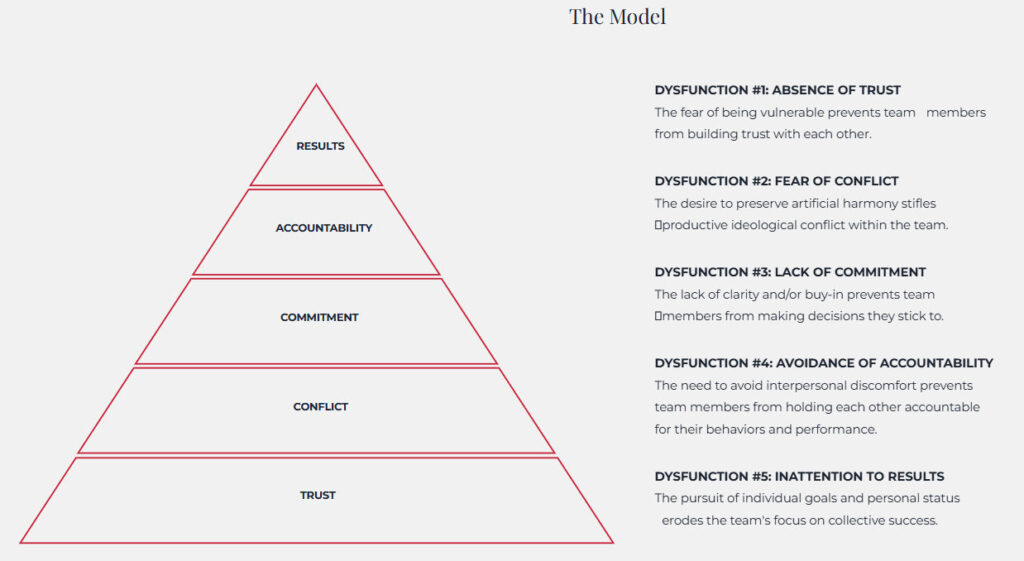
The Five Dysfunctions Model
I want to reference a book by Patrick Lencioni on The Five Dysfunctions of a Team, which is an excellent reader on building functional teams, that focuses more on the establishment of trust, healthy conflict and accountability of its members. This model could easily be applied to teams working towards conflict resolution, just as Hicks’ model is intended. Both models have precepts of basic needs being met as a foundation.
The Five Dysfunctions Model
The Ten Elements of Dignity
Dr. Donna Hicks introduces her model with the following elements – there is no “stack” or “pyramid” built in her model (note that I comment on numbers 2, 6, 7, 9 and 10):
Identity: an introduction of “I” and “Me”; should add “We” that comes later (see Robert Kegan p.152)
≠ Inclusion: acceptance and belonging (my problem here is the paradox of inclusion when looking at the person, their ideology, and their (in)actions together. I cannot separate them)
Safety: free to speak without retribution
Acknowledgement: see and acknowledge the indignities of others
Recognition: show others that they are seen, heard and understood
≠ Fairness: treat others justly, with equality and evenhandedness (without trust, I cannot extend good faith to those who will abuse the privilege – i.e. an agreed ceasefire is violated consistently by one party)
≠ Benefit of the Doubt: treat people as trustworthy (I struggle that all people have good motives or act with integrity – i.e. a delay plays to the advantage of a party that will undermine a negotiation, or keep food and aid from victims of war)
Understanding: believe that what others think matters I LOVED THIS QUOTE: “Seeking understanding is one of the easiest ways of honoring dignity. Allowing people to feel understood is just one short sentence away: “Tell me more”.” (p.85)
≠ Independence: encourage others to act on their own behalf (this should always be a first principle, but there are times when allyship is needed)
≠ Accountability: take responsibility for your actions (all parties must be accountable, and this extends far beyond violations of dignity)
I think you can see this is where I really begin to struggle with Dignity as an underlying core value for which unresolved conflict can be addressed. There must be a basic level of trust, of constraint, of essential humanity, of broad accountability to move forward.
In the section on Benefit of the Doubt, there is a poignant story of Nelson Mandela who says “I loved even my enemies while I hated the system that turned us against one another.” (p.75) He also says “Man’s goodness is a flame that can be hidden but never extinguished.” (p.76)
Not everyone is a leader, and far fewer become a moral authority. Even fewer survive what Nelson Mandela did, and I will use Alexei Navalny as an example. I question the value of giving the benefit of doubt to even one individual whose actions cause harm to many. Is there not an ethical dilemma presented here? Is it not different to bear our own suffering, but do nothing for the suffering of others?
In the section on Accountability, I pondered what if there is no diplomat to negotiate, or if we are faced with institutions built on greed, prejudice and fear? There must be honest arbiters with agency to represent change.
Discipline is mentioned on p.119 under False Dignity, but is not brought up in context of the first 10 elements. I think this, Humility and Reflection, should be elements of consideration.
Fun Distraction: If you were to program Dignity into an AI model, what would it look like? What would happen if you were to run a Monte Carlo exercise on the model?
The Ten Temptations to Violate Dignity
These are not all presented as antitheticals of the Ten Elements, rather it exists as its own list of detriments to Dignity.
Taking the Bait: the lesson here being to show restraint, and noting that action must be measured against a consequence of inaction. This quote in particular was striking: “…know that we have the capacity, in the service of self-preservation, to do great harm to one another, we will be stuck in the never-ending cycle of indignity.” (p.101)
Saving Face: “The dread of having our inadequacy, incompetence, or lack of moral integrity made known is enough to turn us into liars…” (p.103) reminded me of this recent unattributed comment about a political figure: “When he says he knows nothing he knows everything. When he says he knows everything he knows nothing.”
Shirking Responsibility: (as an antithetical to #10 Accountability) An important lesson from this is that when we care, we learn, and this builds strong relationships.
Seeking False Dignity: a short summary might be to not seek false praise or flattery, or accept that our status as a human is tied to an external measure of success. A concern I have for this is that Hicks’ references the individual perspective and not society generally, or where we find ourselves historically within it.
Seeking False Security: be willing to address the risk of the unknown. “Any relationship in which your dignity is being routinely violated is not a safe relationship, no matter how much you deceive yourself into thinking it is.” (p.124) needs to be applied at a larger level. It pertains not just to relationships, but representation, and employment, and society at large.
Avoiding Conflict: a key reason I brought up Lencioni’s Five Dysfunctions is because it specifically calls out healthy conflict as a necessary step for teams to go through. Conflict should not only include standing up for yourself, as Hicks states, but should also include allyship. There is a risk in conflict. Understand the fight before you step into it. There is a great comment about ‘optimal conflict’ by Kegan on p.154 to challenge how we make meaning.
Being the Victim: possibly versus playing the victim? Know the difference. Our self-awareness and objectivity are key to understanding. Our willingness to hear others feedback and process it comes next.
Resisting Feedback: continue to be curious. Continue to receive, accept and process change.
Blaming and Shaming Others as Deflection: “Safeguarding our dignity when faced with a threatening situation requires us to develop both self-restraint and self-assertion.” (p.168)
Engaging in False Intimacy and Gossip: “There is nothing like good dirt to liven up a discussion.” (p.171) Speak truth about yourself; invite others to do the same.
For the topic of False Intimacy and Gossip, I want to juxtapose that with commiserating and discussing rumors generally. A trusted circle is often used to share information, or needs to be used as a sounding board, or where to go for advice. It’s “spill the tea” but also “let’s clean that up”. Very often, the person discussed wields a power imbalance, or shows unreliable behavior.
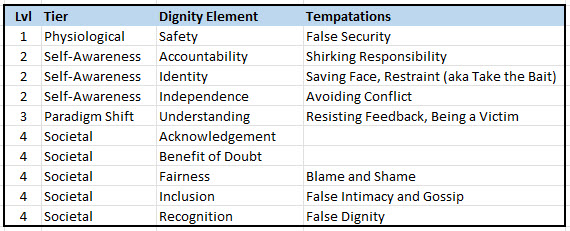
Tiering the Elements of Dignity
I wanted to relate the elements to some order of tiered dependence, and I also wanted to see if there was an association between the elements and the temptations. This is what I came up with.
My intent here is to think about how some things (like safety) are essential in order to do anything meaningful. Then there are elements we are directly responsible and solely accountable for, and there are elements that we extend to ourselves and to others.
On Reverence and Awe
Starting on p.67-69, I especially like what was said in this section on Recognition. The capacity to be in awe and in reverence of a force or forces greater than ourselves is a reminder of the incredible power of humility. (I made a silly note that this was the time to watch more Kaiju films.) These quotes in particular captured me:
“The something greater could be God for those who are religious, or ideals like truth and justice, which captivated the Enlightenment philosophers, or the magnificence of the universe, which is enough to bring Richard Dawkins, an atheist, to his knees.”
“One of the hallmarks of good leadership, then, is the capacity to feel awe and wonder at something greater than oneself, and this feeling acts as a check on arrogance.”
Humility, then, is essential for our ability to see ourselves and the role we play in a grander picture of the world and universe that we are a part of. Humility is “necessary to avoid the temptation to abuse one’s power by harming, exploiting, and disempowering others.” (p.69)
On Social Values of Shame, Ridicule and Satire
There is social value to shame, ridicule, satire and for comedy; but what part does dignity play here? Hicks states on p.22-23 “Our interpretation of what happens in the world is dependent on our experience of it [shame]”. Yet we find disciples of hubris among us.
There is a notable fear of humiliation, except when there isn’t. Senator Ted Cruz, Senator Mike Lee, and Vice President JD Vance in their about-face relationships with President Donald Trump are prime examples of this.
Lying, deception and cover-up are not only employed in self-defense. Senator George Santos literally made a career and was elected to the Senate amidst his willful lies, fraud and corruption.
On Reconciliation
One of the observations I want to make is that reconciliation is not always possible. It may never occur. It would be better to add one more chapter on unreconciled indignities, or “living with indignity”, because that is the circumstance for many.
“Because Mandela’s sense of his own value and worth was so deeply ingrained, he never lost sight of the inherent value and worth of others, no matter how badly he was treated. His sense of dignity is the source of his humility. It is humanity itself that he respects – not just his own but that of every human being. Keeping that truth to the fore is an astonishing human achievement.” (p.76)
“The responsibility is ours to stay anchored in the truth that, as human beings, we are the embodiment of dignity.” (p.139)
What answer is there for unresolved conflict? What of justice not found? What of our own perceptions of safety when the violator just “gets away” or isn’t part of the recognition, or healing? The violation remains. It is inevitable, but the weight of things, whether one or many, has a tendency to shape us.
I am troubled about finding resolution when offending parties do not have integrity. They willfully disregard, lie and are in contempt of words. There is no honor in their actions; they admire ruthlessness; they seek power without humility. The response to this cannot be to simply persevere through it all.
Much of the book describes suffering. Dignity does not take away suffering, and it does not make it tolerable. Dignity can be a lifeline though; in that it cannot be taken away unless you choose to let it go.
“It’s not necessarily about meeting in the middle; but is there a third space?“
Although the topic of the book is on using Dignity to resolve conflict, it’s worthwhile to point out that Dignity can and should be used to avoid or dissolve conflict. Dignity is, after all, a tool of diplomacy.
So the other part of the story should be of preventing conflict. How do we use dignity to restore dialog? How do we ensure that dignity is more present in the words and actions of ourselves, our politicians, business leaders, in community, in our news and in our places of gathering?
Suggested Next Read
I already started this, but want to review and comment next on “Too Much and Never Enough: How My Family Created the World’s Most Dangerous Man“, by Mary L. Trump, PhD. This will likely be a very significant contrast to “Dignity”. Much of my reading on Dignity has led to thoughts on how DJT acts in opposition to dignity but is still projected and supported by an inner circle, and by his followers, who are devout to his political figure.
Ben Peck needs to be our UDP Chair. I think that Brian King can help the party build fundraising efforts and recruit candidates, but he’s not the right candidate to lead the Utah State Party. Jonathan Lopez wasn’t prepared and came across as angry.
The UDP has been running without a director, and has a disconnected outgoing chair. There has been a leadership void since well before the 2024 elections. It will be a scramble for a new team of leaders to come in, and that’s already hurting us.
This debate focused on the UDP chair role, but my personal opinion is that we need a new vice chair as well so that an entirely new leadership team can step in.
There was no discussion during the debate about the ethics of the role. There were questionable relationships and past behind-the-scenes collusion between the UDP board and campaign management companies. Candidate funneling, and some allegations of racism are legitimate.
Developing a candidate pipeline is critical. The UDP was late to the table in the last election, and made poor decisions of financial investment in qualified candidates. There needs to be better vetting and initial investment in candidate campaigns.
The UDP still has no established method of fundraising investment in Utah. There is no ‘blue circle’ to compete with the Utah Republicans ‘elephant club’ https://www.utahelephantclub.com/
Strategies like “contest every race” without training qualified candidates, not supporting qualified Democratic candidates in favor of unaffiliated candidates, preferring statistical advantage and failing to bring the fight to important districts are all signs of poor leadership in the past.
Tick Tock
For 2025 municipal elections, candidate filing opens June 2, 2025 For 2026 mid-terms elections, candidate filing opens January 2, 2026
Video
See the timestamps below to jump to a specific question
Video Timestamps
6:06 Opening Statement: Jonathan Lopez
8:11 Opening Statement: Brian King
10:02 Opening Statement: Ben Peck
11:55 Q1: What do you believe is the role of the UDP at the state level, and how should it serve its members and its candidates?
17:45 Q2: What are your top priorities as Chair for the first 100 days and long term? How will your efforts strengthen the party’s infrastructure and direction?
23:40 Q3: Recent polling shows Democratic party approval rating of 36% nationally. 52% think the party is on the wrong track. How would you work to improve trust within the Democratic party, transparency and communication here in the state; but also work externally to repair the Democratic party brand while maintaining communication with grass roots members in the state of Utah?
30:20 Q4: Regarding the struggles of leadership…. What steps will you take to build a cohesive, effective leadership team that reflects the diversity and values of Utah Democrats?
34:45 Q5: Regarding issue and identity caucuses at large, the necessity or existence of caucuses and a debate whether to eliminate caucuses within the state party. How do you commit to support our caucuses and how do you see their role in strengthening the party?
41:15 Q6: What will you do to ensure ADA access at all party events, to ensure that we are in compliance for people who need special accommodations?
44:10 Q7: The need to reach out to rural voters… How do you plan to support county parties across Utah in rural communities, or historically under-resourced communities like Davis, Weber and Utah?
49:58 Q8: Democratic party has a mandate to elect Democrats. This necessitates quality recruitment prior to campaign season. Talk to us about the approach you would take for candidate recruitment for municipal and statewide offices, and what systems you would put in place to support those candidates throughout their campaigns?
55:43 Q9: Ideas cost money. We have mentioned party branding issues, and no state budget passed. How exactly do you plan to raise money for the UDP? Please be specific about fundraising goals and strategies.
1:01:25 Q10: Let’s talk statistics: there are 242,000 active registered Democrats, and 934,000 active registered Republicans in Utah. The numbers are ugly, but demographics are shifting. What investments will you make in voter outreach, voter registration, to voters of color, young voters and immigrant populations?
1:07:15 Q11: Utah is diverse. 42% are LDS; and 24,000 showed up for Bernie and AOC. We have to unify across all of our people. How will you bridge the divide between progressive and moderates in the party to ensure that all voices are respected and engaged?
1:13:35 Q12: It’s fair to say that parties aren’t an efficient organization – you can look at the UDP bylaws as an example. How would you reform the party if you had the ability to make one big change overnight?
1:20:35 Q13: There are thousands of people gathering at protests and rallies, with different methods of mobilizing and organizing here and across the state. How do you plan to capture and engage these folks? How do you see the party’s involvement at these events?
1:28:05 Q14: Audience Question: Angel Vice, Chair of the UDP Women’s Caucus Our caucuses have been at all the events, tabling, providing signs, providing training, inviting party officials. Disappointed to hear candidates say that caucuses aren’t engaged. Aside from Ben, why wasn’t Jonathan or Brian at these events?
1:32:45 Q15: Audience Question: Jennifer Miller-Smith, Chair of the UDP Disability Caucus The Moab Art Center Building has a giant staircase, was site to host the UDP central committee meeting in December, and Grand county party held their convention. If disabled members are recruited, how are they supposed to go to these events, and what is the policy for not following our governing documents?
1:36:38 Q16: Audience Question: Angela, Black Caucus In the past, candidates of color have experienced racism within the party. Examples include sending campaign materials without their consent less than 2 weeks before an election, or having vendors currently on payroll who support running independent candidates against our currently elected women of color. If elected Chair, how will you work to address to actively dismantle this racism?