Jordan Teuscher wants SpEd students out of public schools

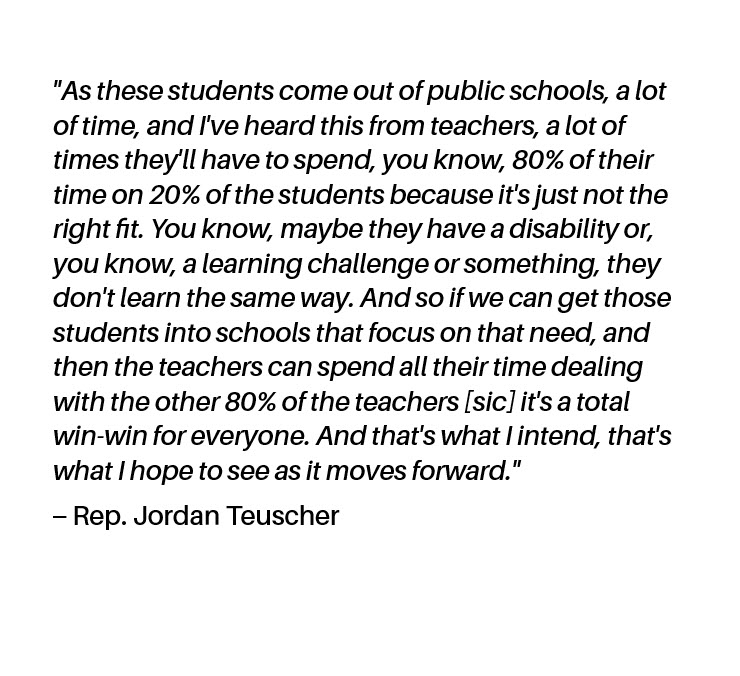
During a recorded Jan 13, 2024 Pre-Legislative town hall, Jordan Teuscher made a statement regarding the 2023 HB215 “Utah Fits All Scholarship” voucher program that was passed despite opposition from teachers and nearly every education organization in Utah. Teuscher says he wants to get special needs students out of public schools.

Here’s the part of the video from the townhall where he says exactly that. The full video is available here, with his comment made after 25 minutes into the video.

Apparently Teuscher doesn’t know much about the disability movement and the battle to move students with disabilities INTO public school systems. It wasn’t until 1975 that the Education for All Handicapped Children Act (EHA) was signed. EHA guarantees a free appropriate public education (FAPE) to each child with a disability in every state. The 1990 reauthorization changed the law’s name from EHA to the Individuals with Disabilities Education Act (IDEA). That’s where IDEA and FAPE come from.

In 1992 Board of Ed v. Rowley case, the Supreme Court concluded that to provide FAPE, a school district must provide access to specialized instruction & related services that provide educational benefit to a child with a disability.

Integrated schools have better outcomes. Students (ALL students) do better when they experience integrated classrooms. Casel studies from as early as the 1960’s point to these improved outcomes.
Link: https://casel.org/fundamentals-of-sel/what-does-the-research-say/

What Teuscher thinks is a “win-win” is a loss for everyone. His plan is regressive and exclusionary.

I have plenty to say about Sen. Lincoln Fillmore’s comments as well, but later. He says a bunch of stuff that’s either disingenuous, misleading or flat-out wrong. Keep in mind that Sen. Fillmore chairs the Public Education Budget Committee, but intentionally misspeaks.

Proposed 2025 Legislation

When elected, I have the following legislative goals to accomplish in my first 2-year term. My obvious first objective is to unseat Jordan Teuscher. I plan to work with an expanded minority caucus and moderates in the House, and with a Democratic Governor.

TOP 2025 PRIORITIES

  1. Support redress following a court decision on LWV Utah and Mormon Women for Ethical Government (MWEG) v. Utah State Legislature
    • Re-implement the independent redistricting commission
    • Implement new district maps based on their recommendations, before the 2026 election cycle
  2. Address government overreach (citizen initiatives, defend constitutional checks and balances, private access to medical, first amendment)
  3. Address Prioritization of bills
    • When infrastructure bills are seconded to who is allowed to use a bathroom, we have a problem.
    • When books are banned in public schools, when phones are banned but guns aren’t, we have a problem
    • When “good enough to get by” isn’t, we have a problem
  4. Support our public schools
    • Support their funding, support the teachers, support the librarians to do their jobs.
  5. Improve cost and quality of living
    • Cost of living (rent/affordable homes), clean air, public access, transit, services
    • Infrastructure project funding and provisions
    • Address wait lists for disability programs (DSPD, Medically Complex Children’s Waiver, Assistive Technology)

EDUCATION

  • Utah State board of education positions should be non-partisan and subject to recall.
  • Funds for Educators. Funds to increase number of Psychologists in district, and Counselors, Nurses at every school
  • Fund specific counseling for in-custody foster children
  • Halt book bans
  • Support learning services thru post secondary certificate programs for intellectual disability
  • Increase unified sports programming in elementary, middle and high schools

GOOD GOVERNMENT

  • The state attorney general position should be subject to recall.
  • Fix Republican gerrymandering by restoring the intent of Prop 4
  • Address homeless population for mentally ill, domestic abuse, financial, LGBTQ+ youth
  • Fund public school programs instructing on legislative processes in Utah
  • Address immigration through refugee programs
  • Constitutional amendment to allow lotteries

HEALTH

  • Fund Medicaid expansion in the state. Ensure medicare/medicaid is accepted in public hospitals, dental offices
  • Defend abortion access (Abortion is currently legal up to 18 weeks in Utah).
  • Reinvest in Caregiver Compensation funds (Utah Medicaid Disability Caregiver Program is a part of the DSPD Medicaid waiver in the state of Utah)

ENVIRONMENT

  • Introduce multi-year legislation for clean air working up to the 2034 winter olympics
  • Introduce multi-year legislation for water use, redistribute water rights through revision of eminent domain in Utah code 78B-6-501
  • Re-introduce safety testing for vehicle registrations
  • Incentives for work-at-home/reduce the commute

DISABILITY

Work with the Legislative Coalition for People with Disabilities, Disability Law Center and Utah Developmental Disabilities Council to build and find sponsorship for the following:

Legislative Advocates: Rep. Marsha Judkins (R-61) (ret.), Jennifer Dailey-Provost (D-22), Rep. Steve Eliason (R-43), Rep. Raymond Ward (R-19), Rep. Anthony Loubet (R-27), Sen. Todd Weiler (R-8)

Blockers: Rep. Brady Brammer (R-54), Sen. Lincoln Fillmore (R-17)

  • Fully fund Medicaid expansion in the state. For details on how the 2018 referendum for fully funded Medicaid warped into our current limited expansion, see From Ballot Initiative to Waivers: What is the Status of Medicaid Expansion in Utah? (KFF.ORG)
  • Fund Services for People with Disabilities (DSPD) to resolve multi-year backlog
  • Support walk & roll cities, not just walkable cities
    • Work with UTA Committee on Accessible Transportation to add ramps for Blue Line Trax (requested from Madison House Autism Foundation) – this has been an ongoing issue for disabled travelers
    • Improve public transportation and affordable housing
    • Accessible transportation options (public transport, UTA services, DSPD)
    • Clean air initiatives for transportation
  • Disability tax credits for disabled children, adults at home
  • Disparities of intervention services
    • For persons diagnosed with Down Syndrome – apply Applied Behavior Analysis (ABA) therapy for diagnostics
    • Expand the list of qualified diagnoses in order to receive services
    • Transition to adulthood (services, housing, jobs)
    • Address the government services or benefits “cliff” to not quality (when moving state to state, and when comparing Medicaid vs private insurance)
    • Behavior Intervention Plan (BIP) addendum to IEP. Fund education and LEAs on behavior plans for children with disabilities. Precision and Command technique. 
  • Address Homelessness and its root causes
    • Expand low-income housing, family group homes, zoning laws/ADUs
    • Accessibility of mental health, drug use for mental illness
    • School funding for supports of mental health/SPED
  • Improve options for disability jobs
  • Incorporate inclusive art programming to current ZAP tax in Utah code 59-12-607
  • Inclusive playground equipment in public parks
  • Community response in lieue of police

DEI

  • Restore DEI at institutions of higher education, the state board, and governmental employers (repeal HB261)

Response: BLM Utah Chapter – Education in Utah Survey

This is not an endorsement.

For transparency, I am providing my answers to a survey from Black Lives Matter Utah Chapter – Education in Utah Survey so that my positions on these questions can be shared with constituents. I want to make note that some of the survey questions are hypothetical/situational, would not be fully covered under legislative action, and would need to include state board, local board, district, administrative and educator supports.


Q1: Email

ggreen.hd44@gmail.com

Q2: First and last name

Greg Green

Q3: Which office are you running for?

Utah House District 44 (South Jordan)

Q4: If elected, would you support efforts to repeal HB11, which bans transgender girls from participating in school sports that match their gender identity? (respond Yes/No)

Yes

Q5: Please explain your answer to the above question regarding HB11.

Legislators should not be legislating gender identity. For reference, policy was updated in the Utah High School Athletics Association handbook in 2020-2021 and going forward (https://uhsaa.org/Publications/Handbook/Handbook.pdf). Equality Utah supports this policy as equal treatment. See https://www.equalityutah.org/youth-laws.

Q6: What do you believe is the best way to keep students safe in school? Rank the following options with 1 being best and 6 being worst. You can only use each rank once. (Rank 1-6)

  • Implement early-intervention systems to identify at-risk students and connect them with resources (1)
  • School Resource Officers (SROs)/School Police Officers (SPOs) (2)
  • Parent/community volunteers (3)
  • Ensure schools have proper physical security measures (e.g., sturdy locks on interior doors) (4)
  • Hold regular lockdown drills in schools (5)
  • Arm teachers (NO)

Comment (not possible in the survey): This is not a good list. The first thing we need is to support broad implementation of SEL programs at schools. We need to support annual DEI training for all teachers. SROs and SPOs need to be trained in CIT, practice de-escalation techniques, and pass background checks that include past disciplinary notes and actions. We need availability of counsellors, we need responsive, supporting administration who will pursue discrimination, hate acts, threats or violence. We need demands for accountability from the community. Volunteers need to be registered with the district, and must have completed background checks.

Q7: An ACLU report found that 54% of Utah students attend schools with a school police officer but no psychologist, nurse, social worker, and/or counselor. If you are elected, what will you do to address this disparity?

The short answer here is that we need to pay teachers and get out of their way. We need to fund nurses, counselors in every school and lower support ratios. We need better access to psychologists and social workers. Pay is poor, school funding is poor, and the politicization of educational roles makes work environs unattractive. Demographically Utah has some of the youngest counties in the nation (https://www.axios.com/local/salt-lake-city/2023/06/26/utah-young-us-median-age-county-cache), so it’s not appropriate by any means that our state spends so little, with Utah spending the LAST per pupil in the nation. Education funding is constantly under attack. We need to tackle the rhetoric in the legislature and work with the Governor’s office to grow funding, remove politics from Education Boards, and return curriculums and text books back to educators.

Q8: Which of the following school personnel should be responsible for responding to the following situations? You can select more than one. (multi-select from: SRO/SPO, Nurse, Guidance Counselor, Social Worker, Principal or Other Administrator, Teacher)

  • Physical/verbal altercations between students (any present)
  • Bullying by a student against another student (any present)
  • Bullying by a staff member against a student (any present)
  • Students experiencing mental health issues (Teacher, Administrator, Counselor, Social Worker)
  • Students’ physical well-being (Teacher, Administrator, Counselor, Social Worker)
  • Students struggling with schoolwork (Teacher, Counselor, Social Worker)
  • Students lacking basic necessities or struggling with issues from outside school (Teacher, Counselor, Social Worker)
  • Reports of alleged criminal activity by students or staff (Administrator, Counselor, Social Worker, SRO/SPO)
  • Students breaking school rules (e.g., using a cell phone during class; dress code violations) (Teacher, Parents)

Comment (not possible in the survey): This isn’t necessarily a point of state legislation. The current “who responds” will be based on who is available and present, and in most cases the appropriate staff is not there. It should also be noted that students should be able to raise concerns or to call out discriminatory behaviors. Parents or Guardians should be involved. Regarding dress code violations, we really should be removing policies that set cultural standards on hair and clothing. Criminal activity may be minor (stealing a lunch) or major (physical violence or damaging property) and the commensurate action should be based on context.

Q9: What is the appropriate consequence for a teacher or administrator who: (select only one from the following: Receive a verbal or written warning, Pay a fine, Suspension without pay, Employment terminated, Banned from employment in other schools)

  • Uses a racial or identity-based slur (Employment terminated)
  • Targets a student because of the color of their skin or another aspect of their identity (Banned from employment in other schools)
  • Fails to escalate a report of bullying or discrimination (Employment terminated)
  • Physically disciplines a student (Banned from employment in other schools)

Comment (not possible in the survey): I don’t believe in nickel jars, so “pay a fine” is not on the table. There should be evidence of slurs or targeting to terminate employment. Banning from employment would need a system of tracking because this may not come up in a background check or from employment history (typically you will see “not recommended for rehire” or something to that effect). Failure to escalate a report may be addressed through training. Corporal punishment in schools is assault. See https://le.utah.gov/xcode/Title53G/Chapter8/53G-8-S302.html

Q10: If one student calls another student a racial or identity-based slur, and a verbal or physical altercation results, which student(s) should be disciplined? (select one)

  • The student who used the slur (x)
  • The student who was called the slur
  • Both students

Q11: Please explain your answer regarding which student(s) should be disciplined. If you selected “both students”, do you believe the consequences should be the same for both students?

In the hypothetical, the student who used the slur should be disciplined. However it may be both students, depending on context and drivers leading up to the altercation. Provocations, taunting, bullying, discriminatory behavior, violence need to be considered beyond acts of defense. Assault should always be reported to law enforcement. Destruction of property may include legal recourse. Repeated outbursts or violence require additional actions.

Q12: Define Critical Race Theory. Please be as detailed as possible.

CRT is Critical Race Theory, which argues that historical patterns of racism are ingrained in law and other modern institutions. It is generally understood that CRT is not taught in K-12 settings, rather is part of higher education programs. “CRT” has been used recently for a word-soup of acronyms, with the intent to get the public thinking that all are the same, and that all are bad. This is broadly an attack against diversity and equity in our public schools.

Q13: Do you think the role of racism in American history and present-day society should be taught in our classrooms? Please explain your answer.

Yes. History matters. We need to stop the re-writing of history for our students. I would also recommend that we offer civics and history classes on African-American studies, Latinx, Disability legislation, and the Pride movement

Q14: Here (https://www.utah.gov/pmn/files/831761.pdf) is an example of the Utah State Board of Education’s Library Materials Model Policy. If elected, what elements of this policy would you keep in place? What elements would you change?

This is a quick review. I have concern about Section III, “local school board’s adopted selection criteria and procedures” being too restrictive. I would base the procedure and selection on recommendations of Professional Library Associations (i.e. American Association of School Librarians (AASL)). Under Section V, a review process should exist but should not qualify removal simply based on objectional material. Review processes should not be burdensome to staff (perhaps included the regular examination of a library collection), possibly annually?. The “Library Media Review Committee” should have accountability to defend first amendment access to materials, and be barred from decisions based solely on objectionable material. Appendix B, Section 5a definitions from Utah Criminal Code 76-10-1201 (Offenses Against Public Health, Safety, Welfare, and Morals) for its inclusion here, particularly of 5(a) “Harmful to Minors”, 5(a)(i) on “prurient interest”, and 5(a)(ii) “patently offensive to prevailing standards in the adult community”. I would support the definition from “Court Cases: Island Trees v. Pico 102 S.Ct. 2799 (1982)”.

Q15: On June 29, the Utah Education Association wrote a letter (BROKEN LINK – https://n2d4q8s9.rocketcdn.me/wp-content/uploads/UEA-Letter-Library-Model-Policy-6.29.22.pdf) to the USBE with recommendations for the Library Materials Model Policy. Which of the UEA’s recommendations do you agree with? Which do you disagree with?

Note that the letter in reference is not accessible.

Q16: Do you agree with Alpine School District’s since-reversed decision to remove 52 books from its library shelves before completing the review process? (respond Yes/No)

No

Q17: Which of the following do you think are appropriate reasons for removing a book from a school’s library or curricula? You can select more than one.

  • “Harmful to Minors” as defined in Utah Code 76-10-1201
  • Offensive language and/or content
  • Content related to suicide, including suicide awareness
  • Violent content
  • Parent complained
  • Student complained
  • None of the above (x)
  • Other: (specify) (x) The librarian removes the book from circulation based on condition, the overall catalog of books, and for out-of-date references. A good article on procuring and retention of school library books is at https://www.edweek.org/teaching-learning/how-school-libraries-buy-books-struggle-for-funds-and-confront-book-bans-an-explainer/2023/02 and in particular this quote: “I believe that decisions are most effectively made closest to the point of consequence,” said Jordan Ely, chief financial officer for the Gresham-Barlow district in Oregon. “The media specialist and the principals in those schools, they know what students are struggling with, what life looks like for them. And frankly, what the kids want to read.”

Q18: Who should have the authority to remove a book from a school’s library or curricula? You can select more than one.

  • Principal
  • Local Education Agency (LEA)
  • District Superintendent
  • Parent-Teacher Association (PTA)
  • District School Board
  • Other: (specify) (x) The school Librarian (who is typically a teacher, with a degree in library science or school library media), and the Principal. A review process should exist but should not qualify removal simply based on objectional material. Review processes should not be burdensome to staff (perhaps included the regular examination of a library collection).

Q19: Do you believe students should be able to exercise their right to peacefully assemble during school hours? (respond Yes/No)

Yes.

Q20: Do Black lives matter? (radio select)

  • Yes (x)
  • Absolutely!
  • Of course!
  • Black lives matter every single day

Note: all of the answers above are correct.

Response: 2024 Utah Education Association PAC Survey

This is not an endorsement.

For transparency, I am providing my answers to a survey from Utah Education Association (UEA) Political Action Committee so that my positions on these questions can be shared with constituents.


Q1: What is your name?

Greg Green

Q2: What is your Political Party?

Democrat

Q3: What are you running for?

House

Q4: What district are you running for?

44

Q5: Why are you running for the legislature?

My step into politics is based on where we as a community stand today. There are divisive legislation and social campaigns that are without empathy, that are breaking the networks in place for us to be informed, that are tearing at the fabric of our nation. There is an infiltration of local school boards, and the introduction of legislation in states that comes from national platforms that do not have our common interests in mind. There is disinformation in social media that is meant to be divisive, that tears on the intent and good will of society, with efforts to promote “strong-leader” fascists who would undermine our democratic systems. I’m stepping into politics because the “our” in our voice needs to be represented. I have enough shared experience and humility to know that I should listen and understand before I speak, and that my actions affect a community that I love and have much respect for.

Q6: What personal experiences have you had with neighborhood public schools and/or with charter schools? (Be as specific as possible.)

All three of our kids went through the public school system in Jordan District. We initially started at Challenger School for pre-school and kindergarten programs for our two eldest children, but moved to Jordan District schools for the remainder of their K-12 education. Natalie attended pre-school in Bluffdale Elementary early intervention program, before attending kindergarten in a mainstream class at Welby. She began special education classes at Terra Linda when the district began revising cluster programs, then moved to South Jordan Elementary when the district did more shuffling for its special education classes. All of our kids attended Elk Ridge Middle School. All of our kids attended Bingham High School with two graduating from that school. Our daughter Natalie moved to RSL Academy High School for grades 11-12 because their teacher/student ratio and special needs classroom support was better for her.

Some of the personal involvement I have had at or on behalf of public schools:

  • Letters written, and attendance at school board, district, or state USBE meetings setting policy or addressing critical issues
  • Participation in groups like “We All Belong Utah – All Abilities, All Schools”
  • In-school volunteering, past mentor/counselor for the South Jordan Youth Council
  • Sponsored and participated in school supply drives at work, participated in school supply drives in the community
  • Participation during Junior Achievement Career Days by speaking to, or bringing my daughter (Special Olympics Global Ambassador) to speak to Special Education classes on personal story and transition for students with disabilities. Special Education is typically not engaged in Junior Achievement Career Day programs
  • Supporting my daughter Natalie as a Special Olympics Utah Global Ambassador and Special Olympics US Youth Ambassador for Unified Champion Schools.
  • Recognition for teachers during teacher’s week in the school year
  • We funded two special education scholarships through Jordan Education Foundation in memory of Cindy Chavez, a para-educator for our daughter who passed away.
  • Invitations and outreach to teachers/classes/teams to attend Best Buddies Friendship Walks, Special Olympics events
  • Sponsoring “Spread the Word: Inclusion” campaigns at Jordan District Schools

Q7: What is your view on the rights of public employees regarding collective bargaining, payroll deduction of dues and other association issues?

I support the right to organize, and to establish collective bargaining.

Q8: What is your position on private school vouchers and voucher-like programs (tuition tax credits, backpack funding, education savings accounts and/or scholarships)?

I am against school vouchers, or any other form of redirecting funds away from public schools. As an example, Senator Lincoln Fillmore and Candice Pierucci have submitted SB44 “ALTERNATIVE EDUCATION SCHOLARSHIP COMBINATION” that diverts funds from public schools to home-school or private schools.

Q9: What ideas do you have related to creating a sustainable increase in revenue to invest in public education funding?

In 2024 I think the first issue is to look at proposals to do away with income tax, which would disproportionally shift the burden of taxes to property and sales taxes. Utah’s Constitution requires income tax revenues to only be used for public and higher education and some social services for disabled residents, so the question is how and where funding would continue to be sourced for education. I would support higher earmarking for education funding. Regarding classroom resources and teacher retention, I think this needs to be addressed in legislation AND in campaigns to defend our public education system and challenge the rhetoric of conservatives that disrupt and dismantle education standards, funding, and outcomes of our public school system. On a side note, it would be interesting if the proposed 2024 bill from Rep. Kera Birkeland on a constitutional amendment to legalize lotteries in Utah could become a source of funding for education in Utah. I am really interested in seeing this legislation introduced (it has not yet been submitted effective Jan 14, 2024).

Q10: What can be done to encourage our best and brightest to enter the teaching profession? How can we assure that every student has a qualified teacher in their classroom? What should be the role of the legislature?

The short answer here is that we need to pay teachers and get out of their way. Pay is poor, school funding is poor, and the politicization of educational roles makes work environs unattractive. Demographically Utah has some of the youngest counties in the nation (https://www.axios.com/local/salt-lake-city/2023/06/26/utah-young-us-median-age-county-cache), so it’s not appropriate by any means that our state spends so little, with Utah spending the LAST per pupil in the nation. Education funding is constantly under attack. We need to tackle the rhetoric in the legislature and work with the Governor’s office to grow funding, but we also need to remove politics from Education Boards, and return curriculums and text books back to educators.

Q11: The UEA believes that teachers and their professional association should be a partner with policymakers in making decisions affecting children and public education. What role do you envision for the UEA in advancing public education?

  • Organize. I have been approached by Utah Parents for Teachers, Utah Education Association PAC and Black Lives Matter Utah Chapter with surveys about education in Utah. All of the surveys had similar questions.
  • Push for accountability. We need to change the USBE Board of Director positions to non-partisan/apolitical positions, and legislate explicit direction for recall of USBE board positions when persons are materially working against interests of a free public education.
  • Be a part of defending freedoms. Assist in writing responses (bills, social media, legal challenges) for attacks on diversity and inclusion, or book-banning, or discrimination, or against re-writing history.
  • Support broad implementation of SEL programs at schools.

Q12: Some legislators have worked to increase legislative oversight of academic course standards, curriculum, classroom materials, books and other instructional resources. Is this an appropriate role for the legislature or should these decisions be made by the State Board of education and local school boards?

I said this previously, but we need to remove politics from Education Boards, and return curriculums and text books back to educators. Legislators are (generally) not academics. In the current year, I am also concerned that we have a highly political and dysfunctional State Board of Education.

Q13: What do the terms diversity, equity, and inclusion mean in the classroom setting?

To borrow words from Nikki Walker, “DEI is an idea and a space to make people who have been traditionally under-represented.

  • Diversity exists everywhere, but when it is not recognized or nurtured it can become a place of division.
  • Equity is a choice. We need to understand what equity looks like to people and our community.
  • Inclusion is the space where people feel their ideas and selves are worthy, and respected, and included.”

DEI programs are more than IDEA and 504 accommodations. It is the conscious awareness and practice to make sure our institutions work for everyone. It’s about who you are, not how well you try to fit within a dominant culture.

There is broadly an attack against diversity and equity in our public schools. I’m fighting against the USBE attempt to repeal of Educational Equity Rule – R277-328 (we won by only 1 vote this week, see my letter at https://utah44.com/letter-vote-against-repeal-of-educational-equity-rule-r277-328/), and also against the UT GOP RESOLUTION IN SUPPORT OF REPEALING R277-328 AND ALL CRT PRAXIS IN UTAH SCHOOLS (https://utgop.org/wp-content/uploads/2023/11/Oct-28-2023-Resolution-in-Support-of-Repealing-R277-328-and-All-CRT-PRAXIS-in-Utah-Schools.docx.pdf).

The ‘AM’ and ‘AM NOT’ of My Campaign

Utah politics are full of politicians who are beholden to something, or using their role to develop their careers, or to financially profit.

WHAT I AM NOT

  • I am not a realtor, a property manager, or a real estate developer.
  • I am not an attorney working for the church. I am not a member of a church.
  • I am not a member of the dominant party.
  • I am not a fan of billboards, and have no engagement with Reagan Outdoor Advertising
  • I am not a racist. I am not a xenophobe. I am not a misogynist. I am not homophobic.
  • I am not about MLM, ETFs, or cryptocurrency. I’m wary of blockchain.
  • I am not a career politician. I think suits and ties are silly attempts to make us look serious.

WHAT I AM

  • I am fair. I am someone who listens. I look for context and understanding of an issue.
  • I am a father of three children, two with permanent disabilities. I am also disabled. I can be ableist but I’m working on that. I support disability rights.
  • I am a supporter of women’s rights, including that we need to stop legislating women’s bodies.
  • I am an LGBTQ+ ally. I believe that we build unity through community.
  • I am respectful of boundaries. Like the boundary between church and state, and fair district lines.
  • I am someone who believes that we should protect our lands, our air and our water. It’s my opinion that “Great Salt Lake” sounds a lot better than “Arsenic Flats”.
  • I believe that “Medicaid for All” is a good thing, and that it’s worlds better than using GoFundMe as your insurance plan.
  • I believe in opportunity. I believe in sharing opportunity, making opportunity, realizing opportunity.
  • I believe a rising tide lifts all boats.

I’ll add to this list as ideas come up in conversation, so expect this post to be updated over time.

Response: 2024 Utah Parents for Teachers Survey

I’m proud to share that Utah Parents For Teachers has endorsed my campaign! Investing in public education, and actively supporting our educators and students are in the best interest of our community.

For transparency, I am providing my answers to a survey from Utah Parents for Teachers so that my positions on these questions can be shared with constituents.


Q1: Your name and the office you are running for:

Greg Green, HD44 House Representative

Q2: If you are currently serving in office, how are CURRENT teachers a consistent part of conversations regarding education policy? If you are not currently in office, how do you plan on making sure teachers are part of your learning when it comes to educational policy in the future?

I’m not currently in office. The first step is for democratic candidates to successfully campaign up and down the ticket to replace USBE board members to restore reasonable oversite for Utah schools.

Q3: If you are currently serving in office, how did you vote on HB215 (vouchers) and why did you vote that way? For everyone, what is your position on increasing the number or amount of vouchers?

I’m not currently in office. I would have voted no for vouchers, and I will categorically state that vouchers work against a free public education system. The particular issue I had with HB215 was the “compromise” of offering salary for educators as a gimmick to gain support. We need to fund our educators, and I will work to promote that, but I don’t believe the compromise in this bill was beneficial. See HB215 https://le.utah.gov/~2023/bills/static/HB0215.html

Q4: What is your position on the current book banning that is happening in all school districts in Utah? What is your position on the bill by Rep. Ivory is proposing that will lower the threshold to ban books statewide to 2 school districts or 5 charter schools causing a small minority to control what is banned statewide?

I am 100% against book banning. Period. You can see my comments about this on my campaign site at https://utah44.com/issues/. You can also see my post at https://utah44.com/a-utah-reading-list/ about response to Utah Parents United. It’s worth mentioning that I have my own Little Free Library charter specifically to make banned books available in the community. Regarding Ken Ivory’s bill HB29 https://le.utah.gov/~2024/bills/static/HB0029.html, he attempts to define “sensitive material” as constituting “objective sensitive material or subjective sensitive material”, he expands the definition beyond library materials, and unnecessarily apportions review to school boards. Contrast that with the quote “A truly great library contains something in it to offend everyone.” from librarian Jo Godwin. We don’t need to be banning books, we need to create more classes in critical thinking and encouraging debate. We need to be funding educators and librarians. We need to offer safe spaces for students to grow into adults with the capacity to think for themselves and make educated, reason-based decisions.

Q5: How do you define CRT and do you believe it is currently being taught in Utah public schools? Do you also support AP African American Studies courses being developed in high schools? If so, why? If not, why not?

CRT is Critical Race Theory, which argues that historical patterns of racism are ingrained in law and other modern institutions. It is generally understood that CRT is not taught in K-12 settings, rather is part of higher education programs. “CRT” has been used recently for a word-soup of acronyms, with the intent to get the public thinking that all are the same, and that all are bad. This is broadly an attack against diversity and equity in our public schools. I’m fighting against the USBE attempt to repeal of Educational Equity Rule – R277-328 (we won by only 1 vote this week, see my letter at https://utah44.com/letter-vote-against-repeal-of-educational-equity-rule-r277-328/), and also against the UT GOP RESOLUTION IN SUPPORT OF REPEALING R277-328 AND ALL CRT PRAXIS IN UTAH SCHOOLS (https://utgop.org/wp-content/uploads/2023/11/Oct-28-2023-Resolution-in-Support-of-Repealing-R277-328-and-All-CRT-PRAXIS-in-Utah-Schools.docx.pdf).

Q6: How often do you meet with local school board members? How often do you meet with teachers/administrators/classified personnel? How many town halls/public meetings have you had since last legislative session? (If not currently in office, what are your plans for this?)

I have 3 adult kids who graduated from the Utah public education system (last in 2019). I have not recently attended local school board meetings but was an active participant in the response to Jordan District’s 2021 attempt to force consolidation of local special education classrooms (see https://utah44.com/letter-all-students-belong-in-all-utah-schools/). Regarding plans to engage constituents if elected, my thoughts have been to host moderated “listening parties” to hear from the public on matters important to them, and supplement that with quarterly local town halls within the House District for accessibility. I’m still figuring out what this will look like, but this is the general idea.

Q7: What ideas have you formulated that will increase public school funding to keep up with growth, fully compensate teachers for their expertise and commitment to teaching, ensure they have the classroom resources they need to be effective educators, and making teacher retention a priority?

In 2024 I think the first issue is to look at proposals to do away with income tax, which would disproportionally shift the burden of taxes to property and sales taxes. Utah’s Constitution requires income tax revenues to only be used for public and higher education and some social services for disabled residents, so the question is how and where funding would continue to be sourced for education. I would support higher earmarking for education funding. Regarding classroom resources and teacher retention, I think this needs to be addressed in legislation AND in campaigns to defend our public education system and challenge the rhetoric of conservatives that disrupt and dismantle education standards, funding, and outcomes of our public school system.

Q8: What are your short and long term plans to address school age population declines, shifts and increases (due to limited housing options for young families, less children being born per family, etc.)? With Utah spending the LAST per pupil in the nation, how can funds be allocated to increase spending per pupil and make it more equitable for rural school districts as well?

I already spoke about the serious funding issue for schools in the question above. Demographically Utah has some of the youngest counties in the nation (https://www.axios.com/local/salt-lake-city/2023/06/26/utah-young-us-median-age-county-cache), so it’s not appropriate by any means that we spend so little. I need to learn more in this topic, but initially some things that I believe would help include Medicaid expansion in the state to provide better health and support services, tackling the rhetoric in the legislature and working with the Governer’s office to grow funding, working with education councils and associations, and more. On a side note, it would be interesting if the proposed 2024 bill from Rep. Kera Birkeland on a constitutional amendment to legalize lotteries in Utah could become a source of funding for education in Utah. I am really interested in seeing this legislation introduced (it has not yet been submitted effective Jan 13, 2024).

Q9: If budget was not a concern, what 3 things would you tackle in education? What steps are you taking now to address those issues?

More than 3, sorry.

  1. Change the USBE Board of Director positions to non-partisan/apolitical positions
  2. Provide explicit direction for recall of USBE board positions when persons are materially working against interests of a free public education
  3. Fund our educators, provide funding for professional development, provide funding for paras, provide funding for libraries, offer qualified reimbursement to teachers for supply purchases for classroom materials.
  4. Provide visible support and expansion of Unified Schools programs that include mainstreaming, clubs, leadership development, and athletics
  5. Broadly implement Social Emotional Learning (SEL) policies in K-12 public education
  6. Restore a science-based nonjudgemental sex education program that is not based on abstinence-only
  7. Expand post-secondary University certificate programs for students with IDD (i.e. Aggies Elevated, Wolverines Elevated, etc)

Q10: What ways can we support diversity in our curriculum so that all students see themselves as culturally relevant?

  1. Stop banning books
  2. Remove policies that set cultural standards on hair and clothing
  3. Report discrimination and abuse, and ensure escalations to investigative or prosecutorial agencies takes place. Hold administration accountable.
  4. Encourage roles for diversity for Student Body Officers (i.e. chief diversity officer)
  5. Stop the re-writing of history for our students.
  6. Offer civics and history classes on african-american studies, Latinx, Disability legislation, and the Pride movement

Q11: What have you personally done to support teachers/public education?

  • Letters written, and attendance at school board, district, or state USBE meetings setting policy or addressing critical issues
  • Participation in groups like “We All Belong Utah – All Abilities, All Schools”
  • In-school volunteering, past mentor/counselor for the South Jordan Youth Council
  • Sponsored and participated in school supply drives at work, participated in school supply drives in the community
  • Participation during Junior Achievement Career Days by speaking to, or bringing my daughter (Special Olympics Global Ambassador) to speak to Special Education classes on personal story and transition for students with disabilities. Special Education is typically not engaged in Junior Achievement Career Day programs
  • Supporting my daughter Natalie as a Special Olympics Utah Global Ambassador and Special Olympics US Youth Ambassador for Unified Champion Schools.
  • Recognition for teachers during teacher’s week in the school year
  • We funded two special education scholarships through Jordan Education Foundation in memory of Cindy Chavez, a para-educator for our daughter who passed away.
  • Invitations and outreach to teachers/classes/teams to attend Best Buddies Friendship Walks, Special Olympics events
  • Sponsoring “Spread the Word: Inclusion” campaigns at Jordan District Schools

Q12: How will you show your commitment to public education outside of your role as an elected official?

By continuing to do what I do. I will maintain engagement with school programs, and if elected will actively sponsor and/or support legislation that defends free public education in Utah.

Letter: Vote AGAINST Repeal of Educational Equity Rule (R277-328)

This letter is posted for reference in work I have performed or been involved in.

January 10, 2024 – a letter to the Utah State Board of Education board@schools.utah.gov and individual board members regarding their attempt to repeal the Educational Equity Rule (see USBE Contemplates Repeal of Educational Equity Rule – R277-328 Repeal)


To our USBE Board Members –

Before I start, I will remind the Board that you have each been elected to improve student outcomes. Every child needs an opportunity to excel, to contribute to our society positively, and to grow Utah’s increasingly diverse and competitive economy. As parents, teachers and leaders, we are concerned about school board members who care about student well-being and are invested in their success.

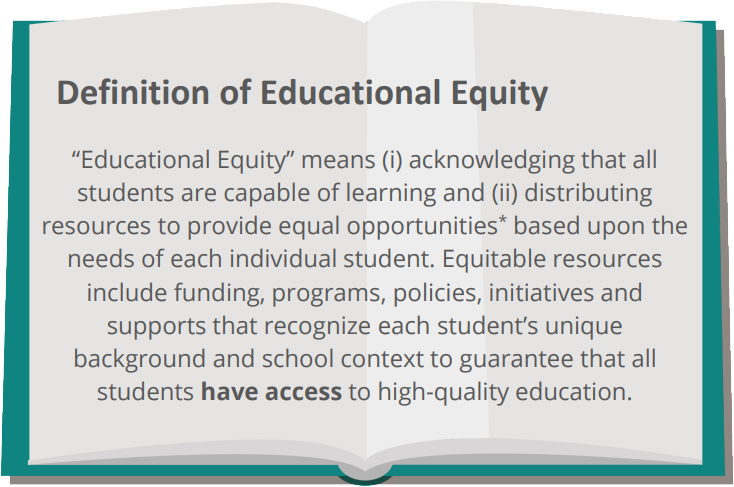
DEI is a protection for everyone. Educational Equity is fundamentally about lifting up every single child so that they have an equal opportunity to succeed. Educational Equity is an enabler for success. All kids benefit from schools that know how to serve each and every child.

That said, it’s not time for stupid political stunts. The attempt to repeal the Education Equity Rule (R277-328) is exactly that. If you say that the equity rule is simply “messaging”, then repeal of the rule is also “messaging”. It is a message that has a chilling effect of the political action taking place at your level.

  • developing tools for students to succeed in school INCLUDE equity.  
  • every superintendent in the state supports retaining the rule
  • a repeal has tangible effects, and would mean loss of professional learning, materials and formal processes for parental feedback 
  • the effort placed to get this rule passed 3 years ago was filled with tough questions about equity, and we got there. Alternately, there are current USBE board members who are actively working to defund public education.
  • for those board members who state that nothing will change after repealing the rule, this is absolutely not true.  There is already clear shift in classrooms after passage of H.B. 427 Individual Freedom in Public Education (https://le.utah.gov/~2023/bills/static/HB0427.html)

The rumors are that this repeal is being forced on the board before the Republican caucus to show alignment to conservative causes. You know, and we know that this is absolutely political.

What exactly is wrong with Educational Equity? What about this definition is disturbing for the board?  Reference https://www.utah.gov/pmn/files/745615.pdf. I encourage you to review the file.

Quite frankly, the policy may be there today, but the impact is not present in schools. It is disingenuous to say that the Education Equity Rule is not relevant because other policies are in place elsewhere. The reality is that discrimination has been happening and is happening today, and the USBE is not taking it seriously.

We need to do MORE to ensure Educational Equity at this time.  It is an embarrassment for the Board to consider a repeal of the Rule when considering events taking place in the past year. 

With a politically elected board, what is the expectation going forward? Should our children, who attend public education classes for 13 years in K-12 experience continued political shenanigans based on the partisan whims of the Board? You remove stability and you lose credibility.

On a personal note, I have 3 children who benefited from the public education that Utah provides. I have a daughter with disabilities who benefited from IDEA and 504 accommodations, but more importantly was accepted by her peers specifically because equity programs existed (i.e. fostering a learning environment that was safe and respectful of students and educators). It was how other students learned to see her as a person, and how she gained and shared important social recognition, and earned opportunities in education and sports working with her peers.

I emphatically request that the Board vote AGAINST Repeal of Educational Equity Rule (R277-328)  

Last, I know that my representative Natalie Cline WILL NOT and CANNOT represent me due to her extreme partisan bias. She is a scourge on the face of public education who actively works against the better interests of the majority of tax-paying Utahns putting their children through our public school programs. If only I had a board representative who believed in the betterment of education rather than to tear it down.  

Greg Green
South Jordan, Utah (District 9)

“Nothing About Us Without Us” – notes on Disability Pride

I inadvertently picked up on a kind of disability code that was common then: minimize the impact, hide it, sweep it aside as a mere personal detail – and get on with your life. This, I see now, was the opposite of disability pride.

Ben Mattlin

It is July 2023, and it’s Disability Pride month. As an ally, and a caregiver, and a person with my own disabilities I know that there are nuances to what pride means to the disabled community; but the word “disability” is an intentionally broad and inclusive term for us to gather under.

Disability Pride is about breaking down the shame and stigma that still abound in our homes, communities and at work. It is about being seen, it is about speaking up, it is for challenging institutional biases. It is a movement of porting conversations, and policies, and law, and architecture to recognize that we all contribute uniquely, that we engage and communicate uniquely, that we access things differently.

As an ally, I want to encourage you to recognize how different a view of the world is for someone who is disabled. Perspective is gained by engaging, by listening, and by learning. It’s a journey that I’m on too and I’m asking you to share it with me.

Learn more. Here are some book and film references (sorted by year of publication):

Connect. Here are some social media accounts to follow (sorted alphabetically by first name) – there are many accounts to follow but this will get you started:

  • Aaron Rose Philip – model – instagram
  • Abby Sams – adaptive athlete, model – instagram
  • Ali Stroker – actor, Tony Award (Oklahoma!) – instagram
  • Alice Wong – author – twitter
  • Andrew Pulrang – Forbes contributor, writer – twitterlinkedinsubstack
  • Ayanna Pressley – US Representative, Massachusetts (D)
  • Chelsea Bear – instagram
  • Christine Miserandino – author, “The Spoon Theory” – twitter
  • Gaylyn Henderson – Aerie model – instagram
  • Jillian Mercado – latinx model – instagram
  • Jim LeBrecht – filmmaker, Oscar nominee (Crip Camp) – instagramtwitter
  • Kim E. Nielsen – professor, author – linkedin
  • Lily D Moore – actor – twitterinstagram
  • Melissa Blake – activist, blogger, author – instagramtwitter
  • Rebecca Cokley – activist, author – twittermedium
  • Ryan O’Connell – author/star of Netflix “Special” – instagram
  • Serge Kovaleski – New York Times reporter – twitter
  • Shane Burcaw – author, model – YouTube
  • Steph Roach – instagram
  • Tammy Duckworth – US Senator, Illinois (D)
  • Zach Anner – YouTube

A Utah Reading List

Thanks to a post from Utah Parents United (who I will affectionately reference as Q-UTiP), we now have access to a fantastic reading list on books about marginalized and oppressed identities, particularly books dealing with race and LGBT issues.

Books on this list are Teacher’s Picks, finalists and winners of awards for National Book Award for Young People’s Literature, the Michael L. Printz Award, Stonewall Book Award, and the Pura Belpré Award. Many of these books are on the New York Times bestseller list. Several have been adapted to film.

DONATE BOOKS HERE: I’m providing a link to the Q-UTiP Banned Books list on amazon.com, where you can purchase any of these books for distribution to Little Free Libraries in our community, and to any 501(c)3 organizations based in Utah that are willing to accept book donations.

BUY YOUR OWN BOOKS HERE: You can peruse the list of Q-UTiP’s “banned” books below, sorted alphabetically by title. The links in the table go to the amazon.com page where you can purchase the book for yourself, if desired.

Title / Link to amazon.comAuthor
33 SnowfishAdam Rapp
A Court of Mist and FurySarah J. Maas
All Boys Aren’t BlueGeorge M. Johnson
Almost PerfectBrian Katcher
Beyond MagentaSusan Kuklin
Call Me By Your NameAndre Aciman
City of Heavenly FireCassandra Clare
Clockwork PrincessCassandra Clare
CrankEllen Hopkins
Deogratias: A Tale of RwandaJ.P. Stassen
Drama: A Graphic NovelRaina Telgemeier
Dreaming in CubanChristina Garcia
Dumplin’Julie Murphy
Eleanor & ParkRainbow Rowell
Extremely Loud and Incredibly CloseJonathan Foer
Forever for a YearB.T. Gottfred
Gender Queer: A MemoirMaia Kobabe
GeorgeAlex Gino
I Am Not Your Perfect Mexican DaughterErika L Sanchez
It’s Perfectly NormalRobie H. Harris
Juliet Takes a BreathGabby Rivera
l8r, g8rLauren Myracle
Lawn BoyJonathan Evison
Leah on the OffbeatBecky Albertall
LolitaVladimir Nobokov
Looking for AlaskaJohn Green
Love is LoveIDW Publishing
Marriage of a  Thousand LiesSJ Sindu
Me and Earl and the Dying GirlJesse Andrews
Monday’s Not ComingTiffany D. Jackson
My Friend DahmerDerf Backderf
Nineteen MinutesJodi Picoult
Not Otherwise SpecifiedHannah Moskowitz
Out of DarknessAshley Hope Perez
Perfectly Good White BoyCarrie Mesrobian
Perks of Being a WallflowerStephen Chbosky
Rainbow HighAlex Sanchez
Real Live BoyfriendsE. Lockhart
SOLDPatricia McCormick
SpeakLaurie Halse Anderson
The Absolutely True Diary of a Part-Time IndianSherman Alexie
The Art of Racing in the RainGarth Stein
The Bluest EyeToni Morrison
The Carnival at BrayJessie Ann Foley
The Handmaid’s TaleMargaret Atwood
The Handsome Girl and Her Beautiful BoyB.T. Gottfred
The Hate U GiveAngie Thomas
The House on Mango StreetSandra Cisneros
The Invisible Life of Addie LaRueV.E. Schwab
The Kite RunnerKhaled Hosseini
The Kite Runner Graphic NovelKhaled Hosseini
The Music of What HappensBill Konigsberg
The Poet XElizabeth Acevedo
The Truth About AliceJennifer Mathieu
Thirteen Reasons WhyJay Asher
Two Boys KissingDavid Levithan

Reference