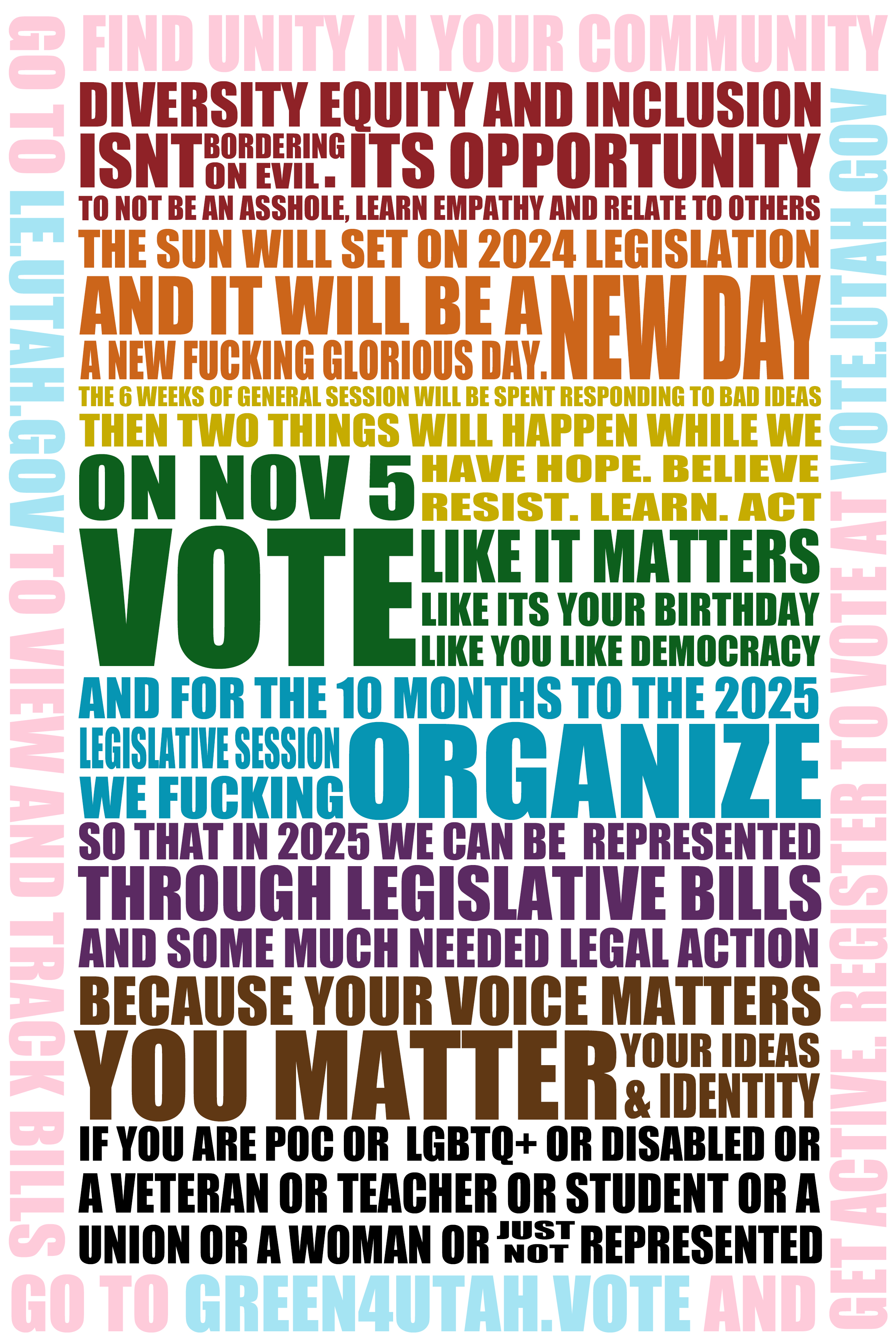
Response: Freethought Equality Fund PAC Survey
March 12 Update: I am pleased to announce that the Center for Freethought Equality Fund PAC has endorsed my campaign! You can find their endorsement here.
For transparency, I am providing my answers to their survey from Center for Freethought Equality Fund PAC so that my positions on these questions can be shared with constituents.
Q1: Do you acknowledge that we are in a climate crisis, which is primarily influenced by human activities?
Yes. The vast majority of scientists agree that humans are causing global warming and climate change, based on our use of fossil fuels.
Q2: Should concepts such as “intelligent design” and/or creationism be taught in public school science classes alongside evolution?
No. These concepts are anti-science and have no basis to be taught in public schools.
Q3: Do you support a person’s right to obtain a medically safe and legal abortion?
Yes. We need to stop legislating a person’s body. Medical decisions should be made in a safe and private setting between a woman and her doctor.
Q4: Do you support public funding of school voucher programs that may be used at religious schools?
No. Public money should go to public schools. Education funds are for education, not indoctrination.
Q5: Should terminally-ill patients have the right to obtain and self-administer palliative, life-ending medication?
Yes, but guardrails are necessary. We would need to address how mental health is treated, prevent institutions from adopting eugenics as a program of treatment, and ensure that incentives for guardians and caregivers don’t exist to influence end-of-life decisions. If a patient is deemed unresponsive, incompetent or intellectually disabled, who decides? In terms of disability law and disability justice, this issue also raises concerns for disabled individuals about disability rights and personal choice/representation.
Q6: Do you support legislation to provide equal rights for members of the LGBTQ+ community in employment, housing, education, and public services?
Absolutely, yes.
Q7: Do you support efforts to establish a federal Commission that would study the effects of slavery and discrimination on African Americans, and would recommend remedies that could include reparations?
Yes. I believe that California’s Reparations Task Force have findings with support of specific state bills based on those findings (formal apologies, addressing health and wealth gaps, returning land). However, a meaningful cash reparation at the federal level is challenging and not likely – political support, details of eligibility, meaningful payments, a system to identify recipients and manage distributed payments are lacking.
Q8: Do you think that belief in a god is a requirement to live an ethical life?
No. To be more specific, a belief in god is often used to justify hateful acts, or to use a confession or conversion as a shield from past wrong-doing. Humility, grace, morality, accountability and servant-leadership are all accessible ethical values that humans can embrace and ascribe to.
Q9: What is your religious background, and how do you identify when asked to do so?
I am an atheist. As a child, my family was originally Methodist and I was baptized in a Methodist church. We moved frequently as I grew up, and my formative years were set in an Assembly of God (AoG) church. When I was 12 my mother was diagnosed with an aggressive form of Multiple Sclerosis, and we experienced the abandonment and judgement of members (if she only renounced sin and truly accepted Jesus in her heart, she would be healed). I intermittently stopped going to church then, but didn’t completely reject a concept of god until my housemate committed suicide when I was 22. At her grave service the priest disparaged her memory by saying he doubted she was in hell but had to make a journey through purgatory. I have no second thoughts following my decision to leave religion behind me.
Q10: What role does religion play in your personal life, and what influence will your beliefs have on your public policy decisions as an elected official?
As an atheist, I respect other’s religion and welcome conversations to learn what motivates and inspires faith for them. I believe that there is a common desire for community, for acceptance, and for hope in all of us.
My beliefs: Act with empathy. Take time to understand where your point of view comes from, and think about where others are coming from. There isn’t a good excuse for ignorance, prejudice or ambivalence – and it’s not respectful to dismiss any of that. Diversity is accepting that we all come from very different backgrounds and understanding that it’s actually a benefit to work with our collectively diverse perspectives. Inclusion is about engagement – having conversations, contributing ideas and sometimes challenging things. Inclusion is about building respect and trust, and taking away barriers that limit us from fully engaging and seeing others. It is about truly understanding the worth and value we each have, and what we can do if we bring it together.
Q11: Will you speak out and be a leader for the equality of all people, including humanists, atheists, agnostics, and other nonreligious Americans?
Absolutely, yes. I will defend our first amendment freedoms.
Q12: If elected, would you take your oath of office on the Constitution rather than on a religious text?
I would not use any religious text. For reference, there is no reference in our Utah Constitution about taking the oath on a document. See Article IV, Section 10. [Oath of office.] All officers made elective or appointive by this Constitution or by the laws made in pursuance thereof, before entering upon the duties of their respective offices, shall take and subscribe the following oath or affirmation: “I do solemnly swear (or affirm) that I will support, obey, and defend the Constitution of the United States and the Constitution of the State of Utah, and that I will discharge the duties of my office with fidelity.”
The Audacity of His 5,000 Words
In a Substack post on February 16, Governor Spencer Cox presented what he called An accounting of my actions on DEI. It appears to be his first article, and utilizes a “coming-soon” suffix in the URL that suggests it was hastily published.
Not to offend his good readers, he has the audacity to call his critics light readers who communicate with elected officials in 280 characters, stoked by anger, reactionary/don’t read the articles, don’t listen to the interview, the progressive left. Way to #DisagreeBetter, amiright? There is one truth – that there is a “growing and divisive political ideology behind DEI”, but it’s coming from the conservative right.
He quickly calls what is now a cherry-picked conservative trope: “We used to aspire towards the dream of Martin Luther King Jr. of a future where our children “will not be judged by the color of their skin, but by the content of their character.”” Maybe we start by educating Governor Cox on the Martin Luther continued to say in the very next paragraph of his “I Have a Dream” speech.
“I have a dream that my four little children will one day live in a nation where they will not be judged by the color of their skin but by the content of their character. I have a dream today.
I have a dream that one day down in Alabama with its vicious racists, with its governor having his lips dripping with the words of interposition and nullification, one day right down in Alabama little Black boys and Black girls will be able to join hands with little white boys and white girls as sisters and brothers. I have a dream today.”
Martin Luther King – I Have a Dream, 1963
The difference, apparently, is that we are in Utah, but our governor still has his lips dripping with the words of interposition and nullification.
Utahns live in a heavily gerrymandered state bent on breaking the voices of what he calls the “progressive left”. He disregards our history; that Republican legislators who thwart the will of its people by over-riding voter mandates, then attempt to legislate future opposition from referendums by setting the bar higher. Our governor signs bills that take away freedom of speech, and freedom of expression. He does not veto, he does not comment, he simply signs. His republican counterparts submit bills that dismantle peoples’ right to organize, or to force their religion into schools, or to tell a woman what she can and can’t do with her own body. And in light of DEI, he works with his Republican legislators to weaken citizen review boards after a series of police shootings that killed POC and disabled individuals. And he takes away the offices of Diversity, Equity and Inclusion from our universities and for public places, even after Davis School District is sued successfully not just once, but TWICE for discrimination. Even though we have a problem with Patriot Front placing banners on our overpasses, and passing Nazi literature around on campuses. He says we need a neutral space to let everyone be comfortable thinking and saying whatever they want. And it’s all for a better purpose, right? Nope.
None of this is new. In fact, the playbook for this doesn’t even start in Utah. In 2023 the far right introduced at least 65 bills to limit DEI in higher education in 25 states and the U.S. Congress. This year there are currently more than 30 bills across the U.S. targeting diversity, equity, and inclusion initiatives at public colleges. Utah is a cuckold to the ideology of a national far-right agenda. Bills introduced in Utah followed other states actions, and are typically copy/pastes of other state bills.
He says “I had no idea that there were these many programs, these many people working in these offices. And so then the question is, well, what are the outcomes? Are we actually making a difference? And we’re not seeing any evidence that they’re actually working.” The funny thing about providing safe spaces for marginalized groups is that when it’s working, nothing happens. Nothing makes the papers. I’m not sure what Cox was expecting. Ironically, he broke DEI because it was working.
Grievances about the illogic of his article:
- Cox really doesn’t like equity. He states in the 2nd paragraph of section “The problem with DEI” that “it’s important to note that the E in DEI stands for “equity” – equal outcomes, and not “equality” – equal opportunity).” Inclusion comes with equitable outcomes, not with the presentation of opportunity.
- It’s clear that Cox doesn’t know what “woke” means. Her prefers to use the conservative slur that the word is evolving to, and fails to recognize the significance of that word’s history. Stay woke, people.
- He claims that diversity programs are “drawing battle lines” and references Eboo Patel to justify his stance, but fails to recognize that Patel was recognized and celebrated by the University of Utah department of Equity, Diversion & Inclusion mere months ago.
- His primary evidence is that a DEI statement was included in university application packages. This is literally the only tangible thing that he can point to when claiming that Universities are using identitarianism to force people into boxes, and into victimhood. And this is AFTER he signed legislation last year that prevent teachers from displaying personal items in their rooms. God forbid that anyone actually have an identity. If this is supposed to be Cox’s smoking gun, why all the huffery puffery when it could have been resolved with a simple HR update?
- In his arguments, he defends white kids, and he defends men. He says “I care deeply about our brown kids and our black kids.” I would ask for the numbers here, because he doesn’t provide any.
- Cox says “Government can and must be race-blind, but that does not make us racism-blind.” This is not true. Government must respect the rights of its constituents, but nowhere does it say to be “race-blind”. To say this is to ignore history, culture, and identity.
- Cox mentions a history of segregation, but fails to mention the actions of the legislature (again) using vouchers to segregate kids with disabilities away from public schools, or to consolidate programs away from home schools.
- Offhand, I’m also concerned that Cox’s chosen platform happens to be Substack, which has recently been described as a newsletter-hosting site with a Nazi problem, and accused of paid advances to several controversial writers, while some writers with long histories of anti-trans work are thriving.
The problem, apparently, is that Cox wants to turn a blind eye to the real problems that DEI offices were addressing by disbanding these offices, creating a “success and support” office with no parameters to build from and with no federal supports. His defense of this horrid legislation will result in the loss of federal dollars for state programs, potentially lose Salt Lake’s bid to host the 2034 Winter Olympics, and will certainly be fought in courts at the expense of Utahns.
MORE READING
Black History Month
I was invited to participate in some brainstorming for the theme of the Wednesday, February 21st Black History Month Day on the Hill at the Utah State Capitol from 3-6PM. The chosen theme inspired some ideas that I had floating around in my head, so I took time to create one (below). Please join us to celebrate and defend our common history, and educate to eradicate racism. Credit to Amanda Gorman
for her words from “The Hill We Climb”.

Response: BLM Utah Chapter – Police Transparency & Accountability Survey
This is not an endorsement.
For transparency, I am providing my answers to a survey from Black Lives Matter Utah Chapter – Police Transparency & Accountability Survey so that my positions on these questions can be shared with constituents. I want to make note that some of the survey questions are either too broad or specific, but are also required to complete the survey. Please see my comments following these blocks of questions for better explainers of my stances. . My response to BLM Utah appears on their site here.
Q1: Email
ggreen.hd44@gmail.com
Q2: Do Black Lives Matter? (respond Yes/No)
Yes
Q3: If elected, or re-elected, what programs will you implement to help the black and brown community?
The House Representative role is a 2-year term, and I will be a freshman in Utah’s congress. Having said that, my approach (if I move forward at Caucus and participate as a candidate in the general election) will be to organize groups to work together on shaping 2025 legislative bills that can be submitted in the new year. You can see the list of topics that I want to submit bills for at https://utah44.com/proposed-2025-legislation/
Q4: First and Last name
Greg Green
Q5: What City/State are you running in?
South Jordan, Utah
Q6: Which district?
44
Q7: Which office are you running for?
Utah House of Representatives, District 44
Q8: Who is/are your opponent(s)? (Please disregard if your race has concluded)
Currently: Jordan Teuscher (R) – incumbent. I expect there will be more candidate filings, as No Labels Party candidates have a filing deadline of April 29, 2024. See https://vote.utah.gov/2024-candidate-filings/ for a current list of candidates.
Q9: Which of your opponents should NOT be elected, and why? (Please disregard if your race has concluded)
I am running against Jordan Teuscher, who is consistently anti-union, and actively legislates against workers rights that negatively affect teachers, public workers, and the unions that represent them. He has supported bills that degrade state career-service employees to at-will status. I support the right to organize, and to establish collective bargaining for both public and private employees. I also support a national bill to pass the Protecting the Rights to Organize (PRO) Act that will expand labor protections for employees’ rights to organize and for collective bargaining in the workplace.
– Jordan actively votes against diversity, equity, and inclusion (DEI) supports, and environmental, social, and governance (ESG) investing. Jordan is party to the overall “chilling” effect in Utah over racial equity, LGBTQ+ supports, trans rights, and promoting bias. I support diversity initiatives and strongly defend marginalized communities and environmental programs.
– Jordan is a proponent of vouchers that bleed our public school funding. I support our public school system, and believe that teachers and school administrators need to be allowed to do their good work without interference from the legislature. I support pay increases and retention programs that incentives to keep teachers in our schools.
– Jordan actively votes against pro-choice. I support women’s rights for safe abortion access. I also support school curriculums that provide age-appropriate instruction on sex education that is not based on “abstinence only”.
– According to the Alliance for a Better Utah, Jordan Teuscher receives an “F” rating for the 2023 legislative session.
Q10: If you are not elected, which of your opponents should win, and why? (Please disregard if your race has concluded)
There is no a preferred alternative.
Q11: What is your political party? (Democratic, Republican, Green, Other)
Democratic
Q12: In September 2021, the Salt Lake Tribune, in partnership with PBS Frontline, released an in-depth investigative report on the racial and ethnic make-up of people shot by Utah police. The report revealed that Utah police shoot people who are Black, Hispanic, Native American, and Pacific Islander disproportionately to white people. Moreover, the majority of white people shot were in possession of a gun or fake gun, while the majority of racial and ethnic minorities were not. What is your reaction to these findings and what will you do to address these disparities? https://www.sltrib.com/news/2021/09/20/new-data-utah-police/
We need a close relationship with our police force that respects community engagement but is not patronizing. Diversity initiatives and accountability measures have significant impact in transparency and trust. Education is important, particularly for de-escalation and for interactions with the disability community, and mental illness. I also think we need more community resource engagement rather than police intervention. Justice is an important concept that must be found in cases where threats, intimidation, discrimination, detaining, violence and death. Our goal should be “everyone is protected, and everyone is respected”. (this answer is repeated later in this survey)
Q13: Several major cities across the United States have created Community Controlled Civilian Review Boards which have the power to discipline police. Community-based organizations in Salt Lake City have developed a model ordinance, the Salt Lake Civilian Police Accountability Council (SLCPAC), which would establish a community-controlled civilian review board in Salt Lake City. Would you support the creation of the SLCPAC or other similar boards in your city and in Utah? (We are aware that HB415, which was passed during the 2019 General Session [https://le.utah.gov/~2019/bills/static/HB0415.html], places some restrictions on creating review boards, yet does not make it impossible.)
I support the creation of the SLCPAC and similar boards in cities and counties of Utah. Following a summer of protests over the killing of George Floyd and widespread examples of police brutality, common-sense reforms like increasing oversight and accountability over local police agencies should continue to receive attention. I have concerns about appointment to a CRB, and what actions can be taken if a member of the CRB acts unethically. Decisions by the CRB should be handed to a prosecuting authority rather than grant the CRB full punitive capabilities. CRBs should have authority to make recommendations for individuals, departments, cities and counties with referral to hiring organizations, or for escalation to broader authorities to intervene.
Q14: Would you support efforts to repeal HB415? (respond Yes/No)
Yes
Q15: What is your reaction to the limitations that HB415 places on local authority to create independent civilian review boards?
HB74 was submitted in 2021 but did not pass through the legislature that year. We need to create a replacement for HB415 that will survive both houses.
Q16: Would you advocate for, or oppose a stronger use of force policy for police?
I oppose a stronger use of force policy. See https://utah44.com/issues-police/
Q17: How strongly will you advocate for the following policies regarding public information about actions taken by police officers in your district? (Select only one: Very Strongly. I will work proactively to make this happen; Strongly. I will advocate when it comes up; Somewhat strongly. I will be mildly positive about it; Not strongly. I do not really agree with this policy; Not at all. I do not agree with this policy)
- Require officers to report all uses of force to a public database (Very Strongly)
- Use a database to inform an early intervention system that retrains and disciplines officers with repeated uses of force or civilian complaints (Very Strongly)
- Make a Use-of-Force database available to the public. (Not at all)
- Make footage from body cams in situations involving use of force available to the public (Very Strongly)
- Publicly release unedited body cam footage of officer-involved shootings (Not at all)
- Require public release of unedited body cam footage of uses of force and officer-involved footage within 10 days of the incident. (Very Strongly)
- Require public release of demographic information on people stopped by police in your district (Strongly)
- Require public release of demographic information on people arrested by police officers in your district (Strongly)
Q18: Please add any comments about your views on providing the public with information about actions taken by police officers in your district.
These radio selections are generally too broad or too specific. Aggregated data on people stopped or arrested should be anonymized to protect individuals, and the frequency of reporting needs to be specified. I have concerns about who would be authorized to maintain the proposed public database, and what compliance measures would be in place to ensure that records are submitted promptly and maintained for a specified period. FOI requests for information, including body footage, should always be expedited.
Q19: How strongly will you advocate for the following policies regarding video recording devices/ bodycams? (Select only one: Very Strongly. I will work proactively to make this happen; Strongly. I will advocate when it comes up; Somewhat strongly. I will be mildly positive about it; Not strongly. I do not really agree with this policy; Not at all. I do not agree with this policy)
- Require police officers use technology that collects audio and visual data of police interactions (including body cameras)(Very Strongly)
- Develop clear policies governing bodycam use, storage and accessibility of footage in consultation with activists and community organizations (Strongly)
- Record all police interactions with civilians (except where a civilian opts not to be recorded, notification of the option not to be recorded should be required upon first contact) (Not Strongly)
- Make footage from body cams in situations involving use of force available to the public (Strongly)
- Allow civilians to review footage involving them or a relative and require this information be released to the public (Strongly)
- Prevent officers from reviewing footage of an incident before completing initial reports or statements (Strongly)
- Secure the privacy of civilians during all processes (Very Strongly)
- Assure the right of the public to record the police by video and audio, without fear of having their devices confiscated or damaged (Very Strongly)
Q20: Please use this area to add comments about your views on policies for bodycam usage.
Again, these radio selections are generally too broad or too specific. If police are required to interact with civilians and be recorded, then it should always be recorded. There are too many legal loopholes for who would be authorized to request no recording (in a domestic dispute, does the abuser have the right to say no camera?). If a violent crime is committed in a business, does the business manager have the right to request no cameras so their business isnt negatively impacted?). Privacy needs to be assured unless the case is exceptional (a threshold would need to be determined). This also raises concerns about the public database access referenced in the previous question. Requests for footage should not be limited to individuals involved and their families. Anyone should be able to make a FOI request for information.
Q21: How strongly will you advocate for the following policies regarding de-escalation techniques and non-force actions by police officers in your district? (Select only one: Very Strongly. I will work proactively to make this happen; Strongly. I will advocate when it comes up; Somewhat strongly. I will be mildly positive about it; Not strongly. I do not really agree with this policy; Not at all. I do not agree with this policy)
- Prohibits officers from using force on a person for talking back or as a punishment for running away (Very Strongly)
- Implement a performance evaluation system that rewards, and values effective interpersonal skills (de-escalation, effective work with people who have mental health and substance abuse challenges, and countering bias, etc.) (Very Strongly)
- Modify police department use of force policies to require officers use minimal force and de-escalation tactics, carry a less-lethal weapon, and intervene when another officer uses excessive force (Very Strongly)
- Require training for and use of non-force techniques for people with mental health and/or substance abuse issues (Very Strongly)
- Require training for and use of non-force techniques for people who are homeless and/or are victims of domestic violence (Very Strongly)
- Re-allocate funding for non-sworn personnel who can assist in cases of mental illness, substance abuse, homelessness, and domestic violence (Very Strongly)
- Require training that uses the latest science on implicit bias based on social identities, including people of color, LGBTQ individuals, and non-English speakers (Very Strongly)
- Require evaluation of police officers’ ability to recognize bias and knowledge of techniques to counter it (Very Strongly)
- Reward police officers who successfully use anti-bias techniques (Very Strongly)
- Conduct an assessment of what kind of training is most effective in terms of helping law enforcement personnel to achieve goals of effective, non-violent policing (Very Strongly)
- Implement training identified as the most successful toward achieving effective, non-violent policing (Very Strongly)
Q22: Please share your comments on de-escalation techniques and non-force actions by police officers in your district.
This is all very strongly supported by me. All of these options are excellent. Might want to update annual trainings on what it means to uphold the law to include mandatory reporting for ethics violations, including acts of excessive force.
Q23: How strongly will you advocate for the following policies regarding community involvement with police officers and the police department(s) in your district? (Select only one: Very Strongly. I will work proactively to make this happen; Strongly. I will advocate when it comes up; Somewhat strongly. I will be mildly positive about it; Not strongly. I do not really agree with this policy; Not at all. I do not agree with this policy)
- Hire a local research institution to field a regular survey of community perceptions of the police (Not strongly)
- Use results of a community survey to guide officer evaluations as well as department policies and practices (Very Strongly Support)
- Institute a model system where people stopped by the police are immediately given a card by the officer, with their name and badge number, what the stop was for, and how to file a complaint, should they chose to (Very Strongly Support)
- Increase representation from the community by hiring more women and Black, Indigenous, and People of Color as police officers (Very Strongly Support)
- Hold regularly-scheduled community forums about police activities (Very Strongly Support)
- Implement special outreach to minority communities to participate in community meetings (Very Strongly Support)
- Support Civilian Review Boards (CRBs) in your district to hold police accountable for misconduct
- Give CRBs the power to investigate police misconduct independently (Somewhat strongly)
- Give CRBs the power to subpoena individuals and collect documentation on police misconduct (Somewhat strongly)
- Give CRBs the power to discipline police officers found guilty of misconduct (Somewhat strongly)
- Give CRBs the power to investigate and discipline police misconduct, specifically in the case of a police shooting (Somewhat strongly)
- Promote, expand, improve, innovate the membership of CRBs (Very Strongly Support)
- Disallow current or former law enforcement personnel to serve on CRBs (Not at all)
- Disallow family members of law enforcement personnel on CRBs (Not at all)
- Make serving on a CRB a paid position (Not at all)
- Require an independent and external prosecutor, separate from the City or County prosecutor’s office, or any other government agency, to manage the proceedings following independent investigation (Strongly Support)
Q24: Please share your comments on community involvement with police officers and the police department(s) in your district
- We need a close relationship with our police force that respects community engagement but is not patronizing. Diversity initiatives and accountability measures have significant impact in transparency and trust. Education is important, particularly for de-escalation and for interactions with the disability community, and mental illness. I also think we need more community resource engagement rather than police intervention. Justice is an important concept that must be found in cases where threats, intimidation, discrimination, detaining, violence and death. Our goal should be “everyone is protected, and everyone is respected”.
- I have some concerns about “local research institution” versus a qualified organization. I understand that local issues, history, demographics affect research but should also include sound information gathering, analysis and reporting that can be aggregated to broader studies to perform meta-analysis of regions within the state, statewide, and regionally.
- Regarding former law enforcement or families being restricted from serving on the board… what if it was a former wife of a law enforcement officer who was protected from domestic abuse charges? What if the law enforcement officer was a whistle blower? Rather than make blanket exclusions, the criteria to serve on the board should be based on their ability to contribute to the stated purpose of the board.
Q25: Alternatives to Incarceration – Background: The United States incarcerates a larger share of its population than any other country in the world (Pew Research Center 2021). There are active nationwide campaigns seeking to reduce the prison population by half using strategies such as alternative to incarceration programs; the reform of money bail systems and extreme sentencing laws, and the provision of support to people who are reintegrating into society after incarceration. Questions: 1) What are your views on reducing the number of people who are incarcerated in Utah and the U.S.? 2) What changes do you believe need to be made to the Utah and U.S. prison systems? 3) Will you support the implementation of alternative to incarceration programs?
Stop privatizing prisons. Personal drug use and possession of drug paraphernalia should not be jailable offenses. At the Federal level marijuana should be removed from schedule 1 list of the Drug Schedule. We need to fund medical and mental health for incarcerated individuals, with tracked referrals for continuing treatment following incarceration. Career training and transition programs are critical to reduce rates of recidivism.
Section: Health and Human Rights – The next set of questions asks for your views on topics related to health and human rights.
Q26: Do you support the overturning of Roe v. Wade? (Respond Yes/No)
No
Q27: Please explain your support for, or opposition to, the overturning of Roe v. Wade.
I support women’s rights for safe abortion access. I also support school curriculums that provide age-appropriate instruction on sex education that is not based on “abstinence only”.
Q28: Do you support Utah’s trigger law (SB174) that would ban abortion with limited exceptions for rape, incest, and the health of the pregnant person? https://le.utah.gov/~2020/bills/static/SB0174.html (Respond Yes/No)
No
Q29: Please explain your support for, or opposition to, Utah’s trigger law (SB174). https://le.utah.gov/~2020/bills/static/SB0174.html
We need to stop legislating women’s bodies. Abortion is medical care.
Q30: Do you support Utah’s ban (HB136) on elective abortions after 18 weeks of pregnancy that went into effect after the overturning of Roe v. Wade? https://le.utah.gov/~2019/bills/static/HB0136.html (Respond Yes/No)
No
Q31: Do you believe the decision about whether to have an abortion should belong solely to the person who is pregnant? (Respond Yes/No)
Yes
Q32: In situations where abortion is illegal, which of the following people, if any, do you think should face penalties? (Select all that apply)
- The person who had the abortion
- The doctor/provider who performed the abortion
- The person who helped pay for the abortion
- The person who helped find or schedule the abortion
- None of the above (x)
- Other (explain): (x) Abortion is women’s health. It is a medical procedure carried out between a woman and her doctor. Travel (including interstate travel) should not be prosecuted. Laws in other states that penalize women, systems of support or health care providers should not be legally recognized in Utah.
Q33: Which of the following sexual and reproductive health measures do you support? (Select all that apply)
- Comprehensive sex education (x)
- Access to low or no cost contraception (i.e., birth control) (x)
- Access to low or no cost emergency contraception (i.e., “morning-after pills”, emergency IUDs) (x)
- Extending Medicaid coverage to postpartum people beyond 60 days (x)
- Expanding the Child Tax Credit (x) – see https://utahchildren.org/newsroom/speaking-of-kids-blog/item/1219-utah-child-tax-credit
- Expanding access to paid family leave (x)
- Other (explain): (x) Remove funding restrictions for charitable organizations, specifically Planned Parenthood.
Q34: On the final day of the 2022 Legislative Session, lawmakers passed a last-minute amendment to HB11 banning transgender girls from participating in school sports that match their gender identity. Although Governor Cox vetoed the bill, the legislature voted to override the veto. HB11 now faces almost certain legal challenges to its constitutionality. Would you support efforts to repeal HB11 in its entirety? (Respond Yes/No)
Yes
Q35: Please explain your answer to the previous question regarding efforts to repeal of HB11.
A similar question was asked in the “Black Lives Matter Utah Chapter – Education in Utah Survey”. Legislators should not be legislating gender identity, and the bill should be struck down as unconstitutional. For reference, policy was updated in the Utah High School Athletics Association handbook in 2020-2021 and going forward (https://uhsaa.org/Publications/Handbook/Handbook.pdf). Equality Utah supports this policy as equal treatment. See https://www.equalityutah.org/youth-laws.
Q36: Do you think that fossil fuels cause climate change? (Respond Yes/No)
Yes
Q37: If elected, what action will you take to divest from fossil fuels?
- Utah recently announced its selection by the IOC for the 2034 Winter Olympics, but the announcement comes with a mandate to improve air quality before we host this international event. Inversions mean that Utah has some of the worst air quality in the nation, and this affects everyone who lives here. Staged, multi-year legislation to reduce traffic, promote remote work, improve public transportation, implement stricter emission regulations on vehicles and commercial production are all necessary.
- We need to embrace clean energy, and that means investing in the development of clean energy technologies as well as producing jobs to replace economies built on fossil fuel industry.
Q38: Is there anything else you would like us to know? We appreciate your attention to these serious matters which so deeply affect the lives of so many.
- Please see my stance on issues at https://utah44.com/issues/. I also regularly post to the campaign blog at https://utah44.com/blog/.
A Democrat Running in a Red District
I hear this question from time to time: “What’s the Purpose of a Democrat Running in a Republican District?” HD44 is largely a Republican House District at 49.4% of voters registered as R’s. And I have responses, but the number one response from me is that my step into politics is because the “our” in our voice needs to be represented.
I am a candidate who is the right person, in the right place, with the right message. You can find my stance on issues at https://utah44.com/issues/.
- I am running against Jordan Teuscher, who is consistently anti-union, and actively legislates against workers rights that negatively affect teachers, public workers, and the unions that represent them. He has supported bills that degrade state career-service employees to at-will status. I support the right to organize, and to establish collective bargaining for both public and private employees. I also support a national bill to pass the Protecting the Rights to Organize (PRO) Act that will expand labor protections for employees’ rights to organize and for collective bargaining in the workplace.
- Jordan actively votes against diversity, equity, and inclusion (DEI) supports, and environmental, social, and governance (ESG) investing. Jordan is party to the overall “chilling” effect in Utah over racial equity, LGBTQ+ supports, trans rights, and promoting bias. I support diversity initiatives and strongly defend marginalized communities and environmental programs.
- Jordan is a proponent of vouchers that bleed our public school funding. I support our public school system, and believe that teachers and school administrators need to be allowed to do their good work without interference from the legislature. I support pay increases and retention programs that incentives to keep teachers in our schools.
- Jordan actively votes against pro-choice. I support women’s rights for safe abortion access. I also support school curriculums that provide age-appropriate instruction on sex education that is not based on “abstinence only”.
- According to the Alliance for a Better Utah, Jordan Teuscher receives an “F” rating for the 2023 legislative session.
I am a candidate serving the community, and not serving myself.
- I am not using candidacy as a means to promote myself, or to gain wealth.
- I am not beholden to any business or religious interests. I am representing the people in my district and statewide constituents.
- I am not hyping blockchain or crypto, or any other means of hiding dark money.
- I believe a rising tide lifts all boats.
- I believe in discourse, and working together when building solutions.
- See my blog post at https://utah44.com/the-am-and-am-not-of-my-campaign/
Even if not elected, I can help shape the voice of politics. I can help shape change:
- Promote upstream and downstream party candidates.
- Raise topics, change discourse and impact platforms.
- Encourage voting and representation for our party.
- Listen, respond and represent the voice of constituents (make the voice of people heard). Recognize that the legislature isn’t balanced to represent constituent interests.
- Challenge partisanship. Talk directly about issues.
- Resist. There are slews of anti-DEI bills introduced by a primarily conservative congress attempt to overwhelm.
I have enough shared experience and humility to know that I should listen and understand before I speak, and that my actions affect a community that I love and have much respect for. I hope that you will stand with me.
HD44 Demographics
House District 44 is a primarily residential district the encompasses the north and west of South Jordan city (28 voting districts SJD002-5, 7-11, 15-21, 27-31, 33-37, 45 and 62), and the southwestern edge of West Jordan city (4 voting districts WJD058-61).
Link: Demographic Profile of House District 44 (PDF)
NOTABLE FEATURES
- Oquirrh Lake, Daybreak Community
- Bingham Creek Regional Park, 10200 South 4800 West, South Jordan, Utah 84095
- Glenmore Golf Club, 9800 S 4800 W, South Jordan, UT 84095
- 16 South Jordan City Parks: Bolton Park, Dunsinane Park, Glenmoor Baseball Diamond, High Pointe Park, Jordan Ridge Park, Kilmuir Park, Oquirrh Shadows Park & Splash Pad, Prospector Park, Rushton Meadows, Southridge Park, Skye Park, Stonehaven Park, Sunrise Mountain Park, Triangle Park, Welcome Park, Yorkshire Park
- 3 West Jordan City Parks: Teton Estates Park, Vista West Park, Wildflower Park
SCHOOLS
Elementary Schools
- Eastlake Elementary, 4389 W Isla Daybreak Rd, South Jordan – home of the Dragons (2010)
- Elk Meadows Elementary, 3448 W 9800 South, South Jordan – home of the Falcons (1998)
- Golden Fields Elementary, 10252 S Split Rock Dr, South Jordan – home of the Gladiators (2017)
- Jordan Ridge Elementary, 2636 W 9800 South, South Jordan – home of the Eagles (1987)
- Welby Elementary, 4130 W 9580 South, South Jordan – home of the Wildcats (1979)
Middle Schools
- Elk Ridge Middle School, 3659 W 9800 South, South Jordan – home of the Wapiti (1994)
- Mountain Creek Middle School, 5325 W Bingham Rim, South Jordan – home of the Moose (2019)
- South Jordan Middle School, 10245 S 2700 West, South Jordan – home of the Snow Leopards (1989)
High Schools, Specialty Schools
- N/A
Public Charter Schools
- American Academy of Innovation, 5410 S Jordan Pkwy, South Jordan – home of the Titans (2016)
EMERGENCY SERVICES
Fire
- South Jordan #62, 4022 S Jordan Pkwy, South Jordan, UT 84095
Police
- N/A
Medical/Care Facilities
- Carrington Court Assisted Living & Memory Care, 1928 W 9800 S, South Jordan UT 84095
- CopperView Medical Center, 3556 W 9800 S #101, South Jordan UT 84095
- Jordan River Family Medicine, 1868 W 9800 S #100, South Jordan UT 84095
PUBLIC SERVICES
Trax
- South Jordan Parkway Station (Red Line), 10605 S. Grandville Ave, South Jordan 84009
- West Jordan 4800 W Station (Red Line), 4800 W Old Bingham Hwy, West Jordan 84088
Libraries, Recreation Centers
- N/A
COMMERCIAL ANCHORS
- Big Lots, 3931 W 9000 S, West Jordan UT 84088
- Harmon’s at Daybreak, 4727 W South Jordan Pkwy, South Jordan Utah 84009
- Maverik #5385, 9780 South Redwood Rd, South Jordan UT 84095
- Novel Daybreak Shops, 10678 S Lake Run Rd, South Jordan UT 84009
- OSI Industries, 4980 West 9470 South, West Jordan UT 84088
- Vasa Fitness, 3709 S Jordan Pkwy, South Jordan UT 84095
- Walgreens Pharmacy, 3863 W 9000 S, West Jordan UT 84088
- Walmart Supercenter #2307, 11328 S Jordan Gateway, South Jordan UT 84095
- Walmart Neighborhood Market #5120 (permanently closed eff Nov 2017), 3706 W 9800 S, South Jordan UT 84095
- 7-Eleven and Holiday #40 gas stations at 4000 W and 10400 South, South Jordan UT 84009
Letter: Addressing the Liability that is Natalie J. Cline
February 8, 2024 – a letter to audit@schools.utah.gov, the Utah State Board of Education board@schools.utah.gov, and individual board members regarding board member Natalie Cline’s reckless and endangering posts on social media.
- https://www.sltrib.com/news/education/2024/02/08/utah-school-board-leaders-promise/
- https://www.ksl.com/article/50871903/lawmakers-considering-impeachment-of-school-board-member-cline-over-controversial-post-
Hello Internal Audit Team and USBE Board Members –
Natalie Cline has committed defamation and reckless endangerment of a minor and her family.
How well beyond normal limits can a board member go before something is done? Please reign in Natalie Cline by censuring her. According to your ByLaws, which states that the board is allowed to immediately remove her from committee meetings and committee assignments, restricting her from placing items on the agenda, and taking other appropriate action.
I urge you to take “other appropriate actions” by censuring her, permanently banning her from all board activities, and referring her to the Attorney General for violations of law. If you can remove her from the board, find a way to do that.
Article IV, #12: A Member may be reprimanded, or the actions of a Member censured, for any violation of law, policy, Bylaws, or any other conduct which tends to injure the good name of the Board, following adequate due process, if appropriate. The Board or Board leadership may authorize any of the following:
a) A conversation between the offending member and the Board Chair/Leadership or Assistant Attorney General;
b) A written letter to the offending Member from the Board Chair/Leadership or Assistant Attorney General;
c) Censuring the offending Member by a vote of the Board;
d) Prohibiting the offending Member from attending any Board advisory committee meeting, as determined by the Board Chair;
e) Prohibiting the offending Member from requesting an item to be placed on an agenda, as determined by the Board Chair;
f) Removing the offending member from any or all committee assignments as determined by the Board Chair; or
g) Taking other appropriate action.
Natalie Cline has attacked schools, doxxed teachers, spied on teacher training, accused educators of “grooming children” for sex trafficking. This time she makes a baseless attack on a Granite District student on social media, and endangers the student and her family.
I know that my representative Natalie Cline WILL NOT and CANNOT represent me due to her extreme partisan bias. She is a scourge on the face of public education who actively works against the better interests of the majority of tax-paying Utahns putting their children through our public school programs.
If only I had a board representative who believed in the betterment of education rather than to tear it down.
Greg Green
South Jordan, Utah (District 9)
Jordan Teuscher wants SpEd students out of public schools
During a recorded Jan 13, 2024 Pre-Legislative town hall, Jordan Teuscher made a statement regarding the 2023 HB215 “Utah Fits All Scholarship” voucher program that was passed despite opposition from teachers and nearly every education organization in Utah. Teuscher says he wants to get special needs students out of public schools.
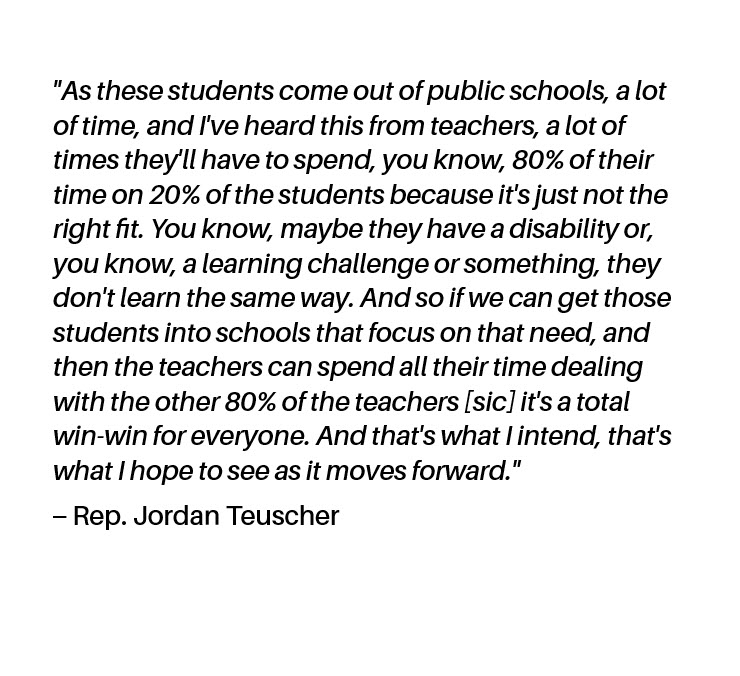
Here’s the part of the video from the townhall where he says exactly that. The full video is available here, with his comment made after 25 minutes into the video.
Apparently Teuscher doesn’t know much about the disability movement and the battle to move students with disabilities INTO public school systems. It wasn’t until 1975 that the Education for All Handicapped Children Act (EHA) was signed. EHA guarantees a free appropriate public education (FAPE) to each child with a disability in every state. The 1990 reauthorization changed the law’s name from EHA to the Individuals with Disabilities Education Act (IDEA). That’s where IDEA and FAPE come from.
In 1992 Board of Ed v. Rowley case, the Supreme Court concluded that to provide FAPE, a school district must provide access to specialized instruction & related services that provide educational benefit to a child with a disability.
Integrated schools have better outcomes. Students (ALL students) do better when they experience integrated classrooms. Casel studies from as early as the 1960’s point to these improved outcomes.
Link: https://casel.org/fundamentals-of-sel/what-does-the-research-say/
What Teuscher thinks is a “win-win” is a loss for everyone. His plan is regressive and exclusionary.
I have plenty to say about Sen. Lincoln Fillmore’s comments as well, but later. He says a bunch of stuff that’s either disingenuous, misleading or flat-out wrong. Keep in mind that Sen. Fillmore chairs the Public Education Budget Committee, but intentionally misspeaks.
Find Unity in Your Community