
My reading of late has been moving away from the traditional analytical non-fiction that I typically read, and is moving into what might be discovery, or distraction, or something like that. I realized recently that I’ve been interacting with an author on social media for a little bit – without having read any of her books – and solely by association through Jennifer Miller-Smith (who I owe thanks to). And that’s how I decided to read an urban fantasy book.
Before I start, I want to comment how there are three related topics that circulate in the book that really made me pay attention:
- Facades, and whether we use them to charm, “shimmer” or repel others
— particularly the way we try to blend and hide ourselves;
— our inability to see ourselves as others see us; and the glimpses we gain of ourselves that can be startling and revelatory;
— and, of course, the obvious characteristics and flaws we can’t hide from ourselves and others, that can be problematic to our own vision of who we are.
— I associate this with the totems we create for ourselves? We either anthropomorphize or attach to stereotypes that ground and connect us. We want to look a certain way, or be perceived a certain way, so we work really hard to create the illusion of ourselves using things around us. - Our desire to find meaning through others’ stories and connection
— using other people’s histories, and finding some reflection and acceptance of personal stories in your own past matters greatly;
— how it takes time to process and cope with tragedy – that too often you have to be able to get through and turn around to look back to know what it was that you went through;
— escaping suicide and its ideations by understanding that pain isn’t escaped, rather it is spread out - The idea of death, and moving between worlds, and what it means to be in between
— there’s a lot to explore here that Arcadia gives room for;
— some interesting comments, like p.85 “Lisa is still dead?” that just… raises questions.
It wasn’t just faeries and mythology either. I really admire the level of detail woven into the characters.
- delving into physical rehabilitation and the use of prosthetics;
- learning about nuances of BPD, with some reflections that felt too harrowingly close to how I have interpreted interactions and mentally processed my life so far;
- the acts of compartmentalization; coping; distracting and the benefits of therapeutic practices at work, and the reason mind and the emotion mind;
- what it’s like to work in systems with unknown rules and suffer consequences; and
- the need for psychological constructs, familiars, muses, and echoes.
I also really loved the neurodivergence on display. I encourage you to go find Abigail and her one-liner.
It’s surprising how much a book can draw you into its space, and that’s improved when the author shares really insightful comments about how she writes to improve a reader’s perception and experience.. a little of that brilliance shared on BlueSky:
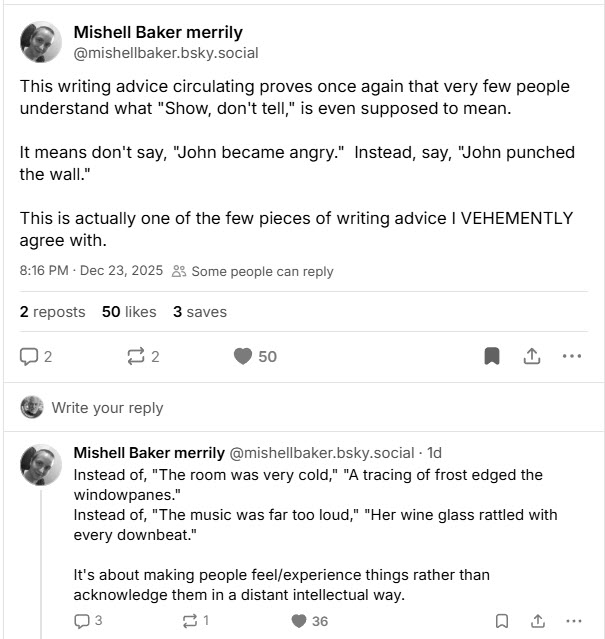
An Interwoven World
The interweaving of folklore, faeries and mythology was actually fun to read. I’m not generally a fiction/fantasy reader by default, so Baker’s descriptions and character’s postulating on “what makes the world” created some nice interconnects. As a new reader in the genre I appreciate that she took time to explain some things that wouldn’t have held glue in my mind.
Some Savored Quotes
I really don’t want to ruin anything, but I really need to impress the thoughtfulness and reflection in the story writing. These page references are from the Saga Press softcover, first edition:
- p33. “Suicide is not a way of ending pain; it’s just a way of redistributing it.“
- p112. “I’m not inclined to elect you arbiter of normal.“
- p134. “…the Borderline apology that means I’ll lie and say I was wrong, just don’t leave me.“
- p302. “Long after you quit feeling that glorious rage, your words linger.“
- p302. “Memory is a sketch artist, not a camera. People add and subtract whatever detail they need to. They say they forgive you, but they don’t. “
Millie’s Work
The Stone Guest (Millie Roper) – is a movie created by Millie Roper that received attention before her life profoundly changed. P222 describes it as a story of a young heroin addict trying desperately to connect with her estranged mother after her father’s death.
If there’s any sort of knock-off from the Arcadia project, that’s a storyline I’d love Baker to flush out.
David’s Work – The Cotton “Trilogy”
- Blue Yonder (David Berenbaum) – Millie is 10 when her dad (still living) takes her to see this
- Red Cotton (David Berenbaum)
- Accolade (David Berenbaum)
- Black Powder – work in post (David Berenbaum) – Millie is 26
I’m including the movie titles and some ages for Millie to give us an idea of the works referenced. I’m honestly not sure what to infer from the movie titles. There are indications of a much more expansive career to Berenbaum’s timeline but these are the notable films for the book. I think it’s interesting that the intended “trilogy” ends with Accolade, which is noticeably less well-received than the first two films, and followed by a fourth unofficial return-to-namesake movie titleage. I’m pretty sure I’m missing something important.
Summary (of Sorts)
I really don’t know how to do reviews for fiction, but I thoroughly enjoyed this book; and I plan to read more of the series. Her stories are well-constructed and provide plenty of circumstance to self-apply and be thoughtful about.
FWIW, it’s now shared in the Little Library in my front yard. Good books are always worth sharing.
Reference
The Arcadia Project series is made up of Borderline, Phantom Pains, and Imposter Syndrome.
Author Site: https://mishellbaker.com/
Amazon Author Page: https://www.amazon.com/stores/Mishell-Baker/author/B01NAJ120T
Discover more from Utah House District 44
Subscribe to get the latest posts sent to your email.