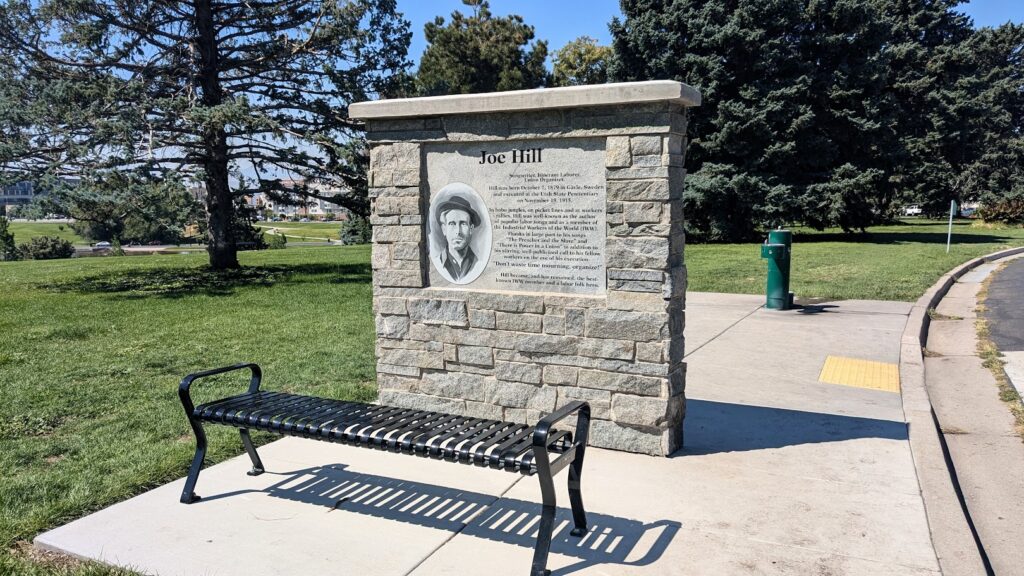
Celebrating Labor Day in Utah

The Joe Hill monument in Sugar House Park

Labor Day is a time to honor the American worker and their contributions to society. In Utah, this holiday holds particular significance, as the state has a rich history of union activity that has shaped its workforce and economy. Unions have played a crucial role in Utah’s labor movement, advocating for fair wages, safe working conditions, and workers’ rights. Through collective bargaining, unions have negotiated contracts that have provided workers with better benefits, education and career advancement, job security, and a voice in the workplace. Labor Unions have been primary drivers for workplace safety, standard working hours, ending child labor, and emphasis for improved public education.

  • In 1852, the National Typographical Union was organized in Salt Lake. It became the first permanent national union in our country. Through its evolution, the International Typographical Union (ITU) merged and is now part of Teamsters and CWA unions. 
  • Joe Hill was a famous activist songwriter and member of the Industrial Workers of the World (aka the “Wobblies”). In 1914, Hill was accused of a murder and subsequently sentenced to death at Sugarhouse Prison.  His lawyer stated “The main thing the state had on Hill was that he was a Wobbly and therefore sure to be guilty. Hill tried to keep the IWW out of [the trial] … but the press fastened it upon him.”  Prior to his execution, Hill had written to Bill Haywood, an IWW leader, saying, “Goodbye Bill. I die like a true blue rebel. Don’t waste any time in mourning. Organize …” A monument to Joe Hill was raised in 2023 at Sugarhouse Park, the site of the former Sugarhouse Prison.
  • In 1933, Utah passed its Prevailing Wage Law, which lasted almost a half century before being repealed in 1981, using claims that prevailing wage was in conflict with right-to-work laws passed in 1969
  • In 1955, Utah became the 18th state to adopt Right to Work legislation (Since the 1920’s there was the national, anti-union, open-shop “American Plan”, a predecessor of right-to-work; and followed closely after the 1947 Taft-Hartley act)
  • When Martin Luther King addressed the AFL-CIO’s fourth convention in 1961, he dubbed the AFL-CIO and the civil rights movement “the two most dynamic and cohesive liberal forces in the country” 
  • Under Title 34, Chapter 34 of Utah Code adopted in 1969, the state code maintains a “neutral” stance in that an employer cannot require or abstain employees from belonging to a union, and does not deny employees’ right to collective bargaining. This means that unions can be formed, but individuals are not required to join a union, or pay union dues. 

It’s important to note the difference between Right-to-Work laws and Right-to-Organize laws. Right-to-work typically focuses on the individual employee, and weakens collective bargaining power. Employees not covered by a union can be subject to at-will work agreements where employers can reduce workforce, lay-off and re-organize with no significant repercussions to the business, but devastating impacts to the employee. Additionally, employees often discover that loyalty to a company isn’t rewarded through commensurate advancement, pay or recognition because employees are treated like assets rather than an investment. In contrast, Right-to-organize typically focuses on the fundamental right of workers to form unions and perform collective bargaining, and strengthens collective bargaining power. 

Utah is a right-to-work state, which means that individuals cannot be compelled to join a labor union as a condition of employment. This law has significant implications for unions in the state. While it allows workers to choose whether or not to join a union, it also limits the ability of unions to negotiate exclusive contracts that cover all workers in a particular workplace. As a result, unions in Utah may face challenges in organizing workers and bargaining for collective agreements that benefit all employees. Right-to-work laws can weaken the bargaining power of unions, making it more difficult to negotiate for higher wages, better benefits, and improved working conditions. The loss of a prevailing wage in our state has significance in that there is a constant demand for “cheap” versus “good” that only encourages a slow spiral to the bottom for workers’ wages, their workspaces, product quality, and service availability. 

Unions are one of the most important tools to address the disparity of wealth distribution, and a legitimate tool to manage the welfare and way of life for Utahns.  This is a key issue separating myself from incumbent Jordan Teuscher. The current representative from our district is anti-union and is the sponsor of HB285 Labor Union Amendments which impacts public employees. He has also submitted bills in past legislative sessions (like the 2023 HB241 Labor Union Amendments) that work against worker rights. We are facing anti-union actions from a national level to degrade unions in Utah. Groups like ‘Workers for Opportunity’ and ‘Mackinac Center for Public Policy’ are engaging with conservative legislators to introduce legislation veiled as “worker freedom”, but in reality represent a furthering of “right-to-work” policies that weaken labor laws and tear down worker rights. Teuscher is a copy/paste legislator introducing right-wing legislation from ALEC that was also run in Texas and Florida. He’s doing the same thing working with the Foundation for Government Accountability (FGA) whose focus is to push, repackage and franchise conservative agendas. He literally takes his cues from national right-wing think tanks rather than representing the people in his district.  

This Labor Day, think about workers’ rights and the state of our economy.  We need to build from the middle up, and that means giving workers the ability to negotiate fair compensation, fight for workspace safety and product quality in response to the do-more-with-less mantra of companies that treat employees like assets rather than real people, and seek less regulation, less liability, less community commitment, but constantly report record profits. Take time to celebrate the achievements of Utah’s labor movement and the contributions of the state’s working people. It is a reminder of the importance of unions in protecting workers’ rights and ensuring fair and equitable workplaces. 

REFERENCE ARTICLES 

A Story of Utah Healthcare

On Sunday it will have been nine weeks after my son left home in psychosis, convinced that a casual remark I made about calling Vocational Rehab for help with a job meant I was (in his mind) a sociopathic narcissist who he wasn’t safe to be around. He left a home to live in his car, with no savings or income. It’s not the first time that he has done something like this, but each time I worry that it might be the last time I see him.

In February there was a national shortage of his antipsychotic medication, a long acting injectable that he took every four weeks to relieve symptoms of psychosis.  Although it didn’t “cure” him, he was stable and had been at home since his last big break in 2019. Since then we had negotiated through parole visits and mental health court. He struggled to work steadily but couldn’t keep a job. He has worked at more than 40 places since he was diagnosed, but hasn’t averaged more than 3 weeks in any single job. In almost all of these jobs he has chosen not to reveal that he has a mental illness. He is fired, or quits, or stops showing up.  There are unreported accidents from work. There are timecards left unsigned and unaccounted. There are customer complaints, or employee complaints, or HR reports. Oftentimes he would come home to say that a co-worker was one of the new voices in his head tormenting him, and he didn’t want to work around them any more.  

To make up for the temporary shortage, his prescriber decided that another LAI could be prescribed. I had immediate concerns because we had tried switching over to this other medication before, and the results were that he lost efficacy in his treatment.  The three of us got on a Zoom call to discuss treatment options, and the doctor was steadfast that the treatment would work with a new method of onboarding doses before transitioning to a more standard regimen.  I was skeptical, but my son trusted the doctor and we agreed that this new plan would be followed. Less than a month after beginning the transition I contacted my son’s doctor and counsellor to say that there were some minor but noticeable changes.  It didn’t appear that the new medication had the same therapeutic effect as the one it was replacing.  This was the beginning of me regularly emailing the hospital to describe my concern as his psychosis became apparent. My son was beginning to drift into paranoia, and it was going to get harder to bring him back each day we delayed. The prescriber suggested that my son supplement his shot with an oral-form antipsychotic. This was not suitable at all – the entire reason we were using a long acting injectable was because my son didn’t take oral meds.  They asked him to come in to pick up the oral medication, and he agreed but didn’t show up. He re-scheduled, then called and cancelled the appointment.  He didn’t want to take the oral meds. He didn’t want the injection either.  He just wanted to be safe because he didn’t trust the hospital anymore, and he didn’t trust me.  

In the week before he left he would come upstairs and talk to the pets. “I’m not afraid of you”, he would say. He no longer looked at any of us, instead he would look up, or look past us, or ignore us altogether while drowning us out with the music playing in his ear buds. At night, when we were in bed, he would go to the same computer that I’m typing this on to watch Youtube videos on narcissism, trauma bonding, sociopathy, tarot and astrology.  I was finding drawings and symbols that were his attempt to cast protective spells and use magic. When he found work he would often complain that a co-worker was a narcissist.  Now that he wasn’t able to work and became more isolated, he was beginning to turn this view on me. When he left he broke his bedroom door. He was angry, or afraid, or both. I didn’t stand in his way, and just let him take what he wanted before he left home. 

My son decided in his psychosis that his doctors and counsellor who had been with him for the past 5 years weren’t safe. He decided that his family wasn’t safe. He decided that the course of treatment he had been following wasn’t safe. He left home without money in his account, without a job, with no place to go.  I was keeping tabs through his hospital until he stopped talking to them. I have called the local police department to explain that he’s out there, and if they meet him they should have a note on file that he has paranoid schizophrenia but has typically been cooperative with police. I wait to hear something, but there is nothing.  I lie awake at night wondering if I would hear him come in during the night when he is routinely up and about.  I wonder if he wants to come home but thinks he can’t.  In one of our last exchanges I told him I didn’t feel safe around him because he was using threatening language about me. I didn’t want him to come home, not until he was willing to get help. 

A few weeks ago there was an officer-involved shooting near my home that involved reports of an adult male looking into cars at a nearby park that I knew my son frequented.  When officers responded in early morning hours, the person was aggressive and was shot and killed. The area was shut down while the investigation of the scene followed. When I heard, I panicked.  Could that have been my son?  I got in the car and drove to see, not sure what I would find.  When I arrived on the east side of the park, I could see his car and my heart sank. All I could think was “Please, no“.  I approached the car slowly. The windows were down. As I came past the vehicle I could see him, sitting in the back seat.  He saw me too, and he wasn’t happy to see me. But he was there, he was alive.  

I don’t know when I’m going to see him again.  I don’t know under what circumstances that I hear from him, or from the hospital, or a police officer, or from the metro county jail.  I have lost my son to psychosis, again.  As an adult, only he can consent to receiving treatment. The exceptions being that he is a danger to himself, or to others.  As his father I cannot request help, and I can’t talk to him in a way that would make him want to seek help.  He has been at UNI twice. The first time I implored him to get help because I was losing my son, the second time he was committed because I found him after a period of homelessness, bloodied and seeing “how far he could go” to cut himself. He doesn’t want to go back, and he thinks he knows better.  

It’s hard to say all of this.  I’m truly at a loss, and I don’t know what to do. We don’t have any laws to protect us from ourselves, and we don’t have any laws to step in when someone is experiencing psychosis.  It doesn’t matter if it leads to financial ruin, or destroying your health, or if it takes away the stability that you worked for years to have.  None of this matters.  

How do I get my son back?  How much will he suffer before something can be done? My heart is breaking for him, for my family, but also for every family who shares a similar story of loss. 

Update: Some readers responded and pointed me to Unsheltered Utah, a 501(c)3 nonprofit with outreach in the south valley. I have contacted them and they have engaged my son. Thank you.

Lions and Tigers and Bears, and Book Bans

The summer is heating up, and Utah gets ready to implement a new statewide book-banning system. The Salt Lake Tribune reports that effective July 1 — ironically three days before the nation celebrates its freedom — a new law originally sponsored by Rep. Ken Ivory and Sen. Todd Weiler takes effect where books will begin to be removed based on “objective sensitive material” as defined by Utah code. There were literal discussions by the Utah State Board of Education (USBE) whether to conduct book burnings.

The bill is HB29: Sensitive Material Review Amendments, and it specifically calls out Utah Criminal Code Title 76, Chapter 10 Part 12 to define what objective sensitive material may be. The code uses terms like “contemporary community standards,” “prevailing standards in the adult community,” and “serious value”. The code is hyper-focused on expressions of sexuality and nudity.

It doesn’t mention physical violence, gore, or abuse. It doesn’t mention persecution, genocide, mass murders. It doesn’t mention drug abuse or recreational drug use. Apparently those depictions don’t constitute objective sensitive material according to the prevailing standards in (our) adult community. Here in Utah, sex is bad, bad stuff.

The law does not take into account that sexuality is identity. It doesn’t take into account, or possibly disregards that for minors a book may be the closest experience to reading about and understanding who they are. It does not factor that its “contemporary community standards” upheld are the religious dogmas of a church, and not broadly representative of religious views, culture and identity in our community. It’s unusual that the titles are works by renowned authors like Toni Morrison, Judy Blume and Margaret Atwood. These authors are now mobilizing as Authors against Book Bans – follow them on Instagram.

Article reference: New Coalition Against Book Bans Launches Nationwide With Support From Authors Like Judy Blume and Julia Quinn (People Magazine)

Our public school systems already have a system in place to monitor what’s appropriate to place on a library shelf. We have librarians who are trained, professional staff with degrees, accreditations, professional associations and administrative support to determine what students are reading, and what’s appropriate (or not) to place on a library shelf.

Stay tuned for the Utah State Board of Education to post its list of banned books on their site after the law goes into effect. July 15 Update: Links to each LEA are now published by the USBE.

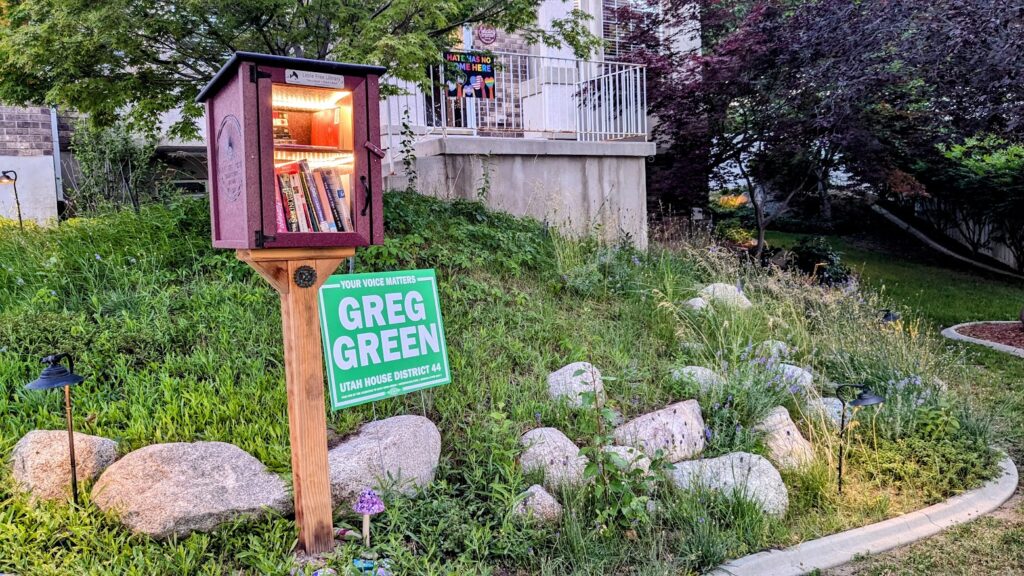
In the meantime, if you want to do something for your community consider fighting censorship and starting a Little Library of Banned Books. If there is interest, I’d be happy to sponsor a workshop to build little libraries for our House District.

Are you interested? Let me know. I look forward to hearing from you.

A Celebration and Defense of Community

June is Pride Month, and on Saturday, June 1st I will be walking at the SoJo Summerfest Parade in South Jordan. On Sunday, June 2nd I will be walking with the Salt Lake County Democrats at the Utah Pride Parade in Salt Lake City. From a rainbow of colors, I will (quite obviously) be wearing green. On the first day we celebrate the city and our community, and on the second we celebrate and defend the people who are part of our community. There is a subtle and important difference between these two days. On the first day we show pride for our home, and on the second, we show pride for our community.

The Pride March started one year after the 1969 Stonewall Riots, and was created as a remembrance and solemn defense of identity. In the fifty years since then, the march has evolved to advocate for, educate about and celebrate the LGBTQIA+ community. According to the Pew Research Center, some 7% of Americans are lesbian, gay or bisexual, and the number is higher for our youth because culture is changing, and because younger generations are more comfortable talking about sex and gender. Nearly 10% of youth ages 18-24 identified as LGBTQIA+. This is why advocacy is so important – in recent years the US Dept of Justice reports that in Utah the number of hate crimes against people due to sexual orientation has increased six-fold between 2020 and 2022. Recent legislation has unjustly inflamed and polarized gender identity and sexual orientation issues. In Utah our LGBTQIA+ youth face discrimination, health access, mental health issues, homelessness, and suicide as significant risks.

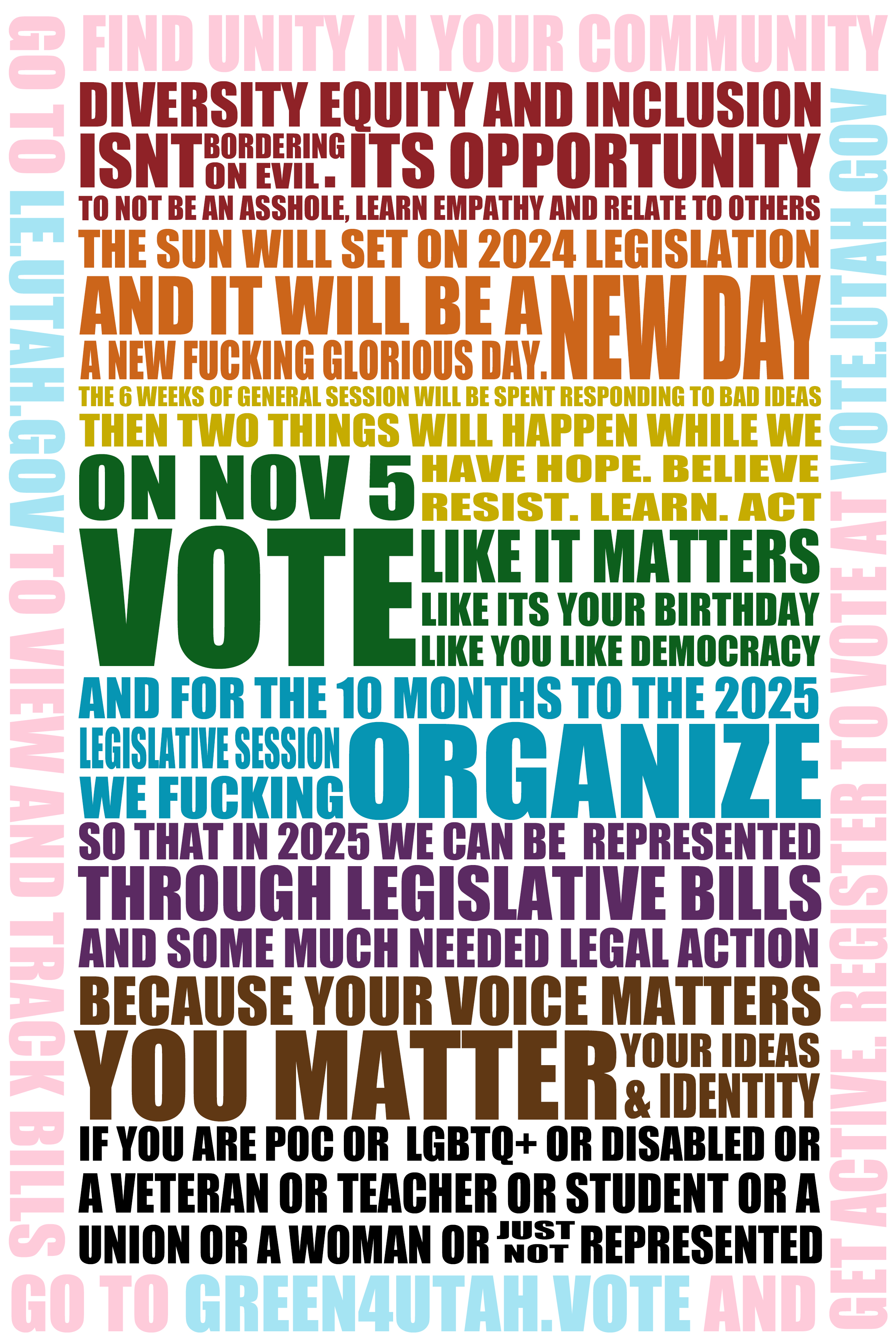
I believe that we build UNITY in COMMUNITY. We do this by being visible, supporting our neighbors, by creating safe spaces, by respecting and celebrating our differences, and by standing together.

Legislatively, I will work to protect our individual rights. You can see my stances on DEI, LGBTQIA+ rights, healthcare, and education at https://utah44.com/issues/.

Resources

You’re invited to come and celebrate on both days. Register at https://utah44.com/get-involved/ if you want to be involved with the campaign.

https://utah44.com/find-unity-in-your-community/

I look forward to hearing from you.

Supporting Public Schools

Our district is a primarily residential district that encompasses the north and west of South Jordan city, and the southwestern edge of West Jordan city. We are home to eight public schools that all fall within the Jordan School District. Our schools service elementary and middle school students. Our oldest school is 45 years old.

Additionally, there is one public charter school for grades 6-12 in our boundaries:

The reason that I’m stating all of this is because I want to raise the issue and address the topic of school vouchers that undermine strong public education and student opportunity. They take scarce funding from these public schools, and move that money to private schools that are not accountable to taxpayers, for test scores, or teacher certifications. The NEA provides a dismal review of the voucher program in Arizona – the Empowerment Scholarship Account (ESA) due to its cost and utter lack of accountability. The Utah Fits All Scholarship program is modeled after the Arizona voucher program, and promises the same fate in our state. Critics of the voucher program object that the voucher program will financially hobble Utah’s public schools, which are already among the least funded in the country.

Families overwhelmingly support public schools. Our public schools are a gold standard for education. They offer programs in arts, STEM, athletics, and robust extra-curricular clubs and activities. Public schools are the only spaces where there are protections for students with disabilities, with a notable exception of specialized schools. Teachers are certified and maintain ongoing education. Our public schools have robust systems of support that include the PTA, Community Councils and volunteers. Our funds should be used to improve public school programs, including school lunch, extended day programs, after school programs, invest in teacher salaries, and to add support positions (paras, nurses, counselors) to administrative staff.

Reference Articles:

Trust in our system of public education. Your representative needs to represent you. You are the voter. You are the constituent. If your voice isn’t represented in the district, then speak up, get involved, and act with your vote in November. I ask that you stand for our system of public education, and stand with me for better representation.

See https://utah44.com/hd44-demographics/

I look forward to hearing from you.

Defending our Public Employees

Jordan Teuscher is no friend to working families. During the 2024 general legislative session, Jordan introduced HB285 “Labor Union Amendments”, which failed primarily due to very present, overwhelming opposition by both public and private sector employees. The Bureau of Labor Statistics reports that the highest unionization rates are among workers in education, training, and libraries (32.7%) and law enforcement (31.9%) — all public sector occupations. This is who Jordan was attacking with his bill, and we’re predicting that if he retains his seat, he’s going to come back in 2025 to continue his assault on public employees and working families.

Who are the people that would be negatively impacted? In this bill, Public employees represent municipality, county, state and school district employees, or any administrative subunit of the state. He’s targeting teachers, school administrators, state employees, city employees, police and firefighters. He’s going after the people who operate our cities and make things run. He’s going after the teachers and administrators who provide sound public education to our children. He’s going after emergency responders and the people who answer the calls for help.

Is Jordan representing Utahns with these bills? The answer is no. His bill language comes from Michigan’s Mackinac Center for Public Policy and its deceptively named “Workers for Opportunity” that are engaging with conservative legislators to introduce legislation to weaken labor laws and tear down worker rights. He’s running bills written from outside of Utah. Unions are one of the most important tools to address the disparity of wealth distribution, and a legitimate tool to manage the welfare and way of life for Utahns. Union members will tell you that human dignity and worth, fair pay, retirement, benefits, safety, training, employer accountability, and opportunity are what are at stake. And Jordan is no friend to unions, or to working families.

“What is government for, if not to better the lives of its citizens?”

Tom Davidson, LiUNA Local 295

Your representative needs to represent you. You are the voter. You are the constituent. If your voice isn’t represented in the district, then speak up, get involved, and act with your vote in November. I ask that you stand with working families, and stand with me for better representation.

I look forward to hearing from you.

How Can We Support Public Education?

Public education is one of the most valuable assets of our community, and our teachers deserve recognition and support for their work. Social Emotional Learning (SEL) programs at school are integral to teaching empathy and connection. Curriculums should provide age-appropriate instruction that is not filtered by religion or revisionist thinking. Our children need to develop broader understandings of the world, and develop critical thinking and social skills to be successful.

I stand with teachers for pay raises and for collective bargaining. It’s frustrating to see that passing teacher pay raises is only negotiated in order to pass negative legislation (i.e. school vouchers), or for publicity moves by the super-majority in Utah’s legislature (i.e. the 2024 election year proposal to do away with the income tax that is a primary funding source for education, but “hey, let’s throw a bone and give teachers raises”). We need a priority bill for teacher funding. We need to fight against the initiative to cancel the so-called “CRT praxis” of the conservative right.

I am against private school vouchers that take money from the public school system. Public money should stay in public schools, and vouchers are literally defunding our system of public education.

Regarding children with disabilities in public schools – I have personal connection to this issue. I have a daughter with cerebral palsy and IDD who went through the Jordan District public education system. I was part of the “We All Belong” campaign in 2021 when Jordan School District attempted to consolidate SPED classes and bus students away from their home schools (we won due to public appeal). Removing students with disabilities from our public schools destroys bonds for these students, both abled and disabled. These relationships are critical for students, who form lifelong bonds and shape perspectives on individuality, purpose, and understanding. Representative Teuscher and Representative Pierucci have stated at Town Halls that “difficult students” need to be removed from public schools. This goes directly against federal IDEA and FAPE; it impacts federal funding and the programs that public schools are eligible for. Their opinions are not qualified or supported by the majority of educators and school administrators.

This is what Jordan Teuscher said when talking about the 2023 HB215 Utah Fits All Scholarship voucher program:

“as these students come out of public schools, a lot of time, and I’ve heard this from teachers, a lot of times they’ll have to spend, you know, 80% of their time on 20% of the students because it’s just not the right fit. You know, maybe they have a disability or, you know, a learning challenge or something, they don’t learn the same way. And so if we can get those students into schools that focus on that need, and then the teachers can spend all their time dealing with the other 80% of the teachers [sic] it’s a total win-win for everyone. And that’s what I intend, that’s what I hope to see as it moves forward.

Jordan Teuscher

I am currently endorsed by Utah Parents for Teachers, and the American Federation of Teachers (AFT). I am seeking critical endorsement from UEA as well. If you are interested in my survey responses from UEA and UPfT see the following links:

I look forward to hearing from you.

Why Disability Legislation Matters

I am the parent of two adult children with disabilities who I am a caregiver for. I have a son diagnosed with paranoid schizophrenia, and a daughter who was born with cerebral palsy, IDD, a left hemiparesis and vision field cut. I have a disability (T2D, and nocturnal hypoxemia following COVID). When I was 12 my mother was diagnosed with an aggressive form of Multiple Sclerosis, and my older sister had schizophrenia. My entire life has been a lesson in caring for, or managing my own, disabilities.

I am a member of the Legislative Coalition for People with Disabilities, participate in the Utah Developmental Disabilities Council ALPS program, and have applied to be a council member of UDDC. My daughter is a Special Olympics US Youth Ambassador and athlete. She and I host a Podcast on disability and inclusion topics. See https://katnnat.com/wp/category/podcasts/.

Adapted from the Disability Victory Fund, when I say all legislation is disability legislation, this is what that means:

  • HOUSING: we need affordable homes. We need safe and efficient homes. We need accessible homes.
  • INFRASTRUCTURE: walk and roll cities: accessible public transit, accessible streets and sidewalks, accessible public buildings, accessible bathrooms. I want to address transportation and accessibility issues by supporting walk & roll cities.
  • ENVIRONMENT: clean air, clean water, and a clean environment
  • JOBS: improved job access, and a true minimum wage – we need better customized and competitive employment options for people with disabilities. We need to address pay inequities that exist not only for people with disabilities; you’ve heard this before but the same job should equal the same pay.
  • MEDICINE: fulfill state Medicaid expand for medical and mental health supports, and caregiver supports. If elected, I will work to fully fund Medicaid expansion in the state. I want to fund Services for People with Disabilities (DSPD) to resolve the multi-year backlog.
  • POLICE: we need continued, improved training on crisis intervention, and standard de-escalation procedures when responding to altercations. Use of community services as first responders, and citizen review boards are sensible considerations to ensure community support and safety.

We have the unfortunate circumstance that our Utah State Legislature has pushed back on Medicaid expansion in our state, which means that Federal funds we have already paid taxes toward are left unused. Claims of fiscal responsibility in choosing not to expand the program in Utah are absurd. You can see my proposed 2025 legislation at https://utah44.com/proposed-2025-legislation/ that includes specific topics on disability.

You can see my stance on issues at https://utah44.com/issues-healthcare/ and https://utah44.com/issues-environment/ and https://utah44.com/issues-police/ (notice the separate links, because this is where “all legislation is disability legislation” comes from).

I look forward to hearing from you.

Representing Working Families

During the 2024 General Session we saw a major anti-union bill introduced in HB285 by Jordan Teuscher. The bill failed primarily due to strong and vocal opposition by public and private employees, including emergency services workers, school teachers, public employees, and union members from across the state. This wasn’t the first anti-union bill from Jordan, and it won’t be the last. Since elected he has introduced nationally-sponsored bills designed to degrade unions in Utah. Groups like Workers for Opportunity and the Mackinac Center for Public Policy are engaging with conservative legislators to introduce legislation veiled as “worker freedom”, but in reality represent a furthering of “right-to-work” policies that weaken labor laws and tear down worker rights. The Bureau of Labor Statistics shows that the highest unionization rates were among workers in education, training, and libraries (32.7%) and law enforcement (31.9%) — all public sector occupations; and that is what Jordan has been targeting. Our public workers, and our working families deserve to be represented. Jordan does NOT represent our community. I’m working to unseat Jordan so that I can become the representative for House District 44. I pledge to protect and advocate for workers’ rights if elected. You can see more of my stance on workers’ rights at https://utah44.com/issues-workers-rights/.

At the national level, watch closely for progress on the Protecting the Rights to Organize (PRO) Act which will expand labor protections for employees’ rights to organize and for collective bargaining in the workplace.

Don’t cross the line. Vote with working families who choose a representative that will fight for your rights and defend your freedom, your job, and you.

You Can Get Involved

An important part of elections is b.

Being informed and voting is the start of engagement in political processes, but if you truly want to have your voice heard, you need to engage in the forums that help build platforms and grow legislation.

Become active in the campaigns that are important to you. Support a candidate, volunteer to work the polls or knock on doors. You can become a precinct chair, or consider taking on a House District role. You can join a legislative committee. By engaging you use your actions and your voice to help grow the conversations that you care about. Help shape legislation, and support or defend the issues you care about.

Who knows? You can even run for office.

I look forward to hearing from you.