The State of Work in Tech (2025)

On February 2, 2026 the Salt Lake Tribune published an article under “Why Utah’s Silicon Slopes hiring feels like it’s at a standstill: ‘It’s taking a toll.’“. I was part of the story based on a survey response I provided in November 2025 regarding “What’s your experience looking for work?“.

This is my survey feedback.

Notes / Feelings about experiences and layoff:

Most of every day is seeking positions, filling applications, writing cover letters, researching companies, networking; then supporting other peers; then supporting my family. I try to be transparent, and I want people to hear it from me when things aren’t going well because I think it’s happening in a lot of our worlds right now. I’m not alone.

There’s a lot here. The layoff wasn’t entirely unexpected, based on the number of rolling layoffs that took place before I was part of one. My notification took place on March 3 in the morning. I was at a medical appointment when I was pinged by my skip manager (a senior director) to meet for a brief update. I took the call on my cell phone in the medical office while the nurse had stepped out. She was a relatively new reporting manager in our organization, and I didn’t know her that well. She read from a script and asked me to verify my personal email to receive exit documents. I was upset and told her that it was on file and to do the work of looking it up, and hung up on her. I started notifying my teams that I was selected to RIF and that I would not be able to meet, but was limited to responding to anyone because I was on mobile. My slack access was cut off during my drive home from the medical appointment. I got to my home office and was able to back up some personal files from my workstation before it went through a force shutdown/reboot and locked me out of the system (it’s an encrypted laptop, so all they had to do was remove my encryption key). In under two hours I was locked out of my workplace and given no real time to notify anyone that I was let go. Unfortunately, this is the way that most of us are termed from Oracle. Employees who remain are not notified who was selected for the RIF. Because we are still in the system for 14 days following the notification, we still appear in the company directory (Aria) but our VPN/Network, SSO, Slack and Email are all disabled. Remaining employees have figured out that if an employee’s Slack account is disabled, it typically means they have been let go, so for most of those still working that’s how we “discover” who was RIF’d. The rest is shared by whisper network. There were some community channels in Slack like #watercooler and #wtf that were privatized and moved under HR to shut down employee discussion about what takes place.

Oracle decided several years ago to stop announcing org changes, and limiting manager communications about reductions like this because there were posts in thelayoff.com or blind about the layoffs, and they didn’t want to see those. There is effectively no organizational change management taking place. Projects go on hold to figure out who’s left and to assess re-planning. Entire teams disappear, and managers tell us that the function was eliminated but there is no contact for support, or for process. It’s hellish for the people who remain working because they are expected to pick up work, or are forced to escalate issues they can’t handle. In most cases, reporting managers don’t know who from their team will be let go, or if they will be let go. There is no consideration about tenure, contribution, performance, active roles; one day you’re just “gone”.

I was the person who created https://oracleworkersunion.org/, but I hadn’t really promoted it until after I was RIF’d. I had started building this after a group of employees created “Employees for Ethics” back in 2017 in response to the first Trump administration’s attacks on foreign workers and the trans community. I was upset then that Oracle’s response to employee concerns was to minimize and control by throwing HR and legal into our conversations and subtly suggesting ramifications. Safra Catz is somewhat famously referenced as saying to employees that if we didn’t like working at a pro-Israel company, we should leave (paraphrased). Excessive campaign contributions to far-right, the hiring of notable figures in the administration of the times (namely from Devin Nunes’ campaign) were bothersome. Many of us were truly disappointed in the leadership and the direction of the company as a whole. When they effectively dismantled our DEI programs and replaced them with “Culture and Inclusion” that included consolidating (i.e. reducing) ERG budgets and blocking employee-matches for LGBT programs through Benevity, it was clear what they were doing.

I started in the tech industry about 26 years ago. I worked at PeopleSoft, and that company was acquired by Oracle in 2005. At the time it was the largest acquisition that Oracle had made, and I really hoped our culture would have some influence there, and I was sincere about that. 20 years in, many of the people who I cared about are being let go, including myself. I’m not happy about the direction of Oracle. I wasn’t happy with the leadership of the company. But people matter, and I truly wanted to see change. At this point I just want to find a company that has integrity and stands for human principles. I don’t think that kind of company exists anymore though.

The current socio-political climate has really hurt a lot of people. It started with companies like Oracle that were more interested in profit margins and less about cost of goods or services that began profiteering – i.e. “restructuring” – essentially laying off workers regardless of performance or contribution. Oracle tech workers are a foundation of knowledge, code and process in the organization, and Oracle intends to replace them with nothing, or bridge the gap by introducing AI. The clear problem is that AI is new technology that requires a regularly updated knowledge base to train on, ongoing maintenance and tuning. AI isn’t autonomous. AI is a tool, and like a hammer it’s useless without someone who can drive a nail with it.

This year is going to be extremely difficult for many of us who are actively looking for work. The reality is that the number of in-field jobs is shrinking, and the number of applicants for those same jobs has grown exponentially.

I was let go 7 months ago. Most of the people I know here are employees at the same company I spent the last 26 years working at. Most of us are looking for similar roles in this reduced field.

Contributors to the SLTrib Article

  • Cody Scott, job seeker
  • Greg Green, job seeker
  • Gwen Kervin, senior economist at Utah Department of Workforce Services
  • Madison McCord, chief human resources officer at Domo
  • Matt Schulz, chief consumer finance analyst at LendingTree (Austin, TX)
  • Hold my Fry Sauce (anon), instagram account
  • Mary Hall, director at University of Utah’s Kahlert School of Computing
Under Pressure

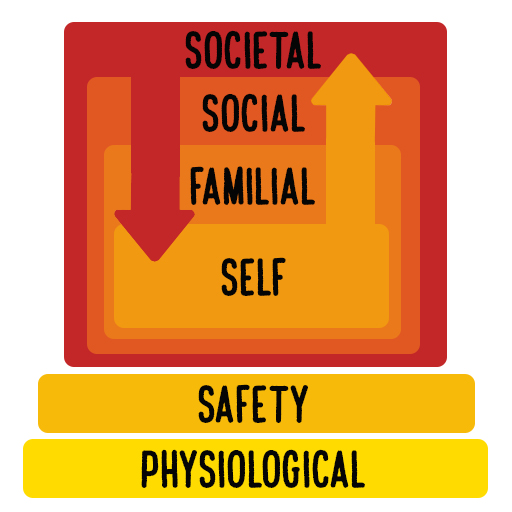
I started thinking about Maslow’s Hierarchy of Needs a while ago, and have been playing with variations of its theme to make it relatable to American politics and identity. With the onboarding of the Trump administration in 2025 we have begun to see attacks at every level, and I’m questioning how we can sustain ourselves through another three years when the first year is technically not even over yet. Keep in mind that DJT wasn’t inaugurated for his second term until January 20, 2025. I’m writing this on January 4, with more than two full weeks left before his first year in office is done.

The most concerning attacks are at the foundation of our hierarchy; specifically on the physiological wellbeing, and the safety of our people.

The Foundation is Under Attack

Physiological

Physiological needs are our fundamental needs for survival. If we can’t meet the basic needs of housing, shelter, food, and rest we don’t tend to focus on much else. One of the main problems we’re seeing are ramifications of a failed economy. Homes are unaffordable, and rent increases are pushing families out of markets. US Courts reports that bankruptcies have jumped 10.6 percent in the past 12 months. Food and product prices continue to go up due to inflation and tariffs passed on to consumers. We are actively in a recession, and there isn’t a positive light to shine anywhere.

Real and perceived threats are growing too. It used to be that having a safe place to rest your head at night mattered, but there is increased vitriol online and notably partisan divisions in media and news that grow a divide. Driven by fear-mongering and contempt, we are seeing attacks on the moral character of good people that lead to physical abuse and violence.

Safety

Safety is a broader term that includes health and wellbeing, stability, financial security (income and savings), and programs that provide aid, like health insurance, or the availability of medical vaccinations.

In Bankrate’s 2025 Emergency Savings Report, 32% of U.S. adults have less emergency savings now than they did at the beginning of the year, while 31% have the same amount and 18% had no savings at the start of the year and still don’t have any now. That means 8 out of 10 people in the US have not improved their emergency savings at a time when growing job losses, increased likelihood of medical issues and other problems are far more likely to happen.

In terms of health and wellbeing, Americans are far less likely to be able to afford insurance, or even have insurance now. Premiums continue to rise. Employees who lose work are likely to not able to afford insurance on their own, at the same time that state (Medicaid) and federal (Medicare) programs are removing expansion coverage and making it harder to qualify for care.

Changes in HHS and CDC policies have been detrimental to US citizens, particularly on the availability of vaccines, recommendations for preventative care, and on research and reporting of disease and outbreaks.

Rollbacks of regulatory procedures and audits are causing environmental and food-related illnesses.

From a financial perspective, the Trump administration attacks against the Federal Reserve and Department of Labor are creating problems with interest rates, labor reporting, and reports of economic growth. In the last two quarters, the Bureau of Labor Statistics is no longer generating trusted numbers that reflect our true market. Groups like the Center for American Progress and Real Economy Blog are providing summaries that reflect signs of weakness—particularly among groups that often foreshadow broader labor-market cooling, such as workers of color and older workers.

More than 300,000 federal employees lost work in 2025, and more than 1.1 million private sector jobs have been lost in the same time. Infrastructure jobs gained during the Biden administration have been erased. Tourism is down. International travel is gone. Regardless of warnings that the US economy is headed for recession, many think that the US economy is already in recession. There is a huge wealth gap divide that is growing.

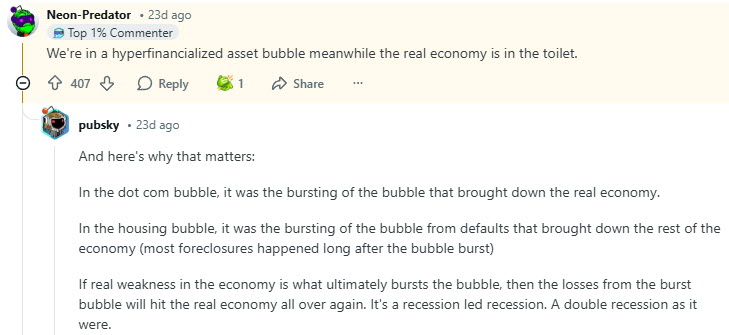
from https://www.reddit.com/r/economy/comments/1pkv4pe/the_us_economy_is_in_a_recession/

Our Socio-Economic Structures are Collapsing

There is a relationship between self, family and culture, social, and societal groups that is under constant adjustment, but overall determines our view of self and others. The entire model is collapsing around us.

Our Critical Thinking

With the loss of trusted media sources it seems that we have lost the capacity to think critically and understand how to interpret media… and we only have ourselves to blame.

  • We have lost focus in a mobile-friendly, short-format publication system, where everyone is a publisher.
  • We have lost context in news that is mixed with entertain and sales. Establishments are no longer selling news, they are editorial boards and infotainment.
  • We have lost criticality and skepticism for what matters in local, national and global events.
  • We have lost reality, particularly with loss of awareness in bias and spin (see where you source your information within the Media Bias Chart), and with the introduction of AI-generated articles and deepfake imagery and videos.

We’re at a point where sarcasm can’t be used because the source has to be thoroughly investigated to know if they are truly using sarcasm, or has “jumped the shark” to present an otherwise irrational statement as conviction. News stories give equal weight to two sides when only one is rational, or true. Publishers are reticent to call out factual lies, or provide fact-checking services for their followers.

Social Media Algorithms and Addiction

It’s been clear for a long time that social media capitalizes on scroll time, and its profitability is measured by how long its audience spends in the app, and how durably it can track your actions across sites. Social media analyzes the amount of time you spend on any given media, search history, cookies, and how you react or comment in posts to determine what to populate your feed with. It isn’t based on “likes” so much as it is based on engagement. And one thing that engages is rage-baited content, rabbit-holes and trolling.

If you have questioned whether social media is healthy for you, the short answer will always be ‘no’. Be careful if you stay because the apps offer an echo-chamber that validates who you are. Watch for the number of negative engagements, whether it is you or someone else trolling. Pay attention to the total time spent in-app. Look for advertisements in your feed based on recent conversations and searches that you may have performed in or out of the app. When you are the product, you have to be extremely careful with how you interact, and how much time you spend in these apps.

The reason that its a problem: Cambridge Analytica proved that targeted influence campaigns can be run on social media to intentionally drive behaviors of social media users. Social Media companies consider you a product. They sell your time in their app, they sell your demographic data to (any and all) advertisers, who target you with curated content to sway decisions you make, whether to make a purchase, or how to vote.

The Undue Influence of AI

There is an unrelenting hype-cycle of what AI can do online, and a lot of money being spent right now on artificial intelligence and their underlying large language models to prove capability and influence investment in more AI. The problem should be obvious but apparently isn’t: AI isn’t a creative tool – it only renders likely answers and images based on what it is trained on. It steals the intellectual property of large groups, is programmed algorithmically to respond in certain ways that can be adjusted up or down (the presumption is to remove bias but it is definitely used to increase bias, avoid facts, and particularly to promote ideology and platforms). AI has no consciousness. AI has no morals. AI is not intelligent, but can utilize layers of decision making filters that give the appearance of intelligence. AI is not creative, but can utilize the same layering method to “predict” what a requestor is asking for. All of this machine learning is built on the stolen data of real people. In worse cases, the machine learning is based on unclean data, or utilizes data pools that include AI-generated content that in turn feed the language model.

As an example, Reddit began charging for large-scale API access in July 2023, and part of the justification was that companies were using data on the site to train LLMs. Two years later Reddit is filling up with AI-generated content. We have AI companies paying Reddit to train their LLMs on AI-generated content, that will influence the results of AI-generated content we see on Reddit, that in cycle train new LLMs. We are at the cusp of an AI circle-jerk of the magnitude which we have not seen.

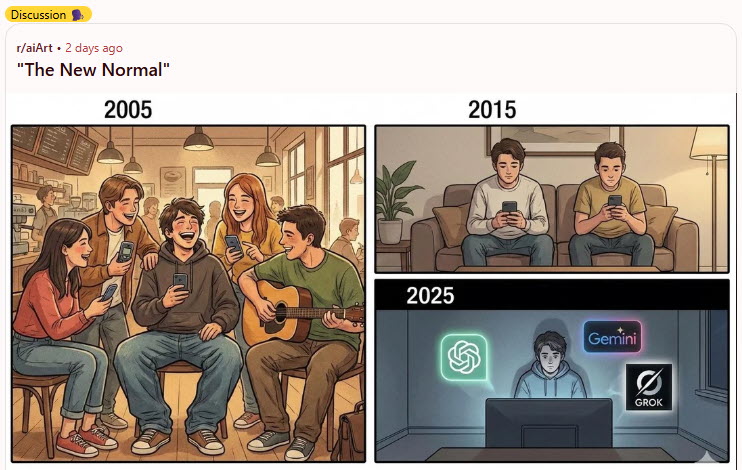
From https://www.reddit.com/r/antiai/comments/1q421qz/this_is_so_ironic/#lightbox

The Survival of Self

There is rapid societal change in that technology is becoming a primary source of news and interaction. Our US government is structurally degraded and moving further into a state of collapse. Our media sources are becoming more consolidated and biased. Our educational institutions are being attacked. Our economy is falling apart. Job loss, the overall mental and medical health of US citizens is worse, and the disparity of wealth is overwhelming.

As a person living in 2026, where are you now in all of this? How are you meaningfully engaged to your family, to your local community, and to the nation-at-large? If you are the heads-down, jesus-take-the-wheel, job-hugging sort… that may be your coping mechanism to get through all of this. But for the rest of America, we’re in a hole that’s growing deeper, and it won’t be long before the bottom falls out.

If you’re with me, know that we’re all feeling the pressure.

Still there? I recommend that you subscribe to Heather Cox Richardson on YouTube, and particularly listen to Today’s News, January 3, 2025 (starting at 28:18 of 32:33 mins) on why the United States has 2-3 months before democracy collapses.

tl;dr – Speak up. It’s going to get worse before it gets better.