Most of every day is seeking positions, filling applications, writing cover letters, researching companies, networking; then supporting other peers; then supporting my family. I try to be transparent, and I want people to hear it from me when things aren’t going well because I think it’s happening in a lot of our worlds right now. I’m not alone.
There’s a lot here. The layoff wasn’t entirely unexpected, based on the number of rolling layoffs that took place before I was part of one. My notification took place on March 3 in the morning. I was at a medical appointment when I was pinged by my skip manager (a senior director) to meet for a brief update. I took the call on my cell phone in the medical office while the nurse had stepped out. She was a relatively new reporting manager in our organization, and I didn’t know her that well. She read from a script and asked me to verify my personal email to receive exit documents. I was upset and told her that it was on file and to do the work of looking it up, and hung up on her. I started notifying my teams that I was selected to RIF and that I would not be able to meet, but was limited to responding to anyone because I was on mobile. My slack access was cut off during my drive home from the medical appointment. I got to my home office and was able to back up some personal files from my workstation before it went through a force shutdown/reboot and locked me out of the system (it’s an encrypted laptop, so all they had to do was remove my encryption key). In under two hours I was locked out of my workplace and given no real time to notify anyone that I was let go. Unfortunately, this is the way that most of us are termed from Oracle. Employees who remain are not notified who was selected for the RIF. Because we are still in the system for 14 days following the notification, we still appear in the company directory (Aria) but our VPN/Network, SSO, Slack and Email are all disabled. Remaining employees have figured out that if an employee’s Slack account is disabled, it typically means they have been let go, so for most of those still working that’s how we “discover” who was RIF’d. The rest is shared by whisper network. There were some community channels in Slack like #watercooler and #wtf that were privatized and moved under HR to shut down employee discussion about what takes place.
Oracle decided several years ago to stop announcing org changes, and limiting manager communications about reductions like this because there were posts in thelayoff.com or blind about the layoffs, and they didn’t want to see those. There is effectively no organizational change management taking place. Projects go on hold to figure out who’s left and to assess re-planning. Entire teams disappear, and managers tell us that the function was eliminated but there is no contact for support, or for process. It’s hellish for the people who remain working because they are expected to pick up work, or are forced to escalate issues they can’t handle. In most cases, reporting managers don’t know who from their team will be let go, or if they will be let go. There is no consideration about tenure, contribution, performance, active roles; one day you’re just “gone”.
I was the person who created https://oracleworkersunion.org/, but I hadn’t really promoted it until after I was RIF’d. I had started building this after a group of employees created “Employees for Ethics” back in 2017 in response to the first Trump administration’s attacks on foreign workers and the trans community. I was upset then that Oracle’s response to employee concerns was to minimize and control by throwing HR and legal into our conversations and subtly suggesting ramifications. Safra Catz is somewhat famously referenced as saying to employees that if we didn’t like working at a pro-Israel company, we should leave (paraphrased). Excessive campaign contributions to far-right, the hiring of notable figures in the administration of the times (namely from Devin Nunes’ campaign) were bothersome. Many of us were truly disappointed in the leadership and the direction of the company as a whole. When they effectively dismantled our DEI programs and replaced them with “Culture and Inclusion” that included consolidating (i.e. reducing) ERG budgets and blocking employee-matches for LGBT programs through Benevity, it was clear what they were doing.
I started in the tech industry about 26 years ago. I worked at PeopleSoft, and that company was acquired by Oracle in 2005. At the time it was the largest acquisition that Oracle had made, and I really hoped our culture would have some influence there, and I was sincere about that. 20 years in, many of the people who I cared about are being let go, including myself. I’m not happy about the direction of Oracle. I wasn’t happy with the leadership of the company. But people matter, and I truly wanted to see change. At this point I just want to find a company that has integrity and stands for human principles. I don’t think that kind of company exists anymore though.
The current socio-political climate has really hurt a lot of people. It started with companies like Oracle that were more interested in profit margins and less about cost of goods or services that began profiteering – i.e. “restructuring” – essentially laying off workers regardless of performance or contribution. Oracle tech workers are a foundation of knowledge, code and process in the organization, and Oracle intends to replace them with nothing, or bridge the gap by introducing AI. The clear problem is that AI is new technology that requires a regularly updated knowledge base to train on, ongoing maintenance and tuning. AI isn’t autonomous. AI is a tool, and like a hammer it’s useless without someone who can drive a nail with it.
This year is going to be extremely difficult for many of us who are actively looking for work. The reality is that the number of in-field jobs is shrinking, and the number of applicants for those same jobs has grown exponentially.
I was let go 7 months ago. Most of the people I know here are employees at the same company I spent the last 26 years working at. Most of us are looking for similar roles in this reduced field.
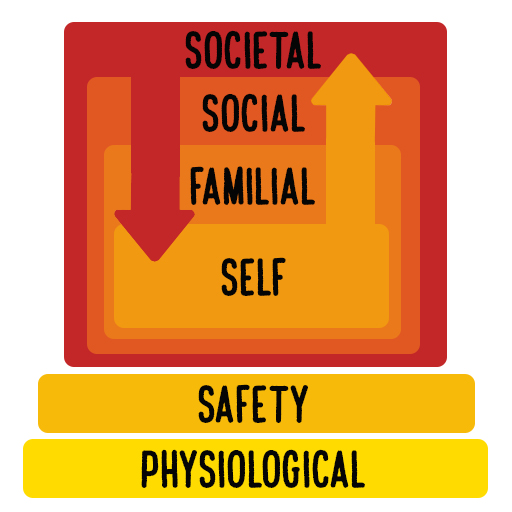
I started thinking about Maslow’s Hierarchy of Needs a while ago, and have been playing with variations of its theme to make it relatable to American politics and identity. With the onboarding of the Trump administration in 2025 we have begun to see attacks at every level, and I’m questioning how we can sustain ourselves through another three years when the first year is technically not even over yet. Keep in mind that DJT wasn’t inaugurated for his second term until January 20, 2025. I’m writing this on January 4, with more than two full weeks left before his first year in office is done.
The most concerning attacks are at the foundation of our hierarchy; specifically on the physiological wellbeing, and the safety of our people.
The Foundation is Under Attack
Physiological
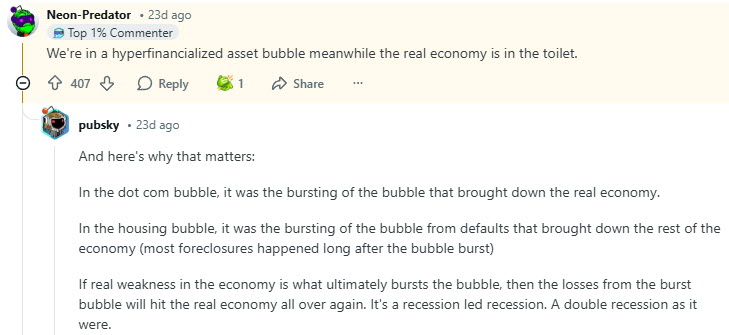
Physiological needs are our fundamental needs for survival. If we can’t meet the basic needs of housing, shelter, food, and rest we don’t tend to focus on much else. One of the main problems we’re seeing are ramifications of a failed economy. Homes are unaffordable, and rent increases are pushing families out of markets. US Courts reports that bankruptcies have jumped 10.6 percent in the past 12 months. Food and product prices continue to go up due to inflation and tariffs passed on to consumers. We are actively in a recession, and there isn’t a positive light to shine anywhere.
Real and perceived threats are growing too. It used to be that having a safe place to rest your head at night mattered, but there is increased vitriol online and notably partisan divisions in media and news that grow a divide. Driven by fear-mongering and contempt, we are seeing attacks on the moral character of good people that lead to physical abuse and violence.
Safety
Safety is a broader term that includes health and wellbeing, stability, financial security (income and savings), and programs that provide aid, like health insurance, or the availability of medical vaccinations.
In Bankrate’s 2025 Emergency Savings Report, 32% of U.S. adults have less emergency savings now than they did at the beginning of the year, while 31% have the same amount and 18% had no savings at the start of the year and still don’t have any now. That means 8 out of 10 people in the US have not improved their emergency savings at a time when growing job losses, increased likelihood of medical issues and other problems are far more likely to happen.
In terms of health and wellbeing, Americans are far less likely to be able to afford insurance, or even have insurance now. Premiums continue to rise. Employees who lose work are likely to not able to afford insurance on their own, at the same time that state (Medicaid) and federal (Medicare) programs are removing expansion coverage and making it harder to qualify for care.
Changes in HHS and CDC policies have been detrimental to US citizens, particularly on the availability of vaccines, recommendations for preventative care, and on research and reporting of disease and outbreaks.
Rollbacks of regulatory procedures and audits are causing environmental and food-related illnesses.
From a financial perspective, the Trump administration attacks against the Federal Reserve and Department of Labor are creating problems with interest rates, labor reporting, and reports of economic growth. In the last two quarters, the Bureau of Labor Statistics is no longer generating trusted numbers that reflect our true market. Groups like the Center for American Progress and Real Economy Blog are providing summaries that reflect signs of weakness—particularly among groups that often foreshadow broader labor-market cooling, such as workers of color and older workers.
More than 300,000 federal employees lost work in 2025, and more than 1.1 million private sector jobs have been lost in the same time. Infrastructure jobs gained during the Biden administration have been erased. Tourism is down. International travel is gone. Regardless of warnings that the US economy is headed for recession, many think that the US economy is already in recession. There is a huge wealth gap divide that is growing.
There is a relationship between self, family and culture, social, and societal groups that is under constant adjustment, but overall determines our view of self and others. The entire model is collapsing around us.
Our Critical Thinking
With the loss of trusted media sources it seems that we have lost the capacity to think critically and understand how to interpret media… and we only have ourselves to blame.
We have lost focus in a mobile-friendly, short-format publication system, where everyone is a publisher.
We have lost context in news that is mixed with entertain and sales. Establishments are no longer selling news, they are editorial boards and infotainment.
We have lost criticality and skepticism for what matters in local, national and global events.
We have lost reality, particularly with loss of awareness in bias and spin (see where you source your information within the Media Bias Chart), and with the introduction of AI-generated articles and deepfake imagery and videos.
We’re at a point where sarcasm can’t be used because the source has to be thoroughly investigated to know if they are truly using sarcasm, or has “jumped the shark” to present an otherwise irrational statement as conviction. News stories give equal weight to two sides when only one is rational, or true. Publishers are reticent to call out factual lies, or provide fact-checking services for their followers.
Social Media Algorithms and Addiction
It’s been clear for a long time that social media capitalizes on scroll time, and its profitability is measured by how long its audience spends in the app, and how durably it can track your actions across sites. Social media analyzes the amount of time you spend on any given media, search history, cookies, and how you react or comment in posts to determine what to populate your feed with. It isn’t based on “likes” so much as it is based on engagement. And one thing that engages is rage-baited content, rabbit-holes and trolling.
If you have questioned whether social media is healthy for you, the short answer will always be ‘no’. Be careful if you stay because the apps offer an echo-chamber that validates who you are. Watch for the number of negative engagements, whether it is you or someone else trolling. Pay attention to the total time spent in-app. Look for advertisements in your feed based on recent conversations and searches that you may have performed in or out of the app. When you are the product, you have to be extremely careful with how you interact, and how much time you spend in these apps.
The reason that its a problem: Cambridge Analytica proved that targeted influence campaigns can be run on social media to intentionally drive behaviors of social media users. Social Media companies consider you a product. They sell your time in their app, they sell your demographic data to (any and all) advertisers, who target you with curated content to sway decisions you make, whether to make a purchase, or how to vote.
The Undue Influence of AI
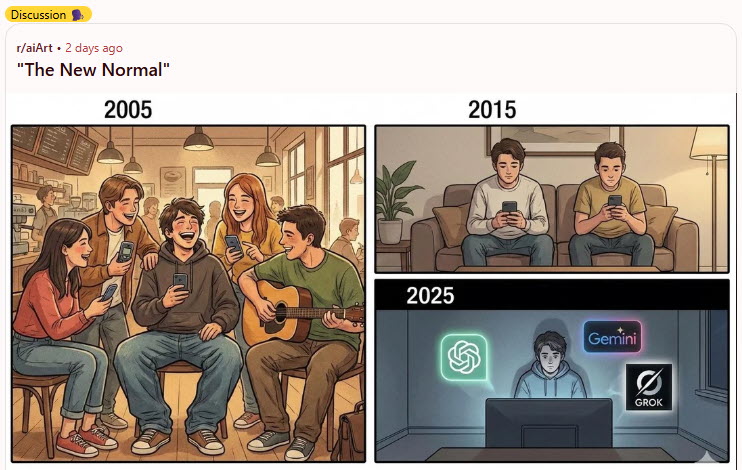
There is an unrelenting hype-cycle of what AI can do online, and a lot of money being spent right now on artificial intelligence and their underlying large language models to prove capability and influence investment in more AI. The problem should be obvious but apparently isn’t: AI isn’t a creative tool – it only renders likely answers and images based on what it is trained on. It steals the intellectual property of large groups, is programmed algorithmically to respond in certain ways that can be adjusted up or down (the presumption is to remove bias but it is definitely used to increase bias, avoid facts, and particularly to promote ideology and platforms). AI has no consciousness. AI has no morals. AI is not intelligent, but can utilize layers of decision making filters that give the appearance of intelligence. AI is not creative, but can utilize the same layering method to “predict” what a requestor is asking for. All of this machine learning is built on the stolen data of real people. In worse cases, the machine learning is based on unclean data, or utilizes data pools that include AI-generated content that in turn feed the language model.
As an example, Reddit began charging for large-scale API access in July 2023, and part of the justification was that companies were using data on the site to train LLMs. Two years later Reddit is filling up with AI-generated content. We have AI companies paying Reddit to train their LLMs on AI-generated content, that will influence the results of AI-generated content we see on Reddit, that in cycle train new LLMs. We are at the cusp of an AI circle-jerk of the magnitude which we have not seen.
There is rapid societal change in that technology is becoming a primary source of news and interaction. Our US government is structurally degraded and moving further into a state of collapse. Our media sources are becoming more consolidated and biased. Our educational institutions are being attacked. Our economy is falling apart. Job loss, the overall mental and medical health of US citizens is worse, and the disparity of wealth is overwhelming.
As a person living in 2026, where are you now in all of this? How are you meaningfully engaged to your family, to your local community, and to the nation-at-large? If you are the heads-down, jesus-take-the-wheel, job-hugging sort… that may be your coping mechanism to get through all of this. But for the rest of America, we’re in a hole that’s growing deeper, and it won’t be long before the bottom falls out.
If you’re with me, know that we’re all feeling the pressure.
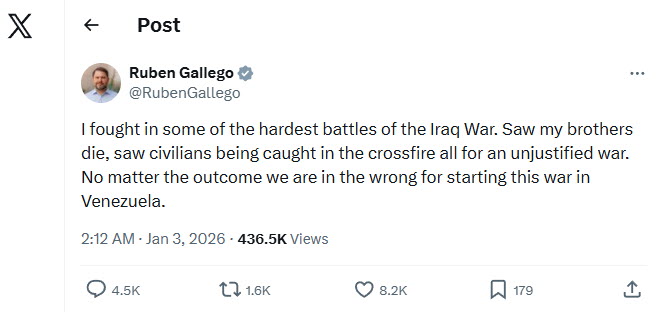
On the evening of Friday, January 2, 2026 the United States invaded the country of Venezuela in an act of war and in violation of international law; and arrested Venezuelan President Nicolas Maduro along with his wife Cilia Flores. The act has already been condemned by our allied governments in Mexico and Brazil. The European Union has called for de-escalation. Russian, Iran and Cuba have all condemned the hostile invasion of a sovereign nation.
Brazilian president Luiz Inacio Lula da Silva called the U.S. actions a “serious affront” to Venezuela’s sovereignty, the AFP reported. He said the strikes and capture of Maduro “cross an unacceptable line” and threaten “the preservation of the region as a zone of peace,” according to the AFP
The War Powers Resolution (50 U.S.C. ch. 33) is a federal law intended to check the U.S. president’s power to commit the United States to an armed conflict without the consent of the US Congress.
There was no threat from Venezuela, and regardless of Trump’s effuse arguments in the press conference, there were no actions that could have been interpreted as an assault by Venezuela against the United States. There was absolutely no criteria that would have legally granted the U.S. any right to invade another country, or depose its ruler.
U.S. Aggression
The United States and the Trump administration have bypassed Congress and violated international law. That is what is happening right now in the United States.
Invaded a sovereign nation
Engaged the military of another nation, and killed citizens of another nation without provocation
Deposed its leaders
Taken over economic operations of the country
References
2026-01-03: Headfirst Into War (contrarian.substack.com) “The dangers to Americans in Venezuela and elsewhere, the potential for chaos or the ascension of an equally bad or noxious figure, international isolation and rebukes, and magnified economic uncertainty are all possible.”
I think the most prescient topics to address in 2026 all deal with digging ourselves out of the mire of the first year of a Trump administration, defending ourselves from another 3 years, and ensuring that our political processes are intact for a fair 2028 federal election cycle.
There are just so many bad things here, and it’s not just a Trump sighting in the Whitehouse. The long game of the conservative right is in view, and they act like there is nothing we can do about. 2026 must be our reckoning through mid-term elections. 2028 is far enough away that it will not matter if we do not win seats this year.
The absolute ugliness of 2025 is remarkable. Internally we are divided. What made America great – our diversity, our people, our freedom – is dead. Externally our (then) friends are our (now) enemies, and our (then) enemies puppet our leader by taking advantage of his hubris.
We have some of the most inept, deceitful and profiteering people at the helm of critical government structures, and we’re watching them tear apart those institutions. We literally have Trump tearing down the Whitehouse while he tears down our economy, while he tears down our people, while he sends AI videos of himself pouring shit on US citizens.
There are WAY TOO MANY egregious violations by this administration but we can start by naming a few things:
Health and Human Services, Medicare and Medicaid
Education programs and funding
Immigration policy
US AID
Labor, Equal Opportunity
FCC, Public Media funding, and license allocations
EPA
National Park Service, BLM
Federal Reserve, Dept of Treasury
I haven’t even mentioned the US as a good neighbor, or the US as a representative of global democracy. The ability of the Trump administration to turn the US on its heel to become an antagonist in global government is profound and of long-lasting negative consequence.
We are no longer a nation that can be trusted. Trump doesn’t care. His cohort are all thugs and monsters and sycophants. Americans need to be sick of his shit and shamed that it got this far.
The Impact of AI to Intellectual Identity, Environment, and Economy
The emergent threat of artificial intelligence cannot be overstated.
There is an AI-hype bubble designed to siphon money, land, water, power, and data (all things we should be incredibly reticent to give away), with the express intent of stealing intellectual property, surveilling citizens, and controlling narratives. AI has a unique capacity to algorithmically produce bias at scale. There are no regulations governing AI in the US, and even though the European Union has produced its EU AI Act: first regulation on artificial intelligence it does nothing to control what takes place in technology to the west of the Atlantic.
AI is being used to build rhetoric, create dissension through rage and misinformation, spew AI-generated deepfakes, and most importantly keep you engaged. AI is the “Soma” that Aldous Huxley describes in Brave New World; a drug to escape reality, ensure constant happiness (or constant rage), a means of self-validation, and effectively act as a tool for social control.
Regulations for Block-Chain and Crypto
Crypto is highly susceptible to fraud and abuse, and it’s appropriate to protect consumers with financial regulation in digital currency and digital payment platforms like Venmo, Paypal and Stripe. Entities that offer accounts with financial balances, linked institutions, transfer capability, debit or credit card type instruments or allow any form of account management in fiat OR cryptocurrency platforms should be regulated and insured in the same way that banks and credit unions are currently insured. Because crypto value is purely speculative, create floors and limits that will protect investors from
Controlling Rabid Reaganomics
Trickle-down economics is a fantasy, and one that built on the lie that deregulation and lower taxes for the wealthy would result in investment and economic growth. Reality shows that the wealthy simply consolidate their wealth and move to control the levers of power (policy, media, and monopolization).
The odd thing we keep hearing is how government would be more effective if it were run like a business; but the purpose of government is to better the lives of its citizens while the purpose of business is to seek profits for its owners. These entities are diametrically opposite of one another, and there is no business model that would administer both. You can be fiscally responsible and a humanitarian, or you can run a business. It’s an either/or situation.
In short, there is no philanthropy in capitalism.
Re-Balancing Ethics and Power
There is a willful disregard by elected officials to not fend our republic from oligarchy. Holding officials accountable to their actions, enforcing or calling-to-reign the authorities of the executive, legislative, and judicial branches, and supporting the independent authority of organizations empowered with investigative, health and regulatory commissions is a minimum requirement of any office holder. We are sorely lacking in both backbone and integrity for this to happen, and the obvious response should be to vote them out. We need candidates who will compete in races, that will stand up for what it right (not what is convenient, or what is profitable to them personally) and represent the Constitution of the United States they took an oath to defend. That document is going on 239 years in the making – here’s the reminder that “freedom isn’t free”.
The sheer grift in politics has to be curbed at the same time.
This means ending Citizens United. End corporate money. End dark money. End PACs and PICs without traceable sources. Impose sever limits on corporate lobbyists.
This means governance and rules on financial instruments that currently have no regulation (and I’m primarily speaking of crypto, but includes membership in distributed autonomous organizations (DAO) that use block-chain to obfuscate its members).
This means ending trading and investments of elected officials, their families and entities during a candidacy, tenure and following exit from public office.
This means full divestiture of any conflicts of interest, whether noted or “found”.
This means imposed limits on any form of gift or exchange to a public official or their family members
and this means the authority to prosecute and convict individuals who are found in violation of any of these breaches of policy.
Campaign financing needs reform as well.
Cap campaign spending. Limit sources of contributions, and establish standard limits for campaign contributions. Allocate a public square to level the playing field for candidates within a campaign. Stop commercial ads on television, radio, streaming media, and social platforms.
Tax, Tax, Tax the Rich
We’re watching the ultra-wealthy influence our administration through bribes and flattery to gain controls in data, media, and investments.
Implement a flat tax for the ultra wealthy, simple as that. Instead of using their money for influence peddling, let them pay taxes.
Defend, Defend, Defend Voter Representation and Rights
There are fraudulent schemes across states and nationally to strip voter rights away through gerrymandering, constitutional changes at the state level, willful misinformation by conservative parties, and by sowing distrust in reliable voting systems, including vote-by-mail and the voter ID system. One of the greatest threats to our system is allowing one party to usurp the power of voters by articulating the boundaries of voter pools and strip voters of their constitutional rights to vote for their elected officials. We need to fight like hell to make sure that our inherent citizen rights are not lost to a group that would otherwise manipulate and control its constituency for its own advantage.
On December 31, 2025 NPR published an article under its “What it Takes” series at His brother’s mental illness isolated his family. Now he’s helping other caregivers. My family is part of the story. We were picked up after answering a survey on caregiving that NPR posted a little over a year ago to “tell us your story: How did caregiving change you? How do you cope with the hard parts? What have you learned that you’d like to share with others?”
My Advice from the NPR Survey
What lessons have you learned that you want to share with other caregivers?
Take care of you. It’s easy to be overwhelmed, frustrated, ashamed, sad, or angry. It’s also easy to let your physical and mental health slip. Look for spaces where you can give yourself priority. Incorporate activity in your day, and find things you love. If you have depression, talk about it.
Seek out your tribe. Find and surround yourself with people who understand the diagnoses you are caring for. The ability to talk with others who not only understand, but can empathize and respond meaningfully matters.
Find local resources (Parent Center, Disability Law, Legislative Advocacy Groups, Charitable Support Groups) to be involved with. They will help you with valuable advice, direction and resources when you need them.
Plan far ahead for what your person may need. Medicaid qualification, Dependent Services, Social Security benefits, Guardianship, Housing, Estate Planning all requires extensive documentation and may have extensive wait periods.
It’s critical to allow your person to self-determine, but know that you are also their best advocate if/when they can’t represent themselves
Learn about the condition, and options for treatment. Be open with treatment providers. If you are a parent/guardian or have permission from the patient to talk with doctors or counselors, use that to discuss concerns. If you don’t have authorization to receive information about a patient relationship, you can still provide information to treatment providers to better help them understand an issue or concern.
Journal relevant thoughts, and look back. Journals can be for your feelings, progression of treatment or documenting a condition. These notes can be invaluable when you talk to a doctor or are qualifying for a resource.
What has been the hardest part of being a caregiver?
Dealing with depression, and having no-one to talk to. Frustration when you can’t get treatment or support. PTSD from events that happen as a care-giver. Anger at “the system” whether it’s insurance coverages, hospital policy, or legislation/funding that negatively affects your loved one, or having resources taken away that you depended on unexpectedly.
If you’re new to caregiving, what questions do you have about it?
I’m definitely not new. My primary advice here would be that friends who knew the “healthy” you, or before you became a caregiver will often disappear. People will say incredibly insensitive things, or make opinions where they have no understanding/expertise to say anything at all. Be critical of advice (not skeptical, but critical) and confirm with qualified research and/or professionals, even if the advice is from within your tribe/group. Be willing to look for new ways to do things. Look into clinical research.
Featured Voices of the Article
My family’s role in the story is to be the “stranger in the story” and to provide an anecdote illustrating what the other subjects offer: data, experience or action. I’m familiar with and a strong supporter of NAMI, and for the Caregiver Action Network.
⬆️ Christine Crawford, National Alliance on Mental Illness (NAMI) https://www.nami.org – NAMI works to educate, support, advocate, listen and lead to improve the lives of people with mental illness and their loved ones – See: Mental Health Education, particularly the NAMI Family-to-Family course. – Consider: NAMIwalks 2026 is a friendly, low-barrier way to connect in your local community. You can register and attend an upcoming walk in your area.
⬇️ Mitul Desai, The CareHack https://www.thecarehack.com – Based in New York, currently working with a multi-state practice and launching a Medicaid-funded project in New York. CareHack is focused on working with “big players in for-profit health care systems”, i.e. insurance companies and large practices – their solution is based on a framework with predictive AI and human coaching
Additional References
I would really recommend checking out these links, and supporting the work of these groups. If you take anything away from this, recognize that there are three absolutes of care: face the difficult topic, keep your heart, and always advocate.
✅ Film: No One Cares about Crazy People, by Gail Freedman https://noonecaresfilm.com/ – a feature documentary film about the tragedy, crisis and chaos of severe mental illness in America, and a national crusade to do something about it
✅ Film: UNSEEN: How We’re Failing Parent Caregivers & Why It Matters https://caregiverdoc.com – Many caregivers for children or adults who are disabled or medically complex are exhausted and isolated. The mental, physical and financial struggle of family caregivers costs us all.
✅Film: The Case for Kindness https://caseforkindness.com/ – Case for Kindness explores the profound impact of kindness on our physical, mental, and emotional well-being.
✅ Organization: National Shattering Silence Coalition https://www.nationalshatteringsilencecoalition.org/ – The National Shattering Silence Coalition (NSSC) is dedicated to dismantling the walls of stigma, isolation, and shame that surround critical public health and social challenges. Silence is not a passive state but an active barrier to healing, understanding, and progress.
🆕 Company: MyWhatIf Foundation https://mywhatif.org/about/ The company provides a self-help AI tool (chatbot) for mental health services.
My reading of late has been moving away from the traditional analytical non-fiction that I typically read, and is moving into what might be discovery, or distraction, or something like that. I realized recently that I’ve been interacting with an author on social media for a little bit – without having read any of her books – and solely by association through Jennifer Miller-Smith (who I owe thanks to). And that’s how I decided to read an urban fantasy book.
Before I start, I want to comment how there are three related topics that circulate in the book that really made me pay attention:
Facades, and whether we use them to charm, “shimmer” or repel others — particularly the way we try to blend and hide ourselves; — our inability to see ourselves as others see us; and the glimpses we gain of ourselves that can be startling and revelatory; — and, of course, the obvious characteristics and flaws we can’t hide from ourselves and others, that can be problematic to our own vision of who we are. — I associate this with the totems we create for ourselves? We either anthropomorphize or attach to stereotypes that ground and connect us. We want to look a certain way, or be perceived a certain way, so we work really hard to create the illusion of ourselves using things around us.
Our desire to find meaning through others’ stories and connection — using other people’s histories, and finding some reflection and acceptance of personal stories in your own past matters greatly; — how it takes time to process and cope with tragedy – that too often you have to be able to get through and turn around to look back to know what it was that you went through; — escaping suicide and its ideations by understanding that pain isn’t escaped, rather it is spread out
The idea of death, and moving between worlds, and what it means to be in between — there’s a lot to explore here that Arcadia gives room for; — some interesting comments, like p.85 “Lisa is still dead?” that just… raises questions.
It wasn’t just faeries and mythology either. I really admire the level of detail woven into the characters.
delving into physical rehabilitation and the use of prosthetics;
learning about nuances of BPD, with some reflections that felt too harrowingly close to how I have interpreted interactions and mentally processed my life so far;
the acts of compartmentalization; coping; distracting and the benefits of therapeutic practices at work, and the reason mind and the emotion mind;
what it’s like to work in systems with unknown rules and suffer consequences; and
the need for psychological constructs, familiars, muses, and echoes.
I also really loved the neurodivergence on display. I encourage you to go find Abigail and her one-liner.
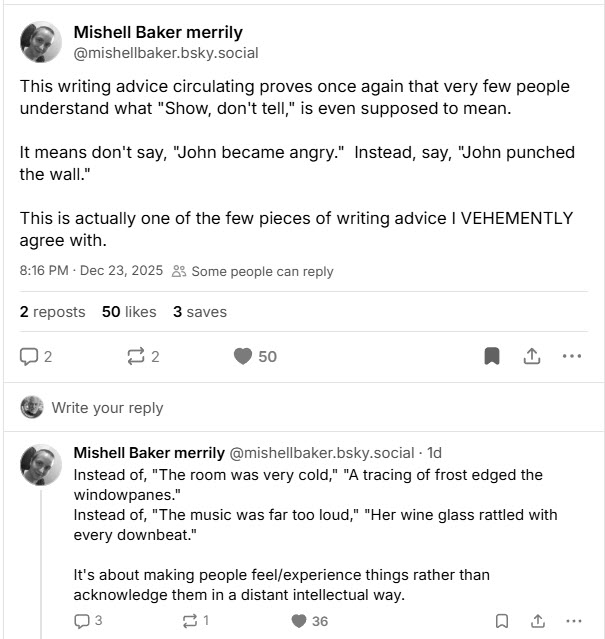
It’s surprising how much a book can draw you into its space, and that’s improved when the author shares really insightful comments about how she writes to improve a reader’s perception and experience.. a little of that brilliance shared on BlueSky:
An Interwoven World
The interweaving of folklore, faeries and mythology was actually fun to read. I’m not generally a fiction/fantasy reader by default, so Baker’s descriptions and character’s postulating on “what makes the world” created some nice interconnects. As a new reader in the genre I appreciate that she took time to explain some things that wouldn’t have held glue in my mind.
Some Savored Quotes
I really don’t want to ruin anything, but I really need to impress the thoughtfulness and reflection in the story writing. These page references are from the Saga Press softcover, first edition:
p33. “Suicide is not a way of ending pain; it’s just a way of redistributing it.“
p112. “I’m not inclined to elect you arbiter of normal.“
p134. “…the Borderline apology that means I’ll lie and say I was wrong, just don’t leave me.“
p302. “Long after you quit feeling that glorious rage, your words linger.“
p302. “Memory is a sketch artist, not a camera. People add and subtract whatever detail they need to. They say they forgive you, but they don’t. “
Millie’s Work
The Stone Guest (Millie Roper) – is a movie created by Millie Roper that received attention before her life profoundly changed. P222 describes it as a story of a young heroin addict trying desperately to connect with her estranged mother after her father’s death.
If there’s any sort of knock-off from the Arcadia project, that’s a storyline I’d love Baker to flush out.
David’s Work – The Cotton “Trilogy”
Blue Yonder (David Berenbaum) – Millie is 10 when her dad (still living) takes her to see this
Red Cotton (David Berenbaum)
Accolade (David Berenbaum)
Black Powder – work in post (David Berenbaum) – Millie is 26
I’m including the movie titles and some ages for Millie to give us an idea of the works referenced. I’m honestly not sure what to infer from the movie titles. There are indications of a much more expansive career to Berenbaum’s timeline but these are the notable films for the book. I think it’s interesting that the intended “trilogy” ends with Accolade, which is noticeably less well-received than the first two films, and followed by a fourth unofficial return-to-namesake movie titleage. I’m pretty sure I’m missing something important.
Summary (of Sorts)
I really don’t know how to do reviews for fiction, but I thoroughly enjoyed this book; and I plan to read more of the series. Her stories are well-constructed and provide plenty of circumstance to self-apply and be thoughtful about.
FWIW, it’s now shared in the Little Library in my front yard. Good books are always worth sharing.
Reference
The Arcadia Project series is made up of Borderline, Phantom Pains, and Imposter Syndrome.
I am calling out the bullshit of Devon Kurtz, Policy Director at The Cicero Institute. Cicero Institute is responsible for pushing to get rid of housing-first solutions THAT WORK, and replace them with institutionalization through civil commitment and incarceration. I live in Utah where he/they have been actively working with legislators to push their agenda.
This is the Utah Homeless Services Board (UHSB) policy recommendation letter. Randy Shumway (Chair) wants a civil commitment facility (bad bad bad)
Note that this letter was heavily influenced by “wants” from Utah Senate Leader Stuart Adams and Utah House Speaker Mike Schultz that incorporated the July 24 Presidential Executive Order policy changes to move away from a housing-first policy that Utah has traditionally been a leader for, and previously shown great success in implementing.
the right-wing think tank Cicero Institute was involved in advocating for the policies that ultimately shaped the Presidential Executive Order “Ending Crime and Disorder on America’s Streets”
The executive order shifts focus from housing-first to institutionalizing homeless individuals with mental health and substance abuse issues
Critics argue the order fails to address root causes of homelessness and may increase untreated mental illness and incarceration.
The Executive Order represents the most sweeping federal pivot toward compulsory treatment and criminal-justice integration since the 1965 Community Mental Health Centers Act redirected asylums toward the community.
In isolation, the order risks exchanging tents for jail bunks and psychiatric wards without tackling the root supply constraints of therapy, housing, and peer support.
The recipient org (https://homelessutah.org/) is comprised of city and county mayors in the Salt Lake area. However I also recognize Wayne Neiderhauser from Utah Office of Homeless Services, who is a Non-Voting Advisor. He sits on the board of Utah Homeless Services Board Members (UHSB) along with Randy Shumway (executive committee chair), who is also the CEO of the Cicero Group.
“State officials have long followed a policy of getting homeless people into housing first, but now officials are weighing a system that focuses on behavioral health care and forcing more people into help. Such a pivot would put the state in line with a summertime executive order from President Donald Trump.”
When Gov. Spencer Cox was quoted in The New York Times saying Utah’s proposed partially involuntary homeless shelter is “a statement of who we are as a state,” Rev. Brigette Weier all but balked. “My Lord,” the minister said. “I pray that is not true.”
Shumway’s recommendations to respond to Trump’s executive order, calling for a “certified community behavioral health clinic” on the campus with 300 to 400 beds reserved for people who are civilly committed — or court ordered into mental health treatment. His proposal drew criticism and concern from some homeless advocates, who worried it would be wildly expensive and could create a chilling effect by building a civil commitment facility in direct proximity to homeless shelter beds.
Stakeholder presentations included Devon Kurtz of The Cicero Institute, who proposed to reallocate grant funds from SAMHSA Protection & Advocacy for Individuals with Mental Illness (PAIMI), and request engagement of the US Dept of Justice to build a framework for expanded civil commitment.
“With the Utah Homeless Services Board’s proposal of a new homeless services campus in the area we represent, we are concerned that this decision was made without any significant input from the public. As leaders and champions on issues of homelessness, we know how critical it is for our unhoused neighbors to have access to safe shelter and the services they need to regain stability. This campus is an important step in addressing the state’s homelessness crisis, but it must move forward in partnership with the people who will live alongside it.”
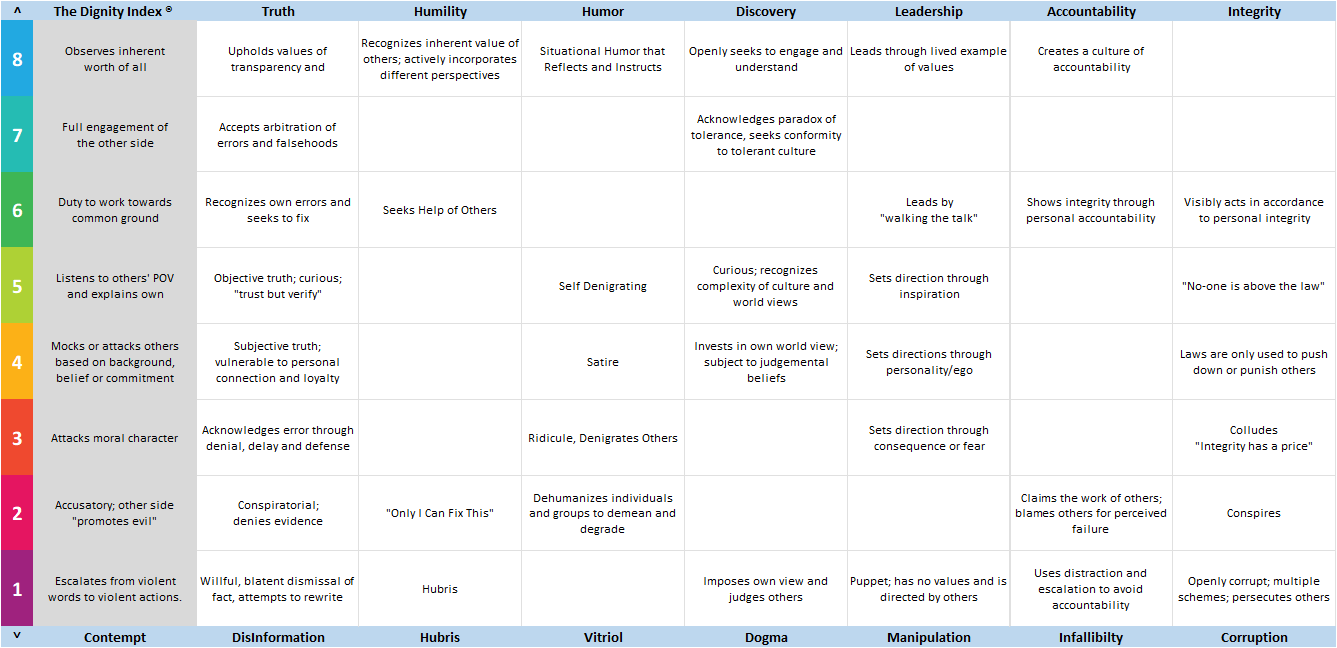
This is a continuation of thought after reading On “Dignity: Its Essential Role in Resolving Conflict”. The Dignity Index doesn’t address accountability. It makes no remark of the uses of power, or willful corruption, or malice. Dignity alone is suffering, and it makes no road to end that suffering except to endure.
There is so much more to address, and I don’t think that a dignity index is sufficient to resolve a root problem: people suffer from both words and acts; and there is no justice or safety found unless words make accountability from action.
I personally am confounded by the lack of response in the dignity movement about disinformation, corruption, conspiracy; and I’m not the only one struggling to understand how dignity alone can be a diplomatic bridge.
The success of a Dignity Movement is based first upon personal exemplification of Dignity. It is based on a hope that others will recognize that inherent dignity, then learn to see it in themselves. It is a desire for cultural adoption of a basic tenancy of human-ness in ourselves and others. It is a thought that shapes words, and it is an influence game.
But dignity does not solve problems. It is a bequest to treat others as you would like to be treated, a call to let go of umbrage towards your fellow man.
It does not fix aggression, or genocide
It does not resolve hunger, or suffering
It does not address corruption, or malfeasance
It does not address greed, or despotism
It does not address misinformation, or falsehood
The Dignity Movement will call as example the trials of Desmond Tutu, but it does not call out the sacrifice of Alexei Navalny. Dignity alone can just as easily amount to suffering as it can for change.
It’s More Than The Measure of a (Single) Man
What we need is more comprehensive than what a Dignity Index alone can provide. It is not sufficient to say the elements of dignity withstand when it does not address suffering, or complicity, or all the other things unaddressed.
We are imperfect, yet we strive to be better than who we are today. We can be personally accountable for who we are and how we act, but as social animals we recognize that there are constructs to society that must also be defended for all of us to find safety and opportunity.
I started a table of indices that matter. It’s just a start… but please, let’s start a conversation about this.
A society must agree on the limits in which it operates, but a society must also trust its members to act in ways that protect each others liberty; and in ways that promote general well-being. For this, we need to recognize the conditions of man, or more specifically the conditions that present themselves in absence of fulfilled need.
“It is an affirmation of values and hopes that I share with millions of Americans that sustain and motivate each of us to do his best, that give vigor and moral direction to our representative institutions. Public service has confirmed my faith in the potential of the human spirit, its generosity, its idealism, its capacity for growth, its resilience, and its infinite resources.”
Dignity is a thought that inspires words. For dignity to thrive, there must be actions that deliver its affirmation to all of us.
Why it Matters
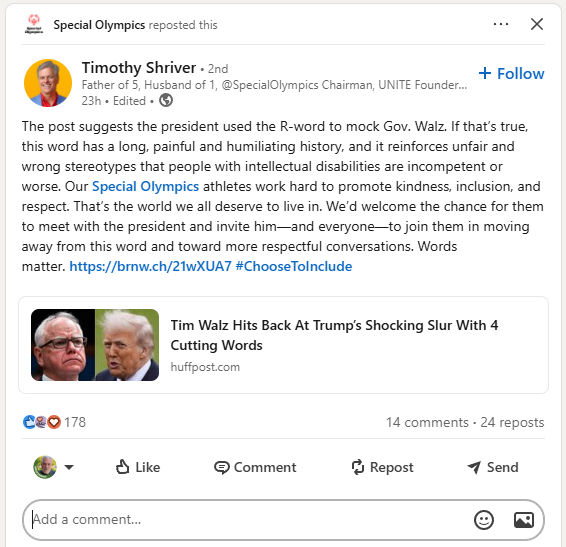
Language matters, but on both sides of the conversation. In reference to a Thanksgiving post from Donald Trump, the response from Tim Shriver was to use indeterminate language like “the post suggests” and “if that’s true”. There is clear evidence that it’s real.
What does the dignity index rank Trump’s own language? Why would that alone matter?
Did the response from Shriver make Trump accountable for his language?
Did it challenge his leadership in making such remarks?
Is there any question of the hubris required for Trump to say these things?
Trump’s cruelty is like a callus that needs to be torn off. We are hardened by it, and in permissing the language the callus (and the callousness) grows. Our responses should be direct when addressing the slight. If words are wielded as a cudgel by one party, we do no service in coddling our response to it.
Our clarity in the definition of egregious behavior matters
We model appropriate responses using language that is precise and remains dignified, and
We back up our words with actions that respect humanity and values
This is why we need more than a Dignity Index. Our measure cannot simply be of the language – because we are not trying to shape language, we are trying to shape a culture and a movement (i.e. action).
This is a 2025 review of “Too Much and Never Enough: How my Family Created the World’s Most Dangerous Man” by Mary L. Trump PhD. I’m saying that, but I want to start this review by quoting another book, which led me to this one. In “Dignity” by Donna Hicks, PhD in her chapter on Safety p.55 she says:
“What is important here is to know the dignity violations we experienced. To know them is to name them, to give them legitimacy and validation. And knowing them is the first step toward healing. The problem… is our strong loyalty to our caretakers, especially if they are parents, which makes it difficult to view them as anything but good.”
Family loyalty is so often the source of what makes us broken.
Introduction
“Too Much and Never Enough” starts in prologue to say some really prescient things for DJT’s second term in office. Observations made in 2017 were that his administration and his party are subsumed by his politics of grievance and entitlement. It goes on to say “He continues to be protected from his own disasters in the White House, where a claque of loyalists applauds his every pronouncement or covers up his possible criminal negligence by normalizing it to the point that we’ve become numb to the accumulating transgressions.“
A contemporary case in point: with hundreds of billions of dollars on the table, on September 4, 2025 oligarchs cluster around DJT to offer their platitudes and flattery.
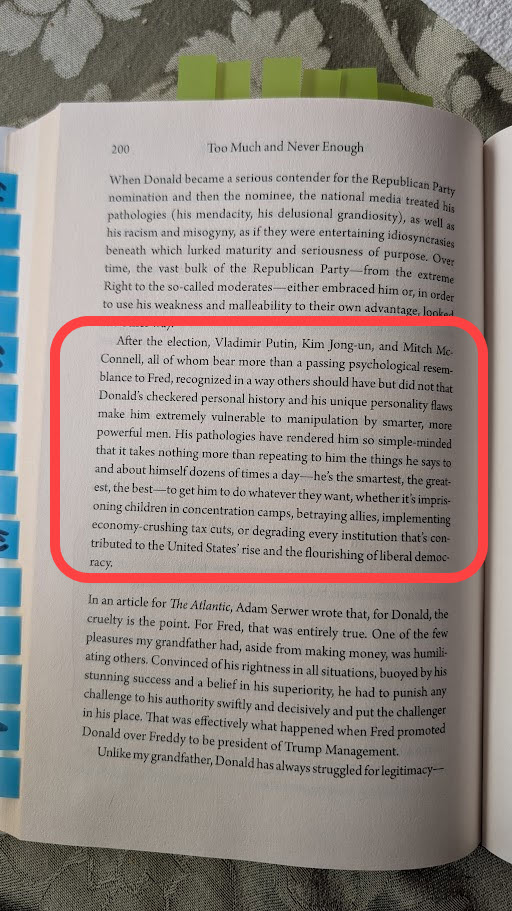
Near the end of the book, Mary L. Trump concludes on p.203 that “The through line from Donald’s early, destructive behavior that Fred actively encouraged to the media’s unwillingness to challenge him and the Republican Party’s willingness to turn a blind eye to the daily corruption he has committed since January 20, 2017, have led to the impending collapse of this once great nation’s economy, democracy, and health.” This was published before the January 6, 2021 United States Capitol attack . It was before DJT’s second term, and before the existence of Project 2025.
She goes on to say “The deafening silence in response to such a blatant display of sociopathic disregard for human life or the consequences for one’s actions, on the other hand, fills me with despair and reminds me that Donald isn’t really the problem after all.“. And she is right for saying that.
The House Down the Hill
In the Netflix fictional horror series The Haunting of Hill House, a fractured family confronts haunting memories of their old home. Starting in Chapter 1 “The House” of Mary L. Trump’s book I can already see parallels. The profound incapacity of empathy from Fred Trump, the emotional withdrawal of Mary Trump, reinforced by a lack of self-awareness; or observance of profound character flaws creates unfulfilled needs of the children, and a “kind of grievance and behaviors – including bullying,… aggressiveness, and disrespect – that served their purpose in the moment and became problematic over time.” (p.27) The family is successful and yet completely dysfunctional. And there are layers to the story. Generations are described to lead us to the present day.
“Everyone in my family experienced a strange combination of privilege and neglect.” (p.140)
Much of the book describes the Trump family growing up “white poor” wealthy, self-absorbed, and chronically disconnected; with a father’s narcissistic interest in the boys becoming “killers” through showmanship, entitlement, misogyny, outright lies, fear, and enablement.
Relationships are transactional. Outside their circle, there is more than one reference to other people as “the rubes”. Without a prerequisite paradigm shift, members of the family were often “rubes” without knowing it.
Religion
Possibly a side note, I find it interesting how religion is and isn’t brought up in the book. There is never any discussions of faith practiced in the home. There are mentions that Mary L. Trump’s aunt Maryellen converts to Catholicism for her first marriage, and DJT’s daughter Ivanka converts to Judaism for her marriage to Jared Kushner.
Friedrich Trump and Elizabeth Christ (paternal great grandparents) are both from Germany, which was primarily Protestant then.
Fred Trump (paternal grandparent) is born in the US. His wife Mary Anne MacLeod is from Scotland, which was primarily Presbyterian (a reformed version of Protestantism) then.
In the early 1900s, the Jamaica Estates area of Queens, New York, was primarily home to upper-middle-class Protestants.
Norman Vincent Peale (mentioned below) was a Protestant
I make a guess that the family was Protestant, but not practicing? The 2016 gaff by DJT about “Two Corinthians” instead of referring to that book of the bible as “Second Corinthians” really makes the case that the household wasn’t well-versed in religion.
Where I would hope to see a sense of awe, or reverence, there is none.
The real influence of religion appears to be of the Prosperity Gospel. Norman Vincent Peale’s book “The Power of Positive Thinking” appears to have a powerful influence on Fred Trump in the 1950’s. It was enough for Fred Trump to join the Marble Collegiate Church in Manhatten, although Mary L. Trump notes that he and his family rarely attended. This is the church where DJT married his first wife Ivana.
“Believe in yourself! Have faith in your abilities!… A sense of inferiority and inadequacy interferes with the attainment of your hopes, but self-confidence leads to self-realization and successful achievement.”
Norman Vincent Peale, The Power of Positive Thinking
The problem of the quote aside, with hubris and self-confidence a monster is made.
The First Son, Sacrificed
Much of Mary L. Trump’s book focuses on the relationship of Fred Trump and two of his sons: Freddy Trump (Mary’s father) and Donald. As archaic as it sounds, as the eldest son and namesake, Freddy was the heir apparent, and subject of intense focus and scrutiny from his father.
“Fred hated it when his oldest son screwed up or failed to intuit what was required of him, but he hated it even more when, after being take to task, Freddy apologized. “Sorry, Dad,” Fred would mock him. Fred wanted his oldest son to be a “killer” in his parlance… and he was temperamentally the opposite of that.” (p.41)
As Fred continually hyper-focused and dismantled his older brother, Donald was able to observe, and learn to give Fred what he wanted.
It would be remiss to fail mentioning the accountability of the family in this. Mary, the mother, chose to withdraw and do nothing. The other siblings learned to operate outside the gaze of their father, and say nothing about their own inattention, or the vexing attacks to the eldest brother’s self esteem. But Donald leveraged it to the father’s delight. And rather than fight, the family gave in. Donald became the “killer”. Donald is described on p.75 as having “all the confidence of a bully who knows he’s always going to get what he wants and never has to fight for it.“
The attacks by Fred Trump, Sr and DJT against Freddy Trump are incessant. This really is the heartbreaking story in the book.
The other story, then, is of DJT. I am reminded of the Native American parable “Which wolf you feed“. “Not only did Fred and Donald share traits and dislikes, they had the ease of equals” (p.84)
“When things turned south in the late 1980s, Fred could no longer separate himself from his son’s brutal ineptitude; the father had no choice but to stay invested. His monster had been set free. All he could do was mitigate the damage, keep the cash flowing, and find somebody else to blame.” (p.103)
“That’s how it always works with the sycophants. First they remain silent no matter what the outrages are committed; then they make themselves complicit by not acting.” (p.108)
Fred is gone, and we are dealing with that same monster (and his claque of sycophants) today.
Simply (Minded) The Best
I will let these quotes from the book speak for themselves. There are plenty of examples of hubris and self-aggrandizement to be found in the book and everywhere else (of late).
“Over time that attitude – that he knew better – would become even more entrenched: as his knowledge base has decreased (particularly in areas of governing), his claims to know everything have increased in direct proportion to his insecurity, which is where we are now.” (p.133)
“Every time you hear Donald talking about how something is the greatest, the best, the biggest, the most tremendous (the implication being that he made them so), you have to remember that the man speaking is still, in essential ways, the same little boy who is desperately worried that he, like his older brother, is inadequate and that he, too, will be destroyed for his inadequacy. At a very deep level, his bragging and false bravado are not directed at the audience in front of him but at his audience of one: his long-dead father.” (p.202)
My Personal Vent
In the chapter titled “The Debacle”, Mary describes the cruel tactics that her family exerted on their eldest sibling’s progeny after his death. In particular, Mary’s brother’s youngest son was born with a genetic mutation called KCNQ2 that required extensive medical care for seizures. Mary’s aunts and uncles took away their family medical insurance through the Trump Management company as leverage for them (Mary and Fritz) to sign away their inheritance after Fred Trump Sr’s death.
There is much, much more to this story than what is covered in the book. I will suffice to say that anyone who questions the humanity of another person, and would use their life as in part to negotiate for anything does not understand the basic, inherent right of dignity.
Consider this p.200 quote from David Corn followed by Mary Trump’s own words in her book. Speaking of Donald:
“”Everything is transactional for this poor broken human being. Everything.” It is an epic tragedy of parental failure that my uncle does not understand that he or anybody else has intrinsic worth.”
A Summary and a Warning
The Epilogue is aptly named “The Tenth Circle”, which I believe is a reference to Jodi Picoult’s 2006 novel of the same name that draws heavily from the nine circles of hell described in Dante’s poem, the Inferno. The “tenth circle” symbolizing a kind of suffering not described by Dante.
When the book was published, I’m not sure if the gravity of a possible second term for DJT could be articulated then. It took the Heritage Foundation’s Project 2025, concerted Republican partisanship, a “hype cycle” and social media to bring him back; and we are suffering greatly for it. Trump has a twisted vision of his place in 21st century politics, and will likely never realize how profoundly his flaws have allowed him to be manipulated and used by others for their own purposes.
The real question for us is whether we realize the threat that his administration presents to us now – the real “We the People” – and do we react? Or do we remain silent enough that he manifests his chaos and we truly are just what he calls us all – “the rubes”.
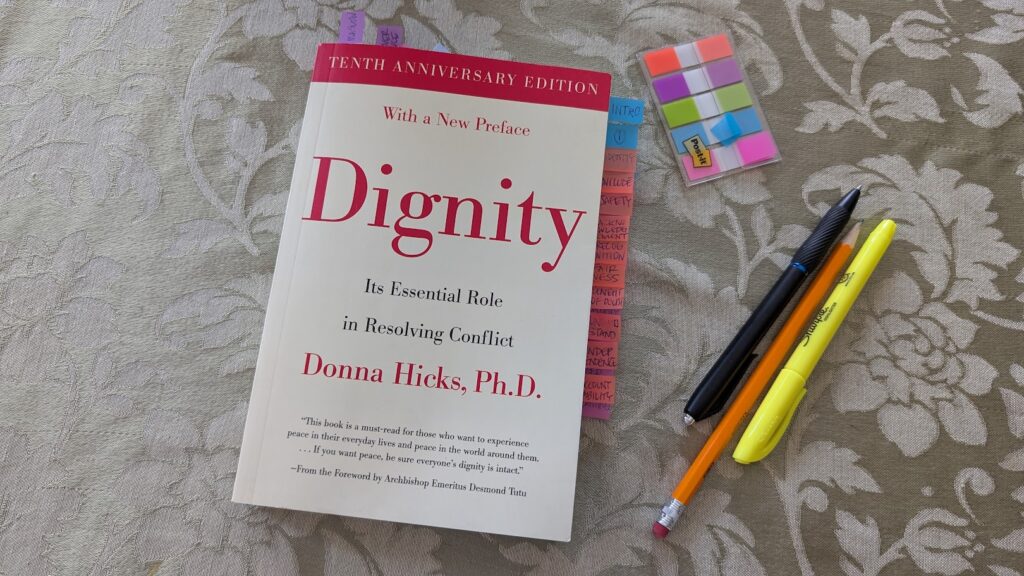
I’m currently reading Dr. Donna Hicks’ book “Dignity: Its Essential Role in Resolving Conflict” leading up to her keynote address at the Dignity Leadership Summit taking place in Salt Lake City, Utah. I’m conflicted on the topic, mainly due to the helplessness I feel in the socio-political climate of the US and the world at large. I thought I would share my thoughts as I read through the book.
My preface is that these are simply notes of mine as I read the book. I make observations, ask questions, and reference what is in my known world to connect to what the author writes.
Dr. Hicks presents what she calls the Dignity Model, with ten elements of dignity; and she expands further by writing about the ten temptations to violate dignity. In the preface she includes the opening words of the Universal Declaration of Human Rights:
“Whereas recognition of the inherent dignity and of the equal and inalienable rights of all members of the human family is the foundation of freedom, justice, and peace in the world…”
United Nations, 1948
After reading the book, my question is how we can embrace dignity in ourselves but know that we will suffer indignity, and watch our communities suffer indignities that we cannot control. My question is how loss of rights, of curtailed freedoms, lost opportunity, and of loss of lives does not result in a loss of faith? There is a certain amount of jadedness, of bitterness I have that I can’t seem to let go of, in part because I have lost faith in the general goodness of people that I once trusted was there.
I am starting to believe that corruption is a rust that goes through our societal values. I am concerned that ignorance, hate and greed is more prevalent than humility, understanding and empathy.
I am concerned that partisanship, tribalism, and righteousness get in the way of humanity, a broader sense of belonging, and a sincere desire to help one another.
Our fight is real, and it has become existential. We are experiencing literal genocide, displacement and suffering take place in front of us, and watch as our leaders give praise to the perpetrators. Our own leaders show only hubris, and seek unfettered power by planning and taking action to harm anyone who does not contribute to their corruption. Where does our dignity fit in all of this?
There is an assumption that we have a common emotional vulnerability, and I’m not sure that I believe that premise.
A Foundation for Dignity is a Common Reality
My first assertion is that dignity cannot exist without a common reality of what values we hold, and how worth is measured. The book’s focus is on dignity, but words like worth, and honor, and respect show up and rival it. On p.3 respect (earned) is differentiated from dignity (a birthright of value and worth). Both require care and attention.
In order to have dignity:
Safety and trust are essential
Science as a method of understanding the world around us is essential
Logic prevails over illogic, and critical thinking is necessary
Truths may include different viewpoints but must be separated from deceit
Bias exists. We must be able to recognize it in ourselves as quickly as in others
“Awareness requires self-understanding and acceptance. It requires work” (p.15)
Last, I would add that humans are social animals, meaning we are of this earth and are part of it. We do not hold a “special status”.
“It’s not just our indignity; it is the indignity of those who we love and care for. It is the loss of well-being of a community of people.”
– From my book notes
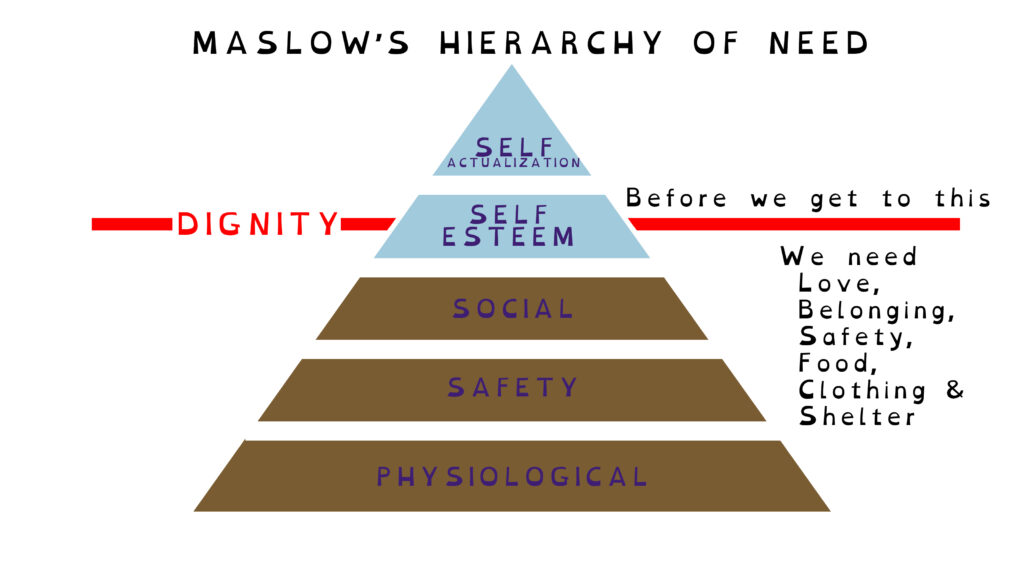
A Hierarchy of Needs
Dignity is not easily found when food and shelter are gone, or when we are without safety, or when community is taken from us. We can choose to be dignified in our thoughts and actions, but dignity can be stripped away from us. It is not our self-worth that I’m speaking of here; dignity is more closely related to esteem than it is to worth.
Taking away the foundation does not attack our individualism, rather it attacks our humanity. Inherent self-worth can be had without dignity, which is a societal value.
Burton’s ontological needs (p.27) of identity, recognition, security and belonging are part of the foundation in Maslow’s hierarchy. Fulfillment of these needs is essential to create a foundation for which dignity can be built upon.
Categorical Imperatives
On p.4 Immanuel Kant is referenced as introducing the idea of the “categorical imperative”; i.e. to “act in such a way that you always treat humanity, whether in your own person or in the person of any other, never simply as a means, but always at the same time as an end.”
Kant surmised that it is “unethical to exploit people or treat them merely as instruments to further one’s own personal goals and interests.” I would go further to say that it is morally wrong to treat others as chattel, or worse, to have no consideration for humanity whatsoever.
On p.10, Hicks summarizes Lindner and Ury in saying “We are becoming aware of our outdated acceptance of humiliating ways of ordering society, and a new human rights culture is taking shape; the value of each and every human being is being recognized.” My response to this is that we are aware, but re-ordering. I agree with Hicks, but I am skeptical.
My concern is that we have actors in today’s society who act with malice, who are willing to deceive and sow distrust for the purpose of acquiring and maintaining power over others. They are driven by greed, fear and hate; and view ruthlessness as strength.
There is an ethical dilemma when the actions of a malevolent person trump the dignity, security and existence of others. How can we value redemption of one individual whose actions may cause harm to many? How do you negotiate with someone who carries no shame?
Sidenote: Speaking outside of this review, I challenge Kant’s notion that suicide is morally wrong. Calling suicide a moral issue speaks more about society’s willingness to ignore personal suffering, and its failure to support and accept individuals who struggle for connection within our society.
It is Connection That Drives Us
Connection is understanding, empathy, acceptance and support. Connection is listening. Connection is contextual. Connection is allyship, a word that I do not see in Hicks’ book.
Connection > Respect
Connection > Esteem
Connection > Dignity
See Lost Connections, and Stolen Focus both by Johann Hari for an interesting take on western society’s root causes of depression and anxiety. I align to his thoughts that connection is what drives us.
Fun distraction: Watch Abbott Elementary S2E3 “Story Samurai“. Jacob learns to come to terms that he is not “cool”. He learns that the students call him Mr. C because he is corny, and that his peers also think of him this way. His persona is reshaped but he realizes that he is loved and accepted. This is an example of connection mattering more than dignity.
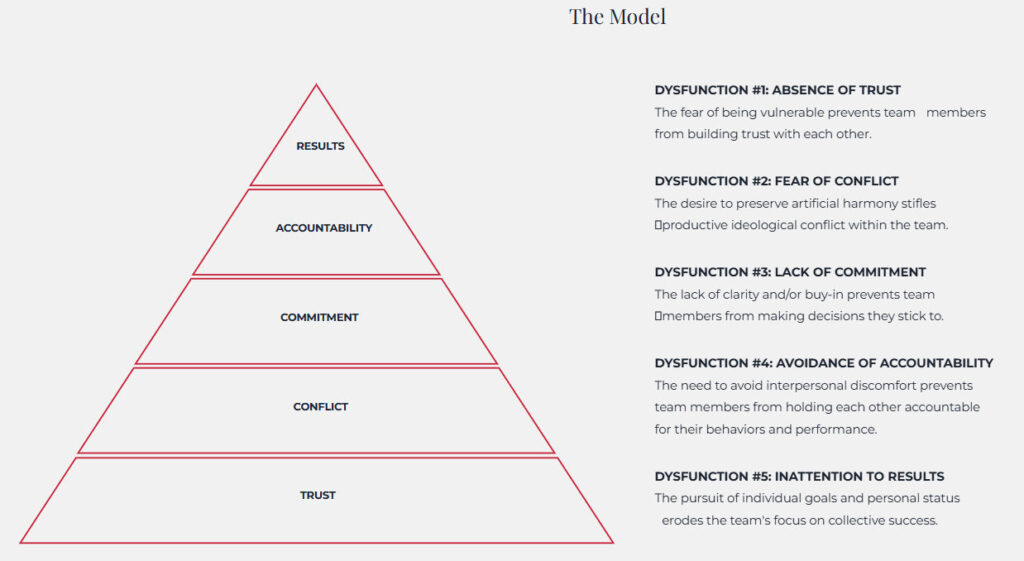
The Five Dysfunctions Model
I want to reference a book by Patrick Lencioni on The Five Dysfunctions of a Team, which is an excellent reader on building functional teams, that focuses more on the establishment of trust, healthy conflict and accountability of its members. This model could easily be applied to teams working towards conflict resolution, just as Hicks’ model is intended. Both models have precepts of basic needs being met as a foundation.
The Five Dysfunctions Model
The Ten Elements of Dignity
Dr. Donna Hicks introduces her model with the following elements – there is no “stack” or “pyramid” built in her model (note that I comment on numbers 2, 6, 7, 9 and 10):
Identity: an introduction of “I” and “Me”; should add “We” that comes later (see Robert Kegan p.152)
≠ Inclusion: acceptance and belonging (my problem here is the paradox of inclusion when looking at the person, their ideology, and their (in)actions together. I cannot separate them)
Safety: free to speak without retribution
Acknowledgement: see and acknowledge the indignities of others
Recognition: show others that they are seen, heard and understood
≠ Fairness: treat others justly, with equality and evenhandedness (without trust, I cannot extend good faith to those who will abuse the privilege – i.e. an agreed ceasefire is violated consistently by one party)
≠ Benefit of the Doubt: treat people as trustworthy (I struggle that all people have good motives or act with integrity – i.e. a delay plays to the advantage of a party that will undermine a negotiation, or keep food and aid from victims of war)
Understanding: believe that what others think matters I LOVED THIS QUOTE: “Seeking understanding is one of the easiest ways of honoring dignity. Allowing people to feel understood is just one short sentence away: “Tell me more”.” (p.85)
≠ Independence: encourage others to act on their own behalf (this should always be a first principle, but there are times when allyship is needed)
≠ Accountability: take responsibility for your actions (all parties must be accountable, and this extends far beyond violations of dignity)
I think you can see this is where I really begin to struggle with Dignity as an underlying core value for which unresolved conflict can be addressed. There must be a basic level of trust, of constraint, of essential humanity, of broad accountability to move forward.
In the section on Benefit of the Doubt, there is a poignant story of Nelson Mandela who says “I loved even my enemies while I hated the system that turned us against one another.” (p.75) He also says “Man’s goodness is a flame that can be hidden but never extinguished.” (p.76)
Not everyone is a leader, and far fewer become a moral authority. Even fewer survive what Nelson Mandela did, and I will use Alexei Navalny as an example. I question the value of giving the benefit of doubt to even one individual whose actions cause harm to many. Is there not an ethical dilemma presented here? Is it not different to bear our own suffering, but do nothing for the suffering of others?
In the section on Accountability, I pondered what if there is no diplomat to negotiate, or if we are faced with institutions built on greed, prejudice and fear? There must be honest arbiters with agency to represent change.
Discipline is mentioned on p.119 under False Dignity, but is not brought up in context of the first 10 elements. I think this, Humility and Reflection, should be elements of consideration.
Fun Distraction: If you were to program Dignity into an AI model, what would it look like? What would happen if you were to run a Monte Carlo exercise on the model?
The Ten Temptations to Violate Dignity
These are not all presented as antitheticals of the Ten Elements, rather it exists as its own list of detriments to Dignity.
Taking the Bait: the lesson here being to show restraint, and noting that action must be measured against a consequence of inaction. This quote in particular was striking: “…know that we have the capacity, in the service of self-preservation, to do great harm to one another, we will be stuck in the never-ending cycle of indignity.” (p.101)
Saving Face: “The dread of having our inadequacy, incompetence, or lack of moral integrity made known is enough to turn us into liars…” (p.103) reminded me of this recent unattributed comment about a political figure: “When he says he knows nothing he knows everything. When he says he knows everything he knows nothing.”
Shirking Responsibility: (as an antithetical to #10 Accountability) An important lesson from this is that when we care, we learn, and this builds strong relationships.
Seeking False Dignity: a short summary might be to not seek false praise or flattery, or accept that our status as a human is tied to an external measure of success. A concern I have for this is that Hicks’ references the individual perspective and not society generally, or where we find ourselves historically within it.
Seeking False Security: be willing to address the risk of the unknown. “Any relationship in which your dignity is being routinely violated is not a safe relationship, no matter how much you deceive yourself into thinking it is.” (p.124) needs to be applied at a larger level. It pertains not just to relationships, but representation, and employment, and society at large.
Avoiding Conflict: a key reason I brought up Lencioni’s Five Dysfunctions is because it specifically calls out healthy conflict as a necessary step for teams to go through. Conflict should not only include standing up for yourself, as Hicks states, but should also include allyship. There is a risk in conflict. Understand the fight before you step into it. There is a great comment about ‘optimal conflict’ by Kegan on p.154 to challenge how we make meaning.
Being the Victim: possibly versus playing the victim? Know the difference. Our self-awareness and objectivity are key to understanding. Our willingness to hear others feedback and process it comes next.
Resisting Feedback: continue to be curious. Continue to receive, accept and process change.
Blaming and Shaming Others as Deflection: “Safeguarding our dignity when faced with a threatening situation requires us to develop both self-restraint and self-assertion.” (p.168)
Engaging in False Intimacy and Gossip: “There is nothing like good dirt to liven up a discussion.” (p.171) Speak truth about yourself; invite others to do the same.
For the topic of False Intimacy and Gossip, I want to juxtapose that with commiserating and discussing rumors generally. A trusted circle is often used to share information, or needs to be used as a sounding board, or where to go for advice. It’s “spill the tea” but also “let’s clean that up”. Very often, the person discussed wields a power imbalance, or shows unreliable behavior.
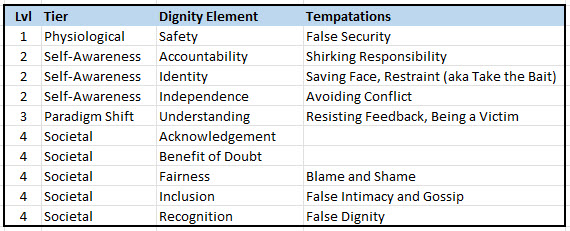
Tiering the Elements of Dignity
I wanted to relate the elements to some order of tiered dependence, and I also wanted to see if there was an association between the elements and the temptations. This is what I came up with.
My intent here is to think about how some things (like safety) are essential in order to do anything meaningful. Then there are elements we are directly responsible and solely accountable for, and there are elements that we extend to ourselves and to others.
On Reverence and Awe
Starting on p.67-69, I especially like what was said in this section on Recognition. The capacity to be in awe and in reverence of a force or forces greater than ourselves is a reminder of the incredible power of humility. (I made a silly note that this was the time to watch more Kaiju films.) These quotes in particular captured me:
“The something greater could be God for those who are religious, or ideals like truth and justice, which captivated the Enlightenment philosophers, or the magnificence of the universe, which is enough to bring Richard Dawkins, an atheist, to his knees.”
“One of the hallmarks of good leadership, then, is the capacity to feel awe and wonder at something greater than oneself, and this feeling acts as a check on arrogance.”
Humility, then, is essential for our ability to see ourselves and the role we play in a grander picture of the world and universe that we are a part of. Humility is “necessary to avoid the temptation to abuse one’s power by harming, exploiting, and disempowering others.” (p.69)
On Social Values of Shame, Ridicule and Satire
There is social value to shame, ridicule, satire and for comedy; but what part does dignity play here? Hicks states on p.22-23 “Our interpretation of what happens in the world is dependent on our experience of it [shame]”. Yet we find disciples of hubris among us.
There is a notable fear of humiliation, except when there isn’t. Senator Ted Cruz, Senator Mike Lee, and Vice President JD Vance in their about-face relationships with President Donald Trump are prime examples of this.
Lying, deception and cover-up are not only employed in self-defense. Senator George Santos literally made a career and was elected to the Senate amidst his willful lies, fraud and corruption.
On Reconciliation
One of the observations I want to make is that reconciliation is not always possible. It may never occur. It would be better to add one more chapter on unreconciled indignities, or “living with indignity”, because that is the circumstance for many.
“Because Mandela’s sense of his own value and worth was so deeply ingrained, he never lost sight of the inherent value and worth of others, no matter how badly he was treated. His sense of dignity is the source of his humility. It is humanity itself that he respects – not just his own but that of every human being. Keeping that truth to the fore is an astonishing human achievement.” (p.76)
“The responsibility is ours to stay anchored in the truth that, as human beings, we are the embodiment of dignity.” (p.139)
What answer is there for unresolved conflict? What of justice not found? What of our own perceptions of safety when the violator just “gets away” or isn’t part of the recognition, or healing? The violation remains. It is inevitable, but the weight of things, whether one or many, has a tendency to shape us.
I am troubled about finding resolution when offending parties do not have integrity. They willfully disregard, lie and are in contempt of words. There is no honor in their actions; they admire ruthlessness; they seek power without humility. The response to this cannot be to simply persevere through it all.
Much of the book describes suffering. Dignity does not take away suffering, and it does not make it tolerable. Dignity can be a lifeline though; in that it cannot be taken away unless you choose to let it go.
“It’s not necessarily about meeting in the middle; but is there a third space?“
Although the topic of the book is on using Dignity to resolve conflict, it’s worthwhile to point out that Dignity can and should be used to avoid or dissolve conflict. Dignity is, after all, a tool of diplomacy.
So the other part of the story should be of preventing conflict. How do we use dignity to restore dialog? How do we ensure that dignity is more present in the words and actions of ourselves, our politicians, business leaders, in community, in our news and in our places of gathering?
Suggested Next Read
I already started this, but want to review and comment next on “Too Much and Never Enough: How My Family Created the World’s Most Dangerous Man“, by Mary L. Trump, PhD. This will likely be a very significant contrast to “Dignity”. Much of my reading on Dignity has led to thoughts on how DJT acts in opposition to dignity but is still projected and supported by an inner circle, and by his followers, who are devout to his political figure.