
This is a continuation of thought after reading On “Dignity: Its Essential Role in Resolving Conflict”. The Dignity Index doesn’t address accountability. It makes no remark of the uses of power, or willful corruption, or malice. Dignity alone is suffering, and it makes no road to end that suffering except to endure.
There is so much more to address, and I don’t think that a dignity index is sufficient to resolve a root problem: people suffer from both words and acts; and there is no justice or safety found unless words make accountability from action.
I personally am confounded by the lack of response in the dignity movement about disinformation, corruption, conspiracy; and I’m not the only one struggling to understand how dignity alone can be a diplomatic bridge.
The success of a Dignity Movement is based first upon personal exemplification of Dignity. It is based on a hope that others will recognize that inherent dignity, then learn to see it in themselves. It is a desire for cultural adoption of a basic tenancy of human-ness in ourselves and others. It is a thought that shapes words, and it is an influence game.
But dignity does not solve problems. It is a bequest to treat others as you would like to be treated, a call to let go of umbrage towards your fellow man.
- It does not fix aggression, or genocide
- It does not resolve hunger, or suffering
- It does not address corruption, or malfeasance
- It does not address greed, or despotism
- It does not address misinformation, or falsehood
The Dignity Movement will call as example the trials of Desmond Tutu, but it does not call out the sacrifice of Alexei Navalny. Dignity alone can just as easily amount to suffering as it can for change.
It’s More Than The Measure of a (Single) Man
What we need is more comprehensive than what a Dignity Index alone can provide. It is not sufficient to say the elements of dignity withstand when it does not address suffering, or complicity, or all the other things unaddressed.
We are imperfect, yet we strive to be better than who we are today. We can be personally accountable for who we are and how we act, but as social animals we recognize that there are constructs to society that must also be defended for all of us to find safety and opportunity.
I started a table of indices that matter. It’s just a start… but please, let’s start a conversation about this.
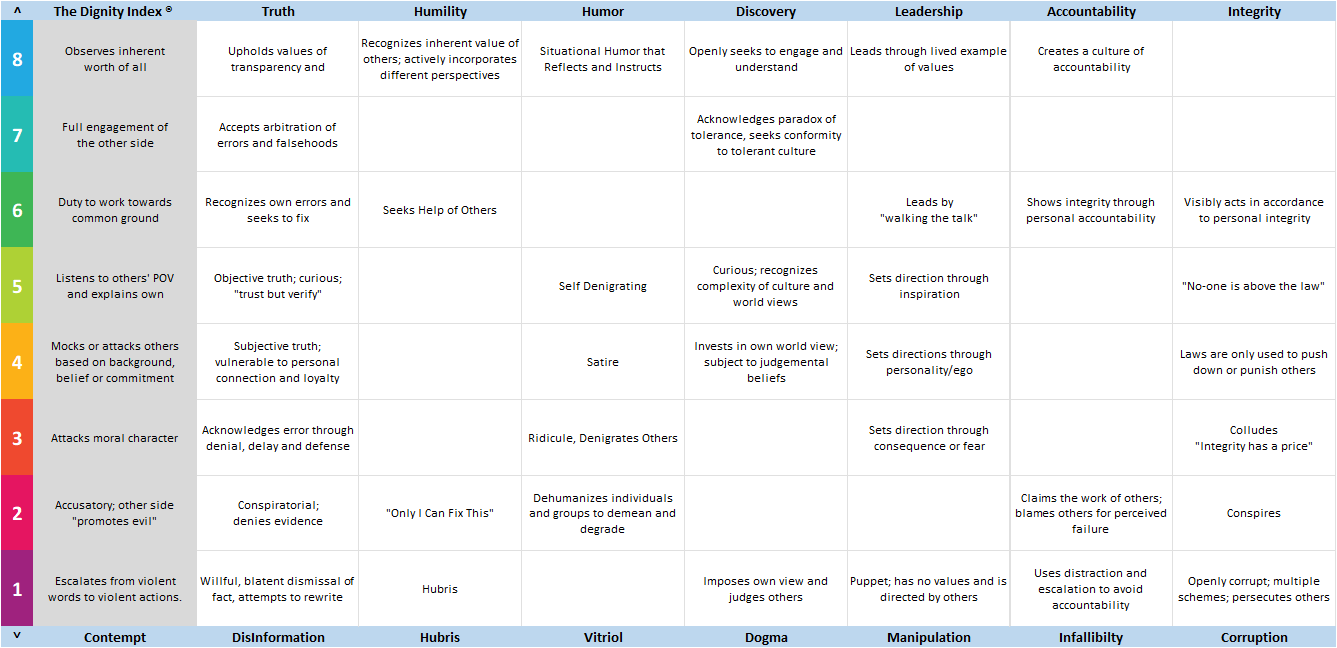
A Proposal: Pillars to Measure Self and Society
- Dignity vs Contempt (this is the Dignity Index)
- Truth vs Disinformation
- Humility vs Hubris
- Humor vs Vitriol
- Discovery vs Dogma
- Leadership vs Manipulation
- Accountability vs Infallibility
- Integrity vs Corruption
A society must agree on the limits in which it operates, but a society must also trust its members to act in ways that protect each others liberty; and in ways that promote general well-being. For this, we need to recognize the conditions of man, or more specifically the conditions that present themselves in absence of fulfilled need.
“It is an affirmation of values and hopes that I share with millions of Americans that sustain and motivate each of us to do his best, that give vigor and moral direction to our representative institutions. Public service has confirmed my faith in the potential of the human spirit, its generosity, its idealism, its capacity for growth, its resilience, and its infinite resources.”
Hubert Humphrey, 1971
Dignity is a thought that inspires words. For dignity to thrive, there must be actions that deliver its affirmation to all of us.
Why it Matters
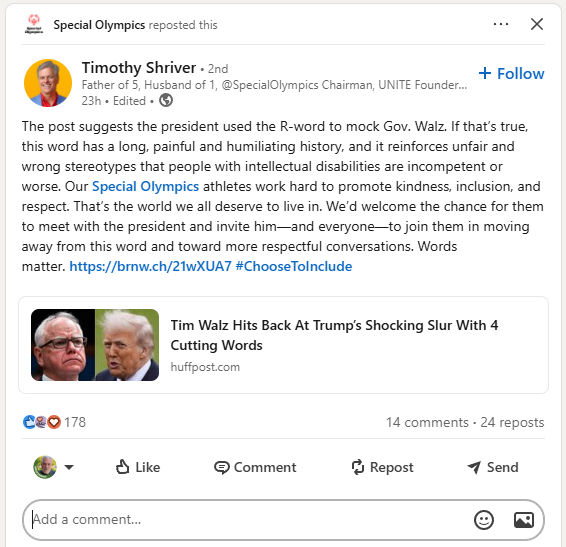
Language matters, but on both sides of the conversation. In reference to a Thanksgiving post from Donald Trump, the response from Tim Shriver was to use indeterminate language like “the post suggests” and “if that’s true”. There is clear evidence that it’s real.
- What does the dignity index rank Trump’s own language? Why would that alone matter?
- Did the response from Shriver make Trump accountable for his language?
- Did it challenge his leadership in making such remarks?
- Is there any question of the hubris required for Trump to say these things?
Trump’s cruelty is like a callus that needs to be torn off. We are hardened by it, and in permissing the language the callus (and the callousness) grows. Our responses should be direct when addressing the slight. If words are wielded as a cudgel by one party, we do no service in coddling our response to it.
- Our clarity in the definition of egregious behavior matters
- We model appropriate responses using language that is precise and remains dignified, and
- We back up our words with actions that respect humanity and values
This is why we need more than a Dignity Index. Our measure cannot simply be of the language – because we are not trying to shape language, we are trying to shape a culture and a movement (i.e. action).
Discover more from Utah House District 44
Subscribe to get the latest posts sent to your email.